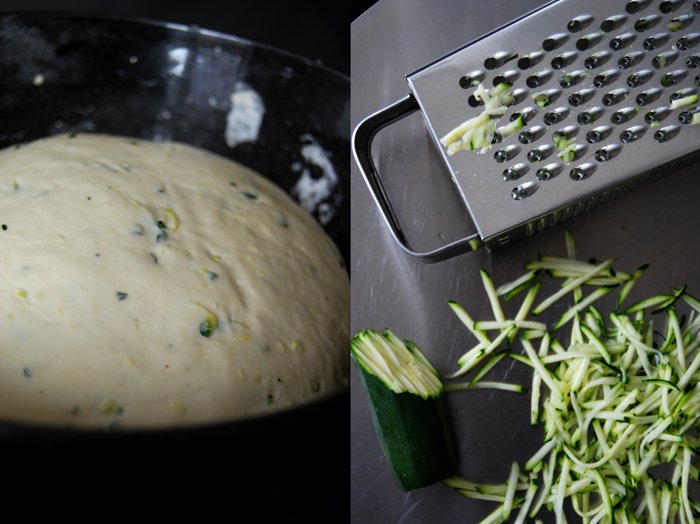
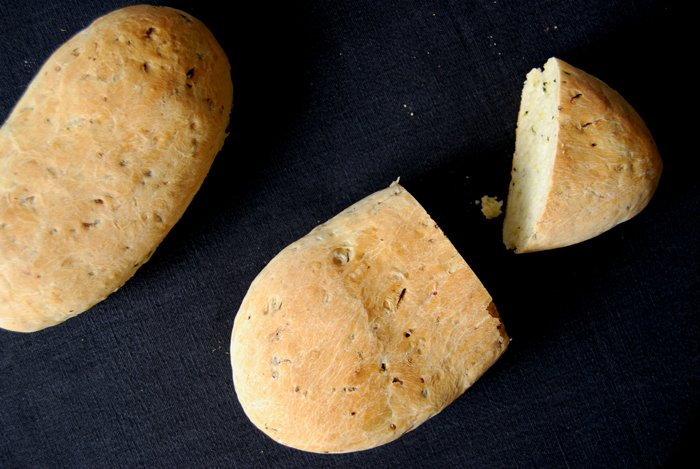
Tyrolean Cheese and Bread Dumplings
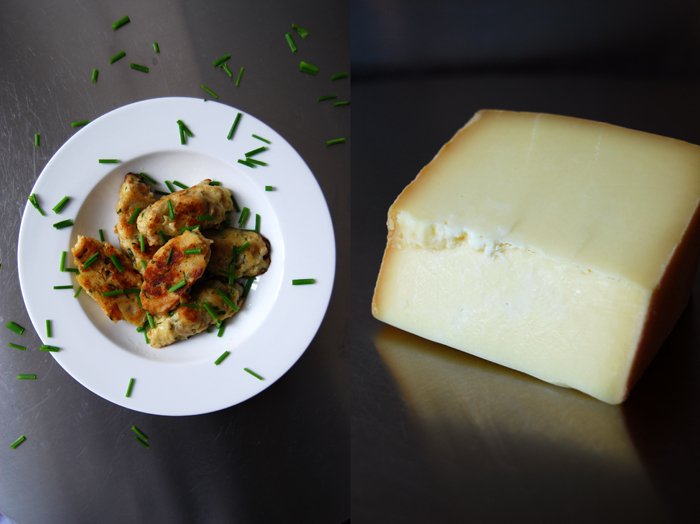
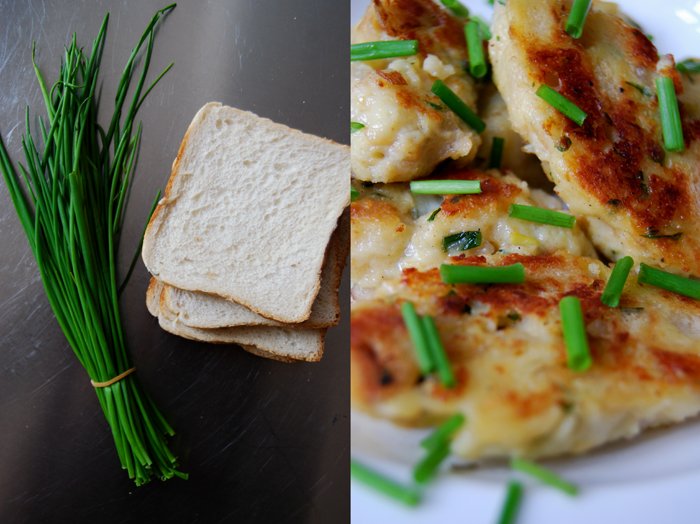
A traditional Tyrolean dumpling is one of the nicest things that can happen to white bread! Mixed with eggs and milk, enhanced with spices, herbs or bacon and finally poached in salted water, the bread turns into delicious little dumplings. Together with roast meat they are the ultimate mountain dish, their spongy texture is perfect to soak up the juices and gravy. They are usually cooked in big batches so that the leftovers can be sliced and fried in butter till golden and crisp.
Sometimes I just skip the first meal, the meat and the gravy and I fry the dumplings right away, filled with aromatic cheese like a strong, ripe mountain cheese, a Tyrolean grey cheese or Swiss raclette. You could also mix all the cheese leftovers which you find in your fridge, I do that sometimes and it can create some interesting results. This time I went for a ripe Swiss cheese, strong without being overpowering and it melted into the bread perfectly. I didn't wait until the next day to fry them, I just let the cooked dumplings dry on a wire rack for about half an hour before I threw them in hot butter and oil. Sometimes, the leftover meal is at least as good as the main!
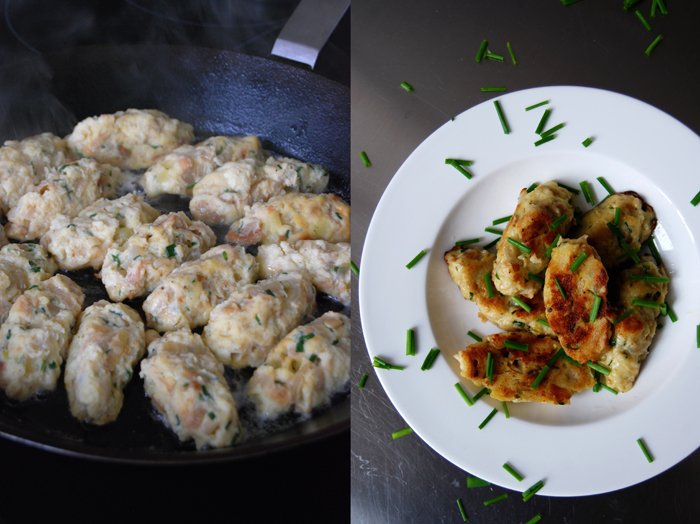
Tyrolean Cheese and Bread Dumplings
For 3-4 people you need
white bread or buns, cut into 1 x 1cm / 1/2 x 1/2" cubes, 350g / 12.5 ounces
milk 250ml / 8.5 ounces
organic eggs 4
plain flour 130g / 4.5 ounces plus more if the mixture is too moist
salt 2 teaspoons
hard mountain cheese (like Appenzeller, Gruyère or Raclette), finely chopped, 100g / 3.5 ounces
medium sized onion, finely chopped, 1
butter for frying
olive oil for frying
salt and black pepper
chives, snipped, a small bunch
In a large pot, bring lots of salted water to a boil.
Fry the onion in a little butter for a few minutes till golden and soft. In a large bowl, mix the bread, fried onions, cheese and chives, leave a few tablespoons for topping. Whisk the milk with the eggs, salt and pepper and pour over the bread. Add the flour, mix with a spoon or your hands. The mixture will be sticky but shouldn't be runny, the dumplings should keep their shape. Add a little more flour if it's too soft. Fill a little bowl with water, wet your clean fingers and form the dumplings into long egg shapes (you need around a heaped tablespoon of the mixture). If you wet you fingers once in a while the mixture won't stick to your hands and it will be easier to form the dumplings.
Simmer the dumplings, in batches on a medium-low heat for about 12 minutes. Take one out with a slotted ladle to check if they are done. Let them dry and cool on a wire rack before you cut them in half (lengthwise) and fry them in a splash of olive oil and around 2 tablespoons of butter on medium temperature till golden brown and crisp on both sides. Season with salt and pepper to taste and sprinkle with chives.

Green Asparagus with my Egg and Lemon Yoghurt Dressing
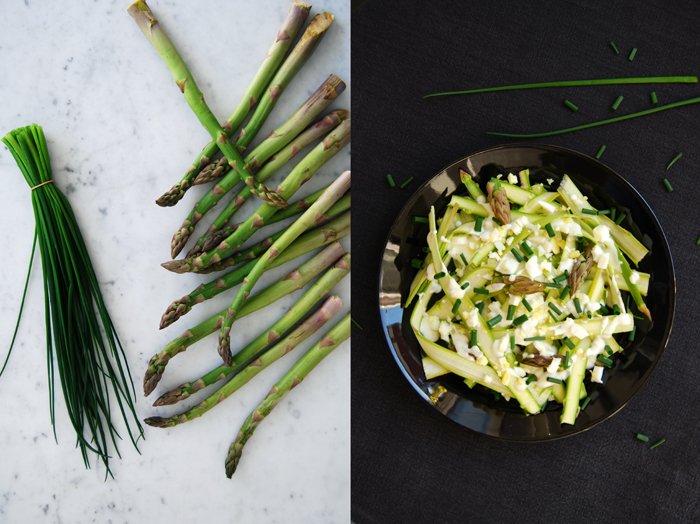
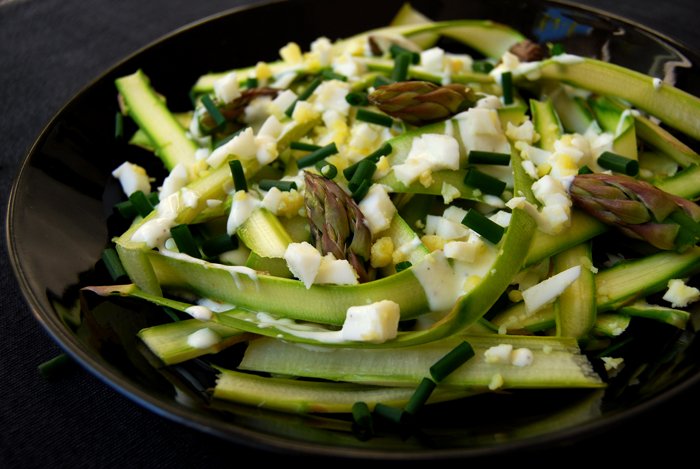
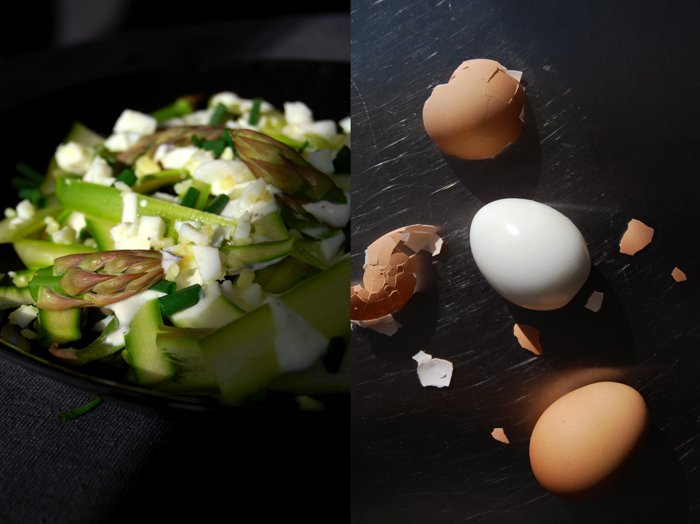
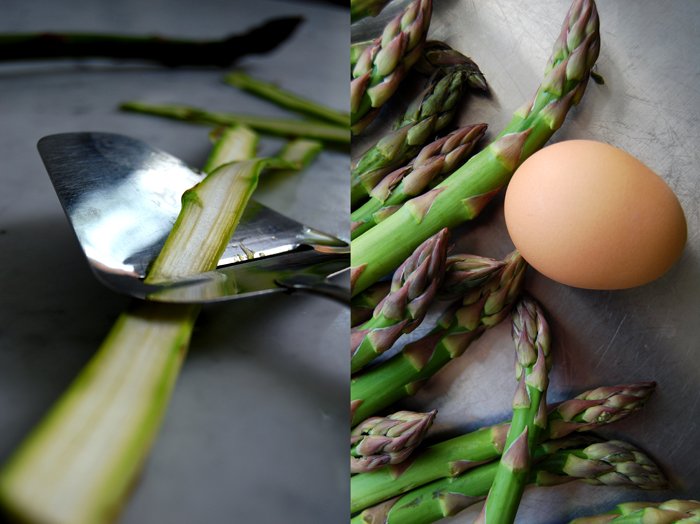
Here is another variation on my raw green asparagus salad, I enjoyed it so much that I tried a few others since I wrote about it on the blog last month. This time I mixed the crunchy vegetable with boiled egg crumbles, chives and a sweet and sour creamy dressing. After my Mediterranean style salad with cherry tomatoes and parmesan I felt like a fresh and Nordic combination. I sliced the green stems thinly with my cheese slicer, they curled up around the eggy crumbles and mixed well with the thick and creamy dressing.
As a starter for 4 or a lunch for 2, you need 500g / 1 pound of raw green asparagus (the woody bottom part cut off), rinsed and thinly sliced (lengthwise). For the dressing I whisked 3 heaped tablespoons of yoghurt, with 3 tablespoons of heavy cream and 2 teaspoons of lemon juice but you should adjust the ratio of milky and sour to your taste. Seasoned with salt, pepper and 1/4 teaspoon of sugar, I dolloped it on the asparagus and finished it off with 2 hardboiled eggs, chopped and crumbled and a small bunch of chives, snipped on top.
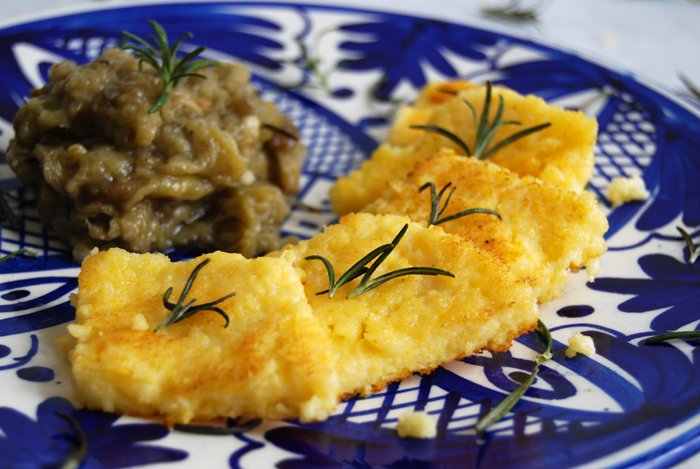
Baked Aubergine Mousse with Rosemary and golden Polenta Slices
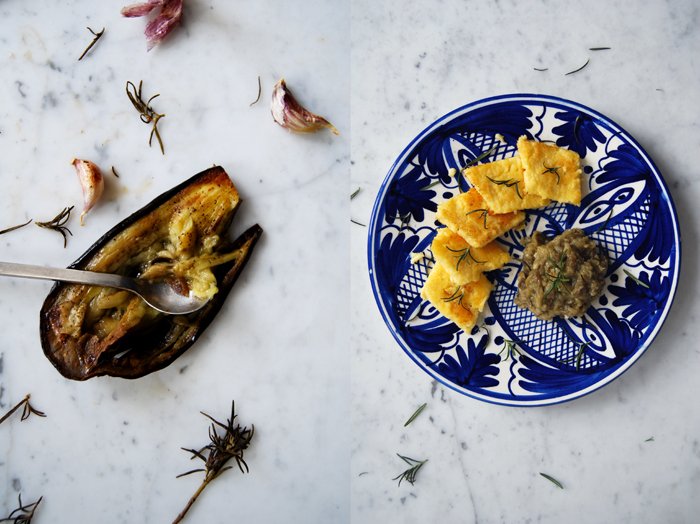
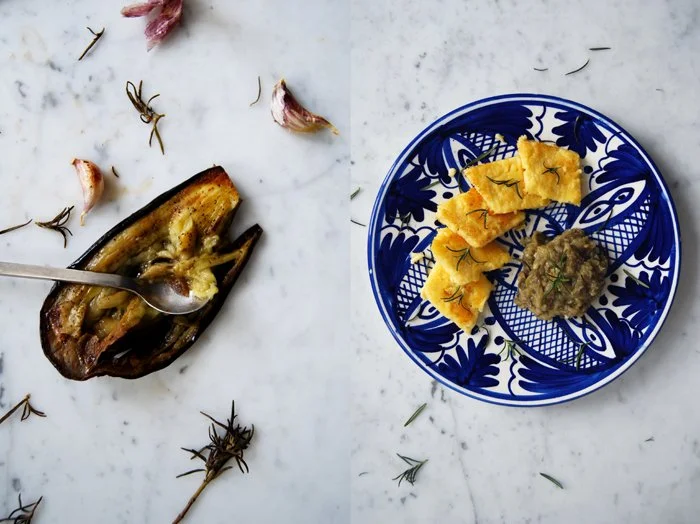
This pale aubergine mousse isn't a beauty but its taste and smooth texture make up for it! Something changes in the purple fruit's flavour when it has been cooking in the oven. If you fry it in a pan or cook it in a stew it's nice but only oven baking manages to extract the aubergine's finer qualities. Sliced, grilled and filled like my aubergine rolls or baked in foil which turns the aubergine into a soft mousse. Both recipes leave no doubt as to why aubergines are so popular in Mediterranean cooking!
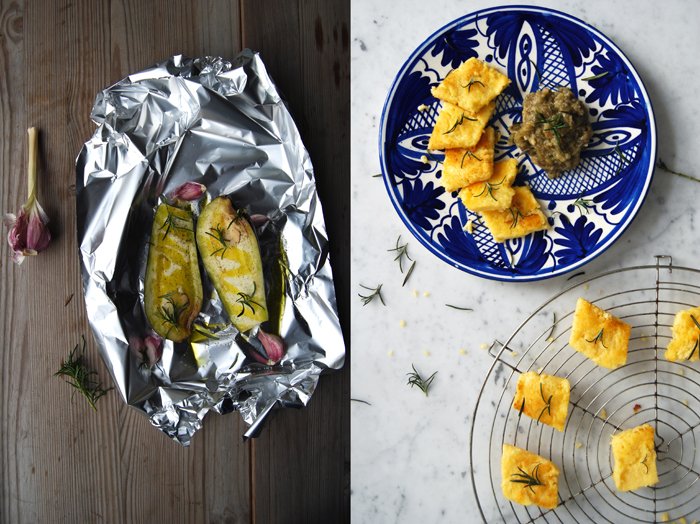
Baking aubergines al Cartoccio together with spices and herbs allows them to become infused with lots of different flavours. The spongey flesh, its soft texture is perfect to absorb tasty liquids and aromatic steam which is why they are also know to soak up so much olive oil! Rosemary was my herb of choice this time which I also used for the golden fried polenta slices. I'm a big fan of this yellow corn, either turned into a thick purée and mixed with gravy and meat or fried, buttery and crisp.
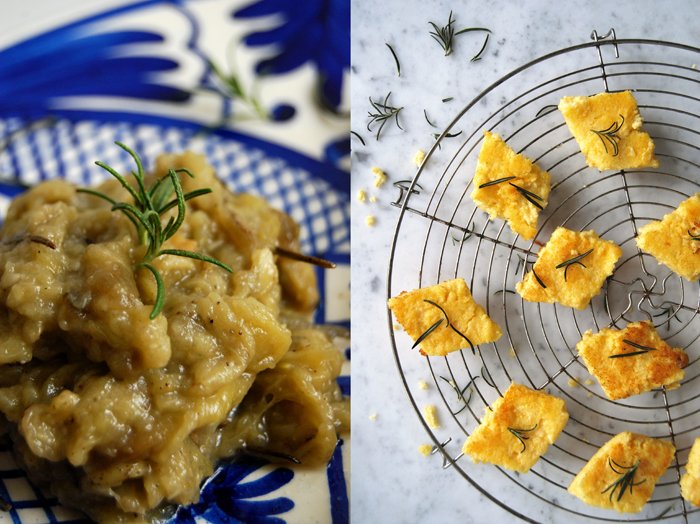
Baked Aubergine Mousse with Rosemary and golden Polenta Slices
For 2-3 people you need
aubergine, cut in half, 1
garlic, 4 cloves in their skin
rosemary, the needles of 3-4 sprigs
olive oil 2 tablespoons
salt and pepper
Set the oven to 200°C / 390°F.
Place the aubergine on a big piece of aluminum foil, sprinkle with olive oil and some rosemary and season with salt and pepper. Turn the fruit's cut side down, add some more rosemary and the garlic and close the pouch. Bake on a baking sheet for about 40 minutes till soft. Check if the flesh is soft and scrape it out with a spoon. Mix in a bowl together with the soft roasted garlic, some of the roasted rosemary and season with salt and pepper, mash with a fork.
For the polenta
polenta 120g / 4 ounces
water 250ml / 8.5 ounces, plus around 100ml / 3.5 ounces for cooking
milk 250ml / 8.5 ounces
salt 1 teaspoon
olive oil 2 tablespoons plus more to grease the baking dish
butter for frying 3-5 tablespoons
rosemary, the needles of 2 sprigs
In a sauce pan, heat the water and milk, add the salt and bring to a boil. Take the pan off the heat, add the olive oil and polenta and whisk. Turn down the heat to the lowest temperature and put the pan back on. Cook the polenta for 10 minutes mixing and adding more water once in a while.
Grease a 28 x 20cm / 11 x 8" baking dish with olive oil. Pour the polenta into the baking dish, let it cool for around 10 minutes. When the polenta is cold and a bit hard, flip the baking dish gently around, either on cling film or directly on your working surface, mine is made of marble and it worked fine. Cut the polenta into diamond shapes and fry in hot butter together with the rosemary on both sides, just for a couple minutes till golden.
Sesame Seed Weekend Bagels
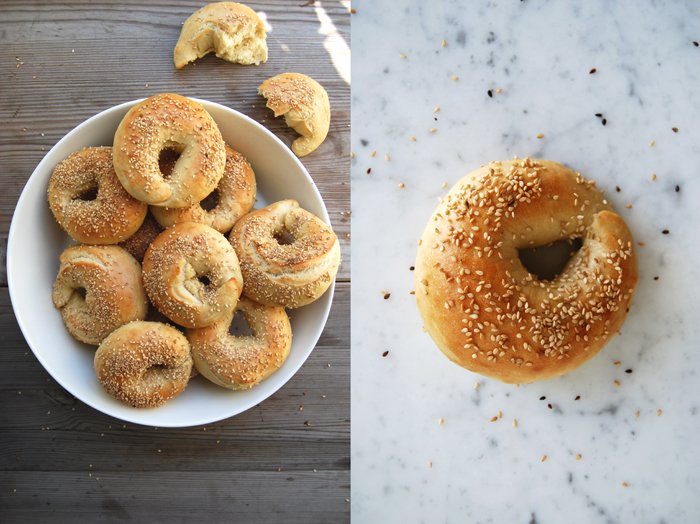
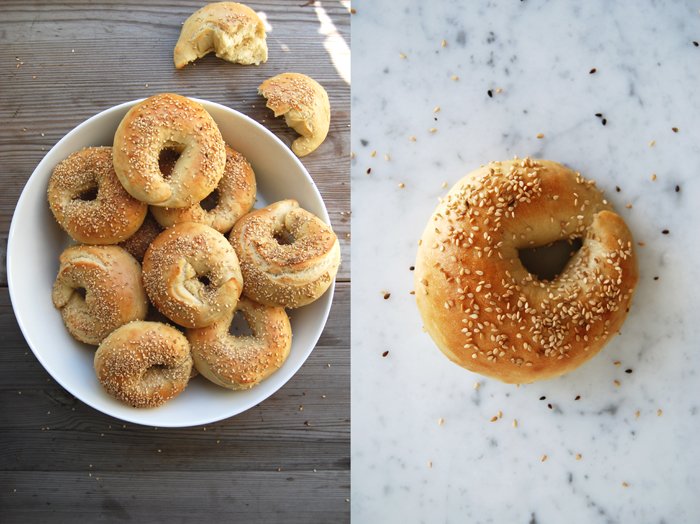
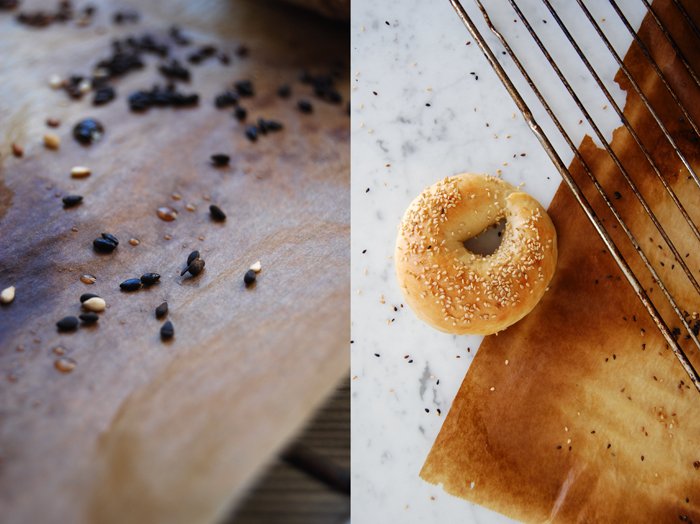
My Sandwich Wednesdays became a tradition shortly after I started eat in my kitchen more than 5 months ago. Usually I choose the bread according to the toppings when I share one of my sandwich recipes but sometimes it's the other way around. The first sandwich post on the 4th December started with a homemade bagel, a defrosted one as I like to bake them in big batches and fill my freezer with them. It's so convenient to have them on hand, I just have to warm them up in the hot oven for a few minutes. The crust becomes a little bit more crunchy but the inside stays soft and as soon as I cut the warm bagels in half the sweet smell of homemade bread fills the air in my kitchen. That's what happened on a cold day in early December, when I smelt the bagel I felt like butter fried leek, sweet tomatoes, hot red chili peppers and smooth cream cheese, the first eat in my kitchen sandwich was born!
Here's the recipe I promised to share! One batch gives me 12 well sized bagels. Most of the time I use organic white spelt flour (type 630) which I prefer to use for my baking in general, for sweet and savory. It's similar to wheat, the results don't differ in taste or texture but it's better for the body as it has much higher nutrition values. My extensive baking demands lots of flour therefore I prefer to go for good ingredients. Another nice side effect is that ever since I changed over to spelt flour a few years ago I lost 2 pounds! When I run out of spelt, I still use wheat without changing the recipes, also for the bagels and they look, feel and taste the same, delicious!
Sesame Seed Bagels
For 12 bagels you need
plain flour, wheat or white spelt type 630, 700g / 1.5 pounds
dry yeast 1 package (for 500g / 1 pound of flour)
water, lukewarm, 380ml / 13 ounces
granulated sugar 2 tablespoons
salt 1 1/2 scant tablespoons
sesame seeds, for sprinkling
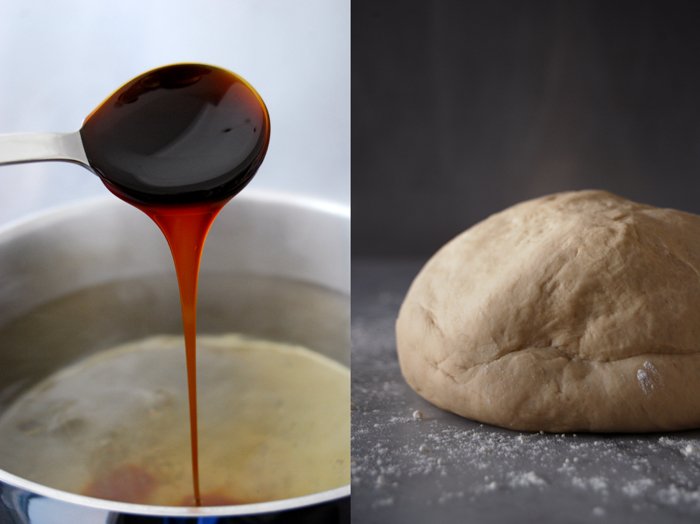
sugar cane syrup or molasses 1 heaping tablespoon, for poaching the bagels
In a large bowl, combine the flour with the yeast, sugar and salt, add the lukewarm water (you might not need all of it). Mix with your dough hooks for a few minutes. The dough shouldn’t be moist and sticky at all, more on the dry side. Continue kneading and punching with your hands until you have an elastic and soft dough ball. Grease the bowl lightly with vegetable oil and put the dough back in. Cover with a tea towel and let it rise in the warm oven (35°C / 95°F) for 60 minutes. This works really well but make sure that your oven is set to top/ bottom heat and not to fan.
Take the dough out, punch it down and knead for 1 minute. Divide the dough in half and each portion in 6 for 12 bagels. Roll each piece into a round ball between your hands and shape into a thick rope. Connect the ends to a ring, sealing and pinching well. Place on two baking sheets lined with parchment paper and greased with vegetable oil, cover with a tea towel and let the bagels rise for 30 minutes in a warm place.
Set your oven to 260°C / 500°F top/ bottom heat. Fill a large pot with water and bring to a boil.
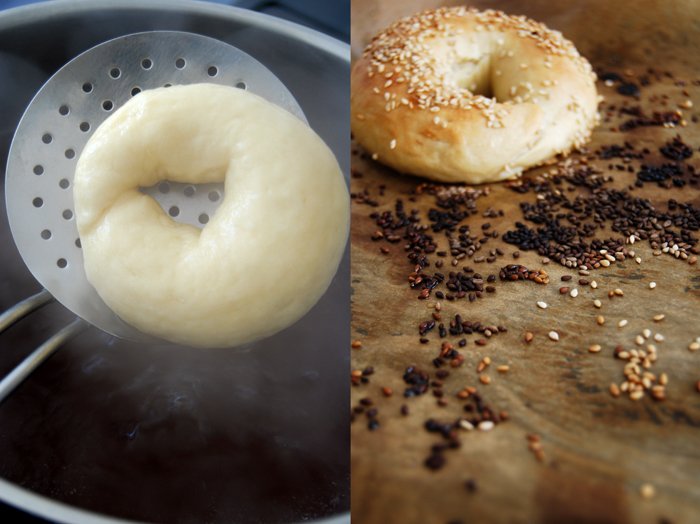
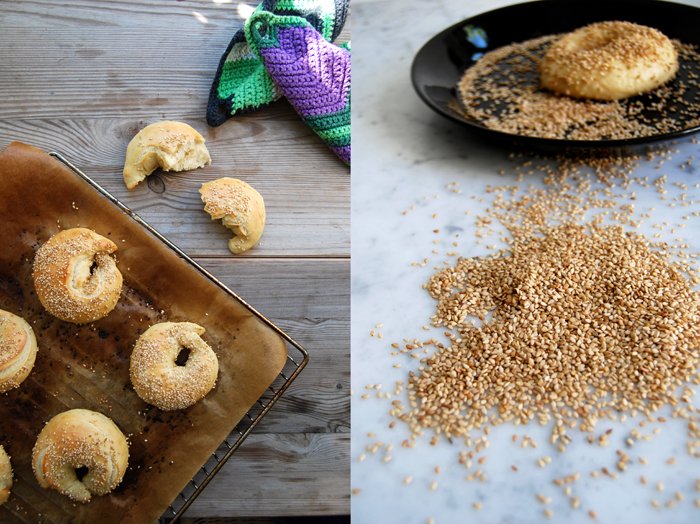
Add the syrup to the boiling water and poach the bagels for around 30 seconds on each side turning them with a spatula or a slotted ladle. I boil 3 bagels at a time, they should swim freely. Put them back on the baking sheets, sprinkle generously with sesame seeds and bake for 8 minutes until golden brown.



Fava Bean Pesto with Mint on a Sandwich
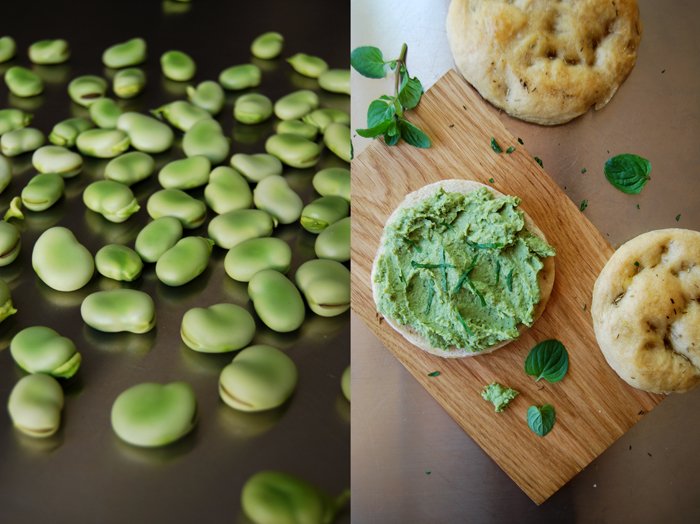
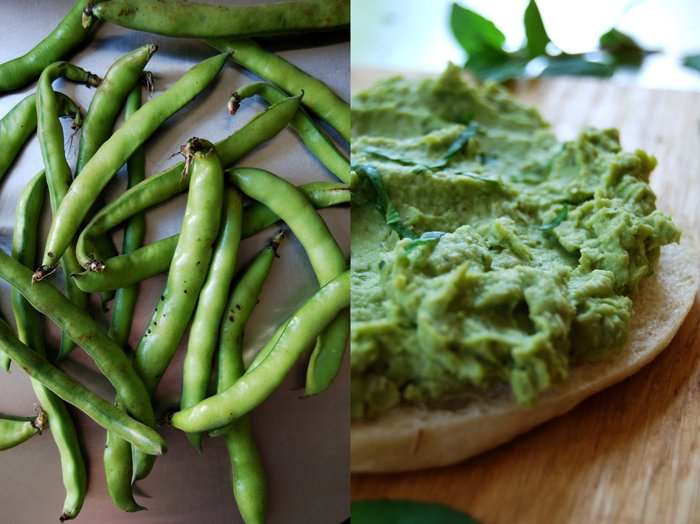
Finally, fava beans are back in season and just peeling them is a sensual experience! These beans are crunchy beauties wrapped in silky transparent shells, protected by the velvety inside of their fleshy pods. To peel them, smell them and finally taste them is a spring highlight to me! I know it sounds a bit overwhelming, but spring vegetables have this effect on me. Luckily, the preparations have a meditative side effect as you have to buy lots of beans to end up with just a handful of this green treasure, but the effort is worth it. The firm texture and fresh green taste stands for everything I love about spring!
Usually I peel the beans out of the shells to achieve a finer taste but for my pesto I skipped this part. The beans were so young, the skin so tender and soft that I could keep them in their shell which also has a nutritional value.
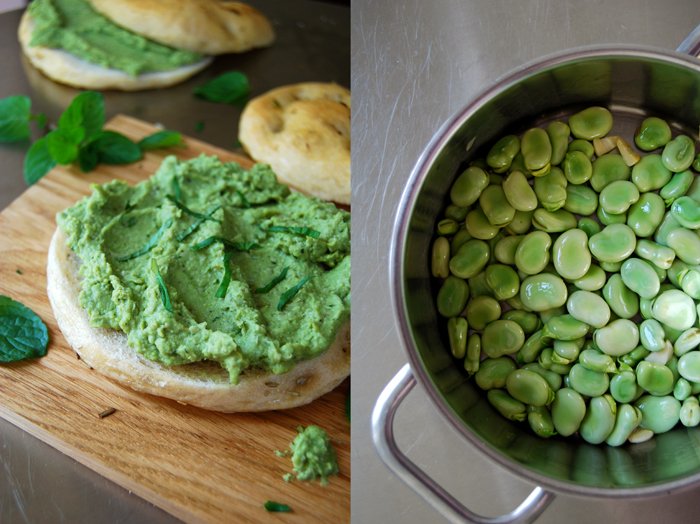
This time, I made a pesto out of my fava beans, cooked only 5 minutes and mixed with garlic, freshly squeezed lemon juice, olive oil and fresh aromatic mint. You could mix it with pasta and some grated Pecorino but I spread it on a sandwich. I covered my juicy focaccia bun with a thick layer which I sprinkled with even more chopped mint leaves.

Fava Bean Pesto and Mint Sandwich
For 4 sandwiches you need
focaccia or soft buns 4 (you could also use thick slices of ciabatta bread)
fava / broad beans, peeled out of the pods, in their shells, 900g / 2 pounds for around 260g / 9 ounces of peeled beans
garlic, quartered, 1 clove
water 100ml / 3.5 ounces
freshly squeezed lemon juice 3 teaspoons
olive oil 1 tablespoon plus more for frying
fresh mint, chopped, 1/2 - 1 teaspoon
salt and black pepper
In a sauce pan, fry the garlic in a little oil on medium heat for 1 minute and mix in the beans. Add the water, season with salt and pepper, close with a lid and simmer for 5 minutes. With a slotted ladle (you will need some of the liquid), take the beans and garlic out of the pan and purée in a blender (or with a stick mixer) together with 1 tablespoon of the liquid from the beans, the lemon juice ,1 tablespoon of olive oil and 1/2 teaspoon of mint. Season with salt, pepper and mint to taste and spread voluptuously on your sandwich.


Fusilli with sweet Bell Pepper and Red Onions
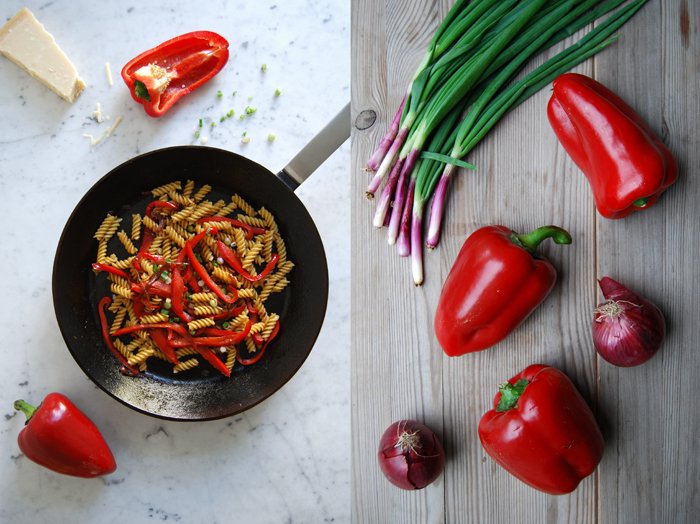
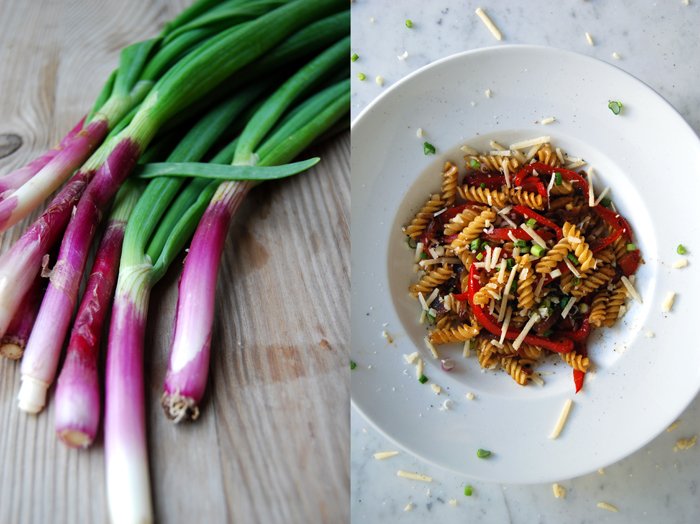
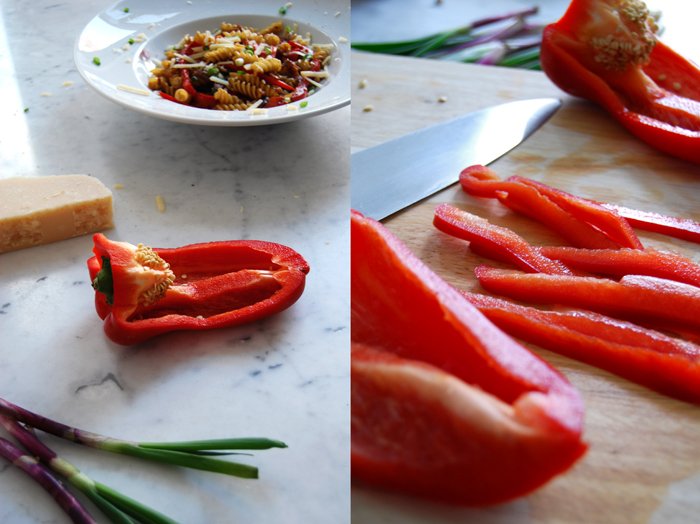
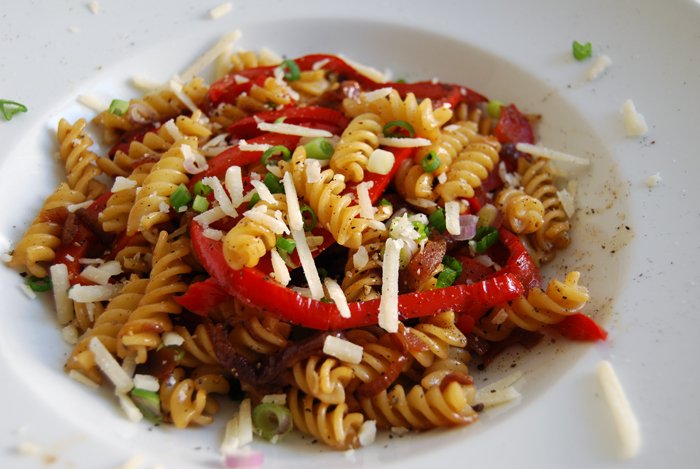
This pasta dish is one for those nights when I just want to get cosy on the sofa with a plate of hot pasta on my lap and relax! It's quick to prepare, it's hearty but still light and all it requires is usually to be found in my kitchen anyway, pasta (for this meal I prefer fusilli as it mixes well with the long strips of the vegetables), red bell pepper, red onions or shallots, garlic and parmesan. This time I added finely chopped spring onions, it's not necessary but the added spiciness was a nice contrast to the sweet flavours. When I fry the bell pepper and onions and they start to brown I deglaze them with white wine or vermouth or I just use the water from the pasta. The liquid helps the juices and roasted bits and pieces to combine to a thick sauce, perfect to glaze the spiral pasta.
For 2, I cooked 200g / 7 ounces of fusilli in lots of salted water al dente and kept 75ml / 2.5 ounces of the water used to cook the pasta. I always start frying the onions and cooking the pasta at the same time which allows me to take out the water when I need it. I cut 1 big red onion in half and sliced it finely, likewise the bell pepper (about 3mm / 0.1 "). In a large heavy pan, I fried the onions in a splash of olive oil on medium heat for about 5 minutes till golden and soft and added the slices of bell pepper. After a few minutes of frying and tossing I deglazed the vegetables with a splash of vermouth which you could replace with white wine, preferably a sweeter one, and poured the water I kept from the pasta on top. I immediately covered it with a big lid, let it simmer for a few minutes until soft and seasoned it with salt and pepper. Mixed with the pasta I filled everything in big plates and sprinkled it with thinly sliced spring onions and freshly grated Parmesan, time to get cosy!

Pizza Bianca with Moroccan Lemons, Chèvre and Rosemary
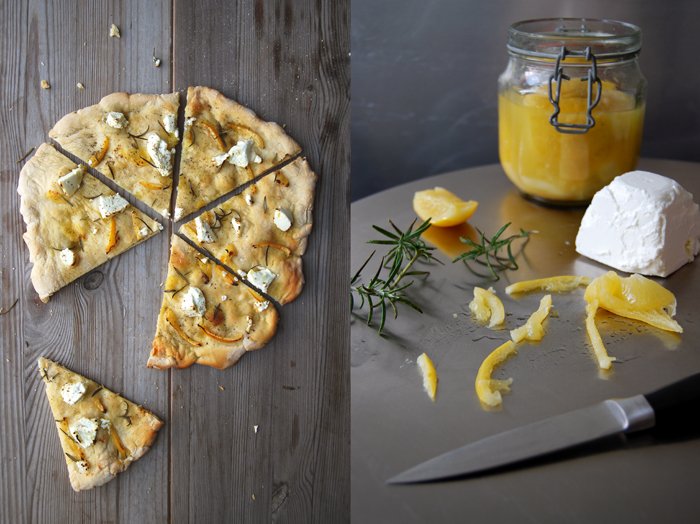
When I wrote about my Moroccan Preserved Lemons about a month ago, Kelly from My Soulfull Home got in touch. I met Kelly through a blog tour in February which she had organised. She asked me to join the tour together with 15 other bloggers, it was carnival and I shared my family's Berliner experience. A few weeks ago she told me about a delicious pizza bianca with lemons and rosemary which one of her friend's makes and she told me that I should give it a try as soon as my lemons were ready. Here they are, sour, soft and juicy!
When I had the first piece of my own preserved lemons in my mouth, I felt a bit excited! My aunt was with me in my kitchen, she was the one who inspired me to preserve lemons in the first place. The first bite was intense, a bit salty as I forgot to rinse the slice of lemon, too much excitement! When I let some water rinse off a bit of the saltiness (for 2-3 seconds), they were perfect! The preserving liquid, concentrated juices of all the lemons, tastes as good and is great for strong sauces and stews.
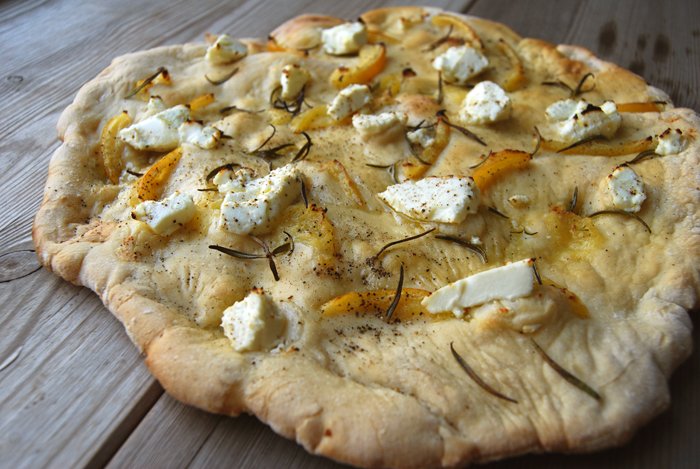
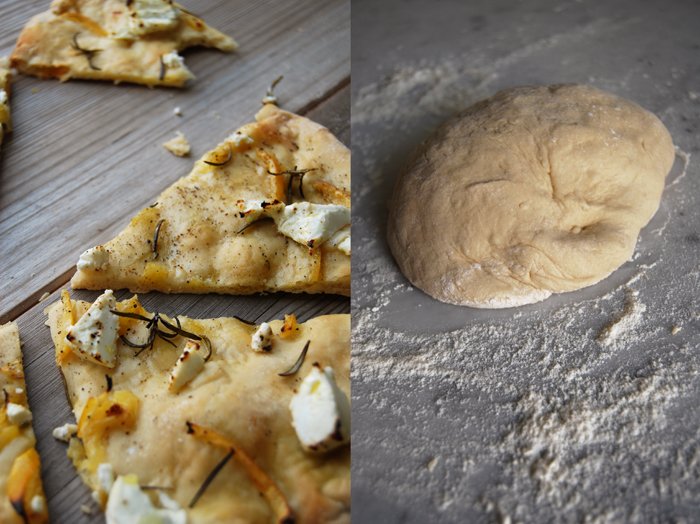
For my pizza bianca, I decided to add some chèvre to mix its smooth milkiness with the lemon's sourness and the woody rosemary. Ricotta would have worked too, but I wanted the strong aroma of this soft goat cheese. I sprinkled some olive oil on top which gave it a bit of a focaccia feeling, some sea salt and pepper and enjoyed this absolutely delicious summery snack. Thank you Kelly!
If you like pizza as much as I do, you can also try my Aubergine and Pecorino Pizza or my Spinach and Ricotta Pizza.
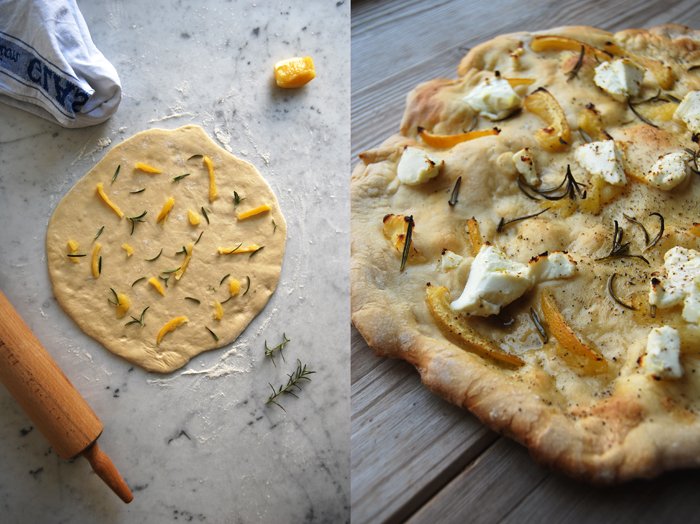
Pizza Bianca with Moroccan Lemons, Chevre and Rosemary
I always start to prepare the dough 2 hours before I bake it to give it enough time to rise. I bake my pizza on a hot baking sheet which has a similar effect to a pizza stone.
For 1 large pizza (size of 1 baking sheet) you need
For the topping
chèvre or ricotta, 200g / 7 ounces
preserved lemon, rinsed and thinly sliced, 1(you could also use lemon zest)
fresh rosemary, the needles of 5 sprigs
olive oil 4-6 tablespoons
salt and black pepper
For the dough
plain flour 350g / 12.5 ounces plus more for mixing
dry yeast 1 package (for 500g / 1 pound of flour)
water, lukewarm, 190ml
olive oil 3 tablespoons
salt 1 teaspoon
Combine the flour with the yeast and salt, add the lukewarm water (you might not need all of it) and olive oil. Mix with your dough hooks for a few minutes. The dough shouldn’t be moist and sticky at all, more on the dry side. Continue kneading and punching with your hands until you have an elastic dough ball, not too hard, not sticky. Put the dough back in the bowl, cover with a tea towel and let it rise in the warm oven (35°C / 95°F) for 40 minutes. This works really well but make sure that your oven is set to top/ bottom heat and not to fan.
When the dough is well risen, roll it out on a very well floured working surface (this is very important or you'll have problems taking it off again). It should be a bit smaller than the size of your baking sheet. Cover with a tea towel and let it rise for another 10-15 minutes.
The pizza
Set your oven to 260°C / 500°F. My oven has a special pizza setting but you can use top / bottom heat as well. Put the baking sheet on the bottom of your oven to heat it (for around 10 minutes).
Take the hot baking sheet out of the oven, turn it around and place it carefully on two stable wooden boards or mats as it will be very hot. Place your risen dough carefully but quickly (best done by two people) on the baking sheet, push it gently into place if necessary. Sprinkle with the slices of lemon, rosemary and olive oil and dollop the chèvre with a tea spoon on top.
Put the baking sheet back into the oven, on the bottom again, and bake for a few minutes until the pizza is golden, season with salt and pepper.

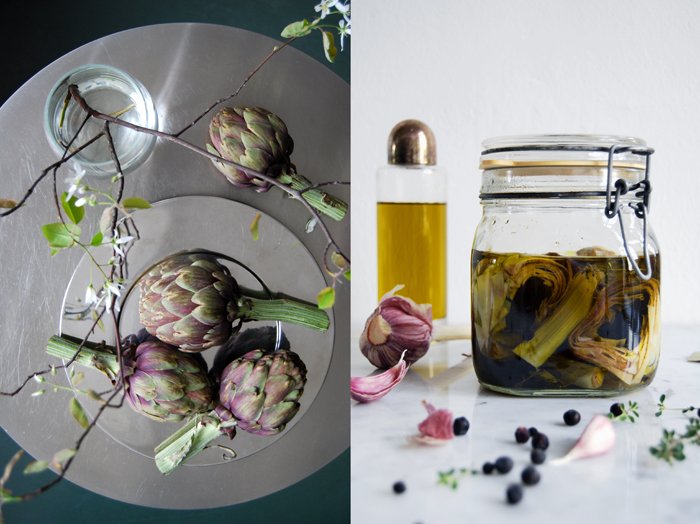
Preserved Artichoke Hearts with Spices and Thyme
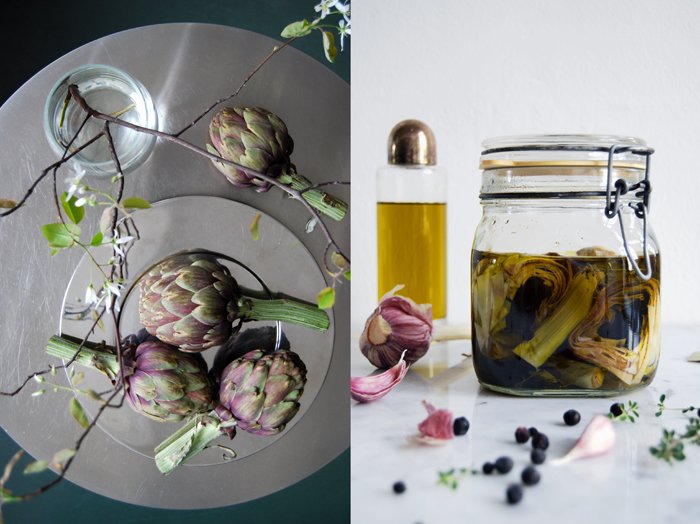
I've been wanting to marinate artichokes for so long, ever since I had my own kitchen in fact, which is quite a while ago. I took my time and over the years I discovered the advantages of a pantry packed with jars of homemade jams, chutneys, preserved lemons and fruits but now I want to see some artichoke hearts cooked in wine and vinegar, with lots of spices on my shelves as well. I love to fill this space with all the jars that make my favourite food so handy and always available, I don't have to worry about industrial preservatives which are banned in my kitchen.
The process of preserving has a wonderful side effect, it's so relaxing! I understand why my grandmother used to have a room in her cellar packed to the ceiling with preserving jars and bottles, cherries, pears and plums, German apple purée, gherkin, jams, so much that even my big family didn't manage to eat everything that she produced. I imagine that she enjoyed preserving food as much as I do now, standing peacefully in her kitchen, keeping an eye on the bubbling and steaming food in the pots. When I'm done with cooking and have filled my culinary products into the jars and line them up on a table, I feel so satisfied and rewarded for the work I've done, it's truly therapeutical!
Artichoke hearts preserved in olive oil are great on bread sprinkled with parsley, on crostini or pizza, mixed with pasta or in a risotto. You could also fry them together with your omelet, mix them into a Mediterranean salad or enjoy them pure on a summery antipasti platter.
Preserved Artichokes Hearts
For 6 artichoke hearts preserved in an 800ml jar you need
baby artichokes 6
water 900ml
white wine 350ml
white wine vinegar 150ml
garlic, quartered, 2 cloves
bay leaves 2
black peppercorns 8
juniper berries 5
thyme 8 small sprigs
salt 1 teaspoon
lemon 1/2, to prevent the artichokes from turning brown
olive oil to fill the preserving jar
spirit to sterilise the rim of the jar
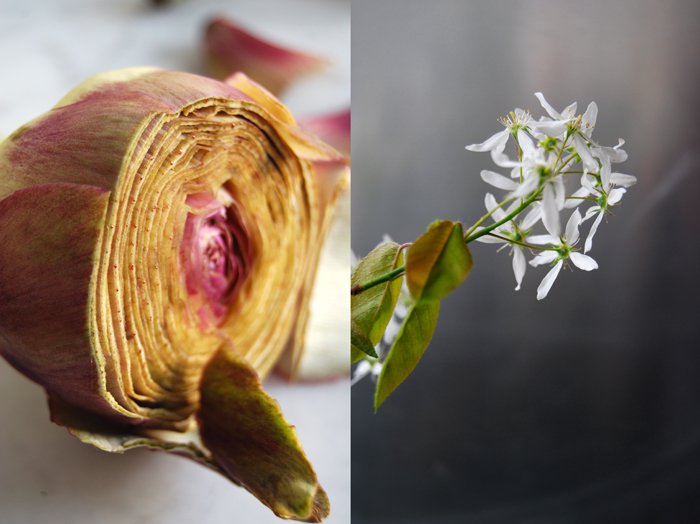
Peel the artichoke stems, if it isn't soft but woody you have to cut it off. Pluck the hard outer leaves and cut the artichoke's tip off (1/3 - 1/2 of the artichoke), just the soft parts of the leaves should be left. Loosen the hairy choke with a knife and scoop it out with a spoon. Keep the prepared artichoke heart in a bowl of cold water and the juice of half a lemon to avoid it discolouring while you're finishing the rest.
In a large pot, bring all the ingredients to a boil, add the artichoke hearts and cook for 10 minutes.
Sterilise the preserving jar in boiling water for 5 minutes. Take it out, let it dry for a few minutes and dip the rim of your jar in the spirit and wash out the lid with the alcohol as well.
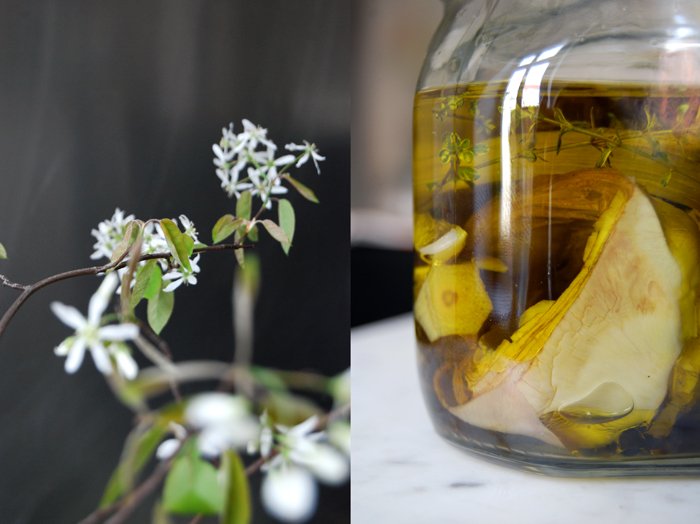
Drain the artichokes and put them in the sterilised jar, fill with olive oil till covered and add some of the spices and thyme sprigs. The jar should be filled with oil to the top! Close the jar, keep in your pantry or enjoy immediately.


Vichyssoise with crunchy Garlic Chips
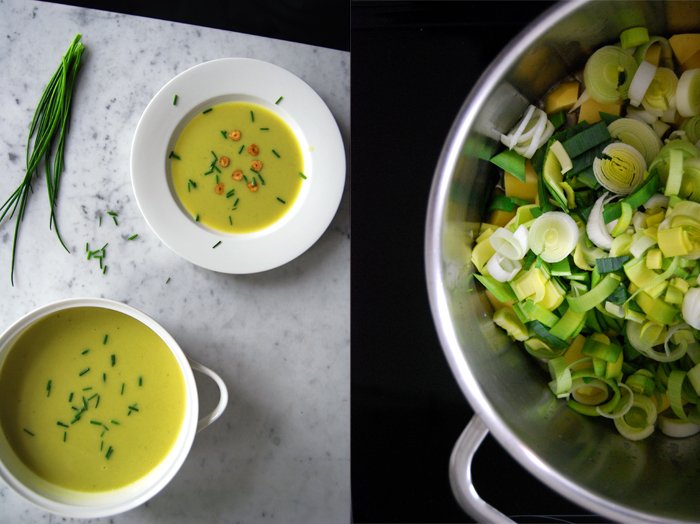
Velvet in a bowl, vichyssoise! This traditional soup is made with only a few ingredients, potatoes, leek, heavy cream and broth besides the spices which were garlic, bay leaf, salt, pepper and nutmeg in my case. There is an ongoing dispute if the recipe is a French or an American invention. Louis Diat from a French town close to Vichy who was a chef at the Ritz Carlton in New York claimed that he cooked the first vichyssoise in the early 20th century, in remembrance of his mother's and grandmother's cold potato and leek soup. The first written proof is found in 1923 in French culinary magazines which relate it to the American cooking. Either way, it's such a simple yet delicious soup and one of the first recipes I made on my own when I started cooking.
I always preferred to eat this soup warm and not cold as I'm not too fond of cold soups in general. My vichyssoise is quite leeky and light, I go easy on the cream and want the vegetable's flavours to be prominent. My addition of garlic and bay leaf is also a variation on the original recipe. That's what recipes are for, to evolve and adapt them to your own taste!
Vichyssoise with Garlic Chips
For 4 people you need
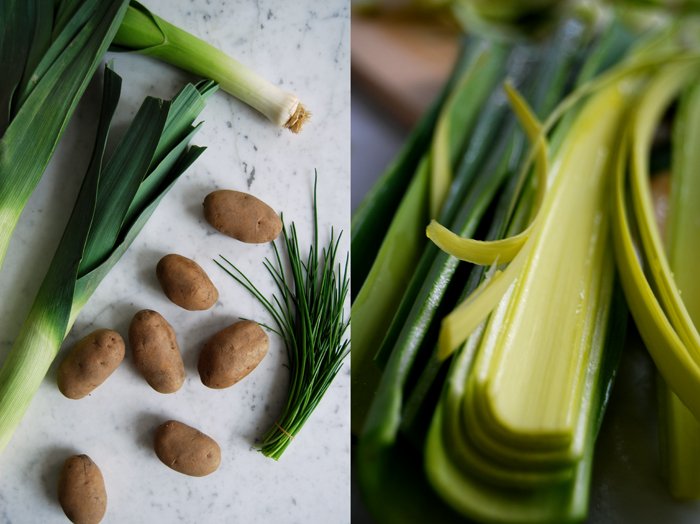
potatoes, peeled and cut into cubes, 450g / 16 ounces
leek, sliced, 350g / 12.5 ounces
vegetable or chicken broth 1300ml
heavy cream 75ml
bay leaf 1
nutmeg, freshly grated
salt and pepper (black or white, as you prefer)
butter 1 tablespoon
olive oil for frying
garlic, thinly sliced, 4 cloves, for the topping
chives, snipped, a small bunch, for the topping
In a large pot, heat the butter and a splash of olive oil and sweat the potatoes and leek for a few minutes. Add the broth and spices and simmer for 25 minutes on low heat. Take out the bay leaf and purée the soup in a blender or with a stick mixer. Whisk in the cream and bring to a boil, cook for about 5 minutes and season with salt, pepper and nutmeg to taste.
In a sauce pan, heat a splash of olive oil and fry the slices of garlic for a few seconds until golden and crisp on both sides. Don't burn them as they will taste bitter.
Either serve the soup immediately, sprinkled with the garlic chips and chives, or let it cool and chill in the fridge.


White Asparagus wrapped in Crêpes with Sauce Hollandaise
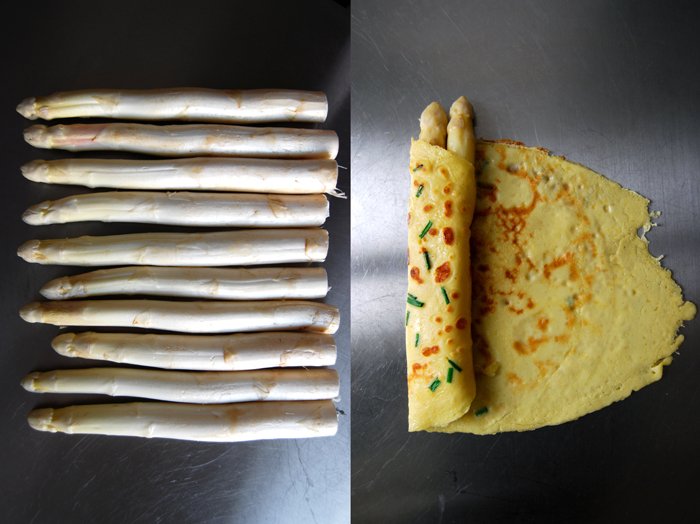
A bag full of white asparagus is laying on my kitchen top, so crunchy and fresh, that its juices start running as soon as I cut the bottoms off. Their short season which ends in late May or early June has just started. It's a delicate gem, also referred to as the royal vegetable, white gold or edible ivory. While green asparagus grows above the ground, the white shoots stay covered in soil and ripen in the dark which prevents photosynthesis, hence the white colour. This technique is called blanching in horticulture, it creates a delicate flavour and makes them tender and less bitter. Unlike their green relatives, white asparagus has to be peeled and also needs to cook a little longer, around 8 minutes to keep them al dente.
One of the most common recipes which puts the focus on the pure taste of the asparagus, is white asparagus served in brown butter with breadcrumbs and slices of cooked ham and new potatoes on the side. A very popular variation on this meal which is also my favourite, is to replace the butter with a sauce Hollandaise, homemade of course as it's not as complicated as one may fear. The taste of this sauce, buttery, eggy, enhanced with Dijon mustard and lemon brings the best out of this royal vegetable. There is some helpful information put together on Food52 for dressings which demand emulsification like sauce Hollandaise or aioli.
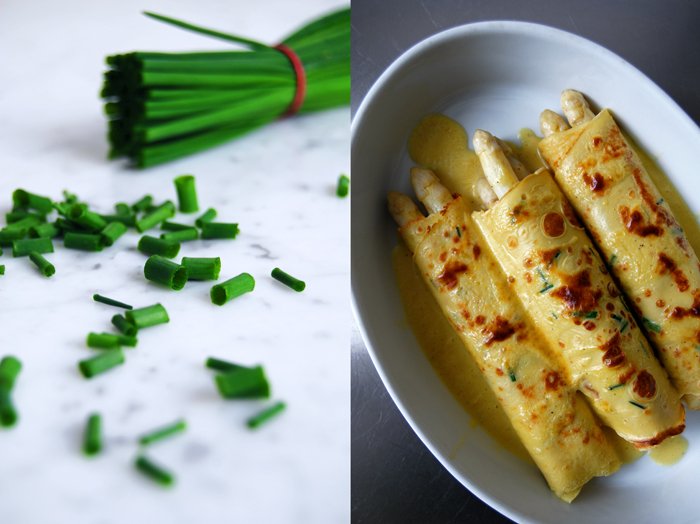
I wrapped my first white asparagus of the year in thin crêpes with chives and baked them with a thick and fluffy sauce Hollandaise under the grill, just for a few minutes until it had a golden bubbly crust.

White Asparagus wrapped in Crêpes with Sauce Hollandaise
For 4 people you need
white asparagus, peeled, the bottoms cut off, 1.5kg / 3 pounds
In a large pot, cook the asparagus in plenty of salted water for about 8 minutes till al dente.
For the crêpe
organic eggs 4
milk 400ml
plain flour, sieved, 200g / 7 ounces
salt 1 teaspoon
chives, chopped, 1 bunch
Whisk or mix the ingredients for the pancakes until well combined, stir in the chives at the end. Fry the crêpes thinly in a large non-stick pan in a little butter for 1-2 minutes. They should be golden on both sides.
For the sauce Hollandaise
butter melted 120g / 4.5 ounces
organic egg yolks 4water 4 tablespoons
freshly squeezed lemon juice 2 tablespoons
Dijon mustard 2 tablespoons
salt and black pepper
In a sauce pan, whisk the egg yolks with the water, lemon juice, mustard, salt and pepper for the sauce Hollandaise till fluffy. Put the pan on a low temperature, the pot should become warm but not hot. Whisk the melted butter into the egg mixtures, adding just a tablespoon at a time and whisk well in between. If the sauce becomes too hot, take it off the heat immediately or add a little more water. When its all combined continue whisking for 1-2 minutes, off the heat if it's already thick and creamy or on the heat, but mind the temperature. Season with salt and pepper and more mustard to taste.
For the crêpe roll
Roll 2-3 asparagus in each crêpe, put the wraps flat onto a large baking dish and pour the sauce over it. Bake under the grill for a couple minutes until the sauce starts bubbling and turns a golden brown. Serve immediately.
If you don't need all of the sauce for the asparagus you can keep it in the fridge until the next day and eat it with potatoes or mixed in an omelet, both are great with chopped chives!



Cucumber Salad with Dill and Sour Cream Dressing
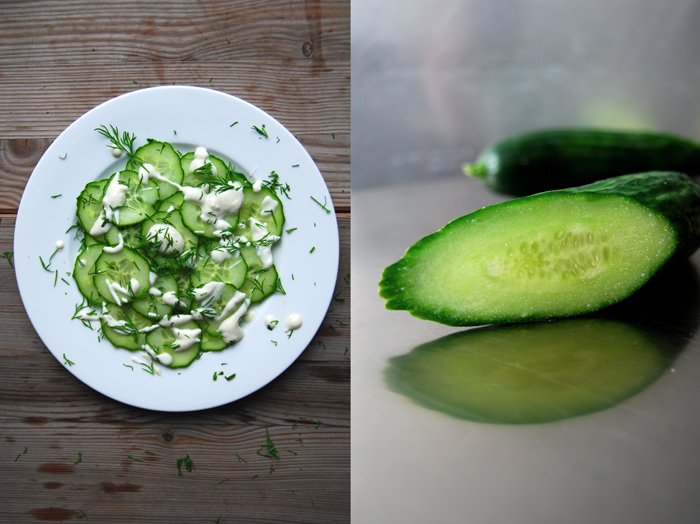
Lots of amazing food was gathered on my own and on my friend's and family's tables in the past couple days, we enjoyed some special culinary treats, had a great time, and of course ate lots of sweets, cakes and chocolate. No complaints but it's time for a break! I love to feast for days, especially together with the ones I love. Treating others and myself to good homemade food, spending time together at a long table, trying out and sharing new recipes, I need and appreciate this so much. It's like taking a break from the daily routine when time is tight and work is always waiting. These feasts caress my soul, I treasure these moments highly and most of the time they become my most beloved memories!
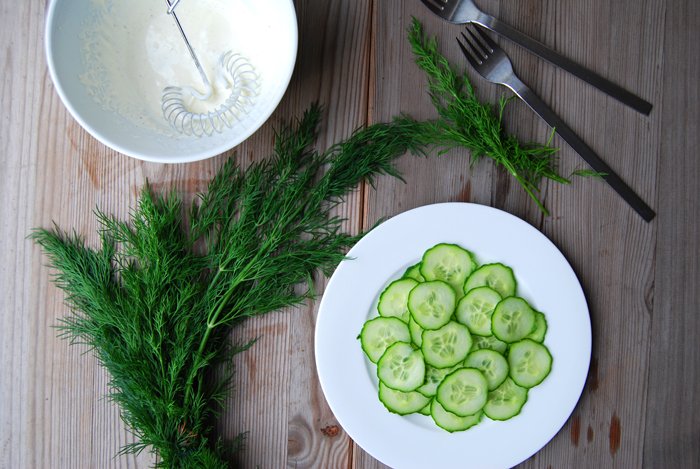
But each feast has its end, otherwise it wouldn't be so special. Therefore I gladly enjoy a light salad, simple and quick. It combines a lot I love about spring, juicy and tasty cucumber which is such a pleasure after months of watery winter cucumbers, fresh dill, strong and aromatic, and a smooth dressing with sour cream and lemon. For the two of us, I sliced 1 small cucumber very thinly and dolloped my milky dressing over it. I whisked 2 heaped tablespoons of sour cream with 1 tablespoon of olive oil and 2 tablespoons of heavy cream and added 1 tablespoon of freshly squeezed lemon juice, salt, pepper and a pinch of sugar. This is just a rough guideline, adjust the ingredients to your own taste, or add some more herbs like chives or parsley or some other vegetables like cherry tomatoes or lettuce. I was happy with my puristic combination, just cucumber, the dressing nicely balanced between sweet, sour and milky, and some freshly chopped dill sprinkled on top.


Grilled Aubergine Rolls filled with Ricotta and Basil
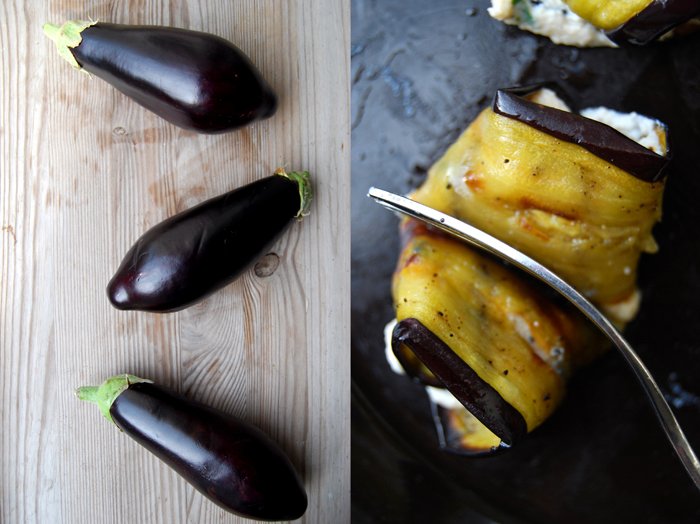
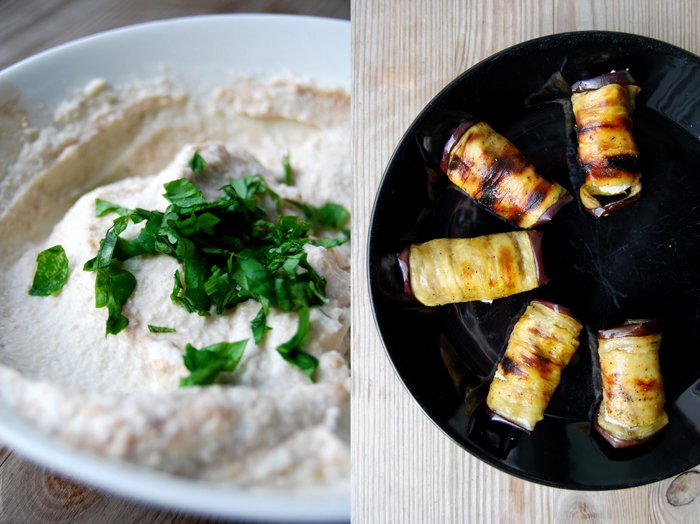
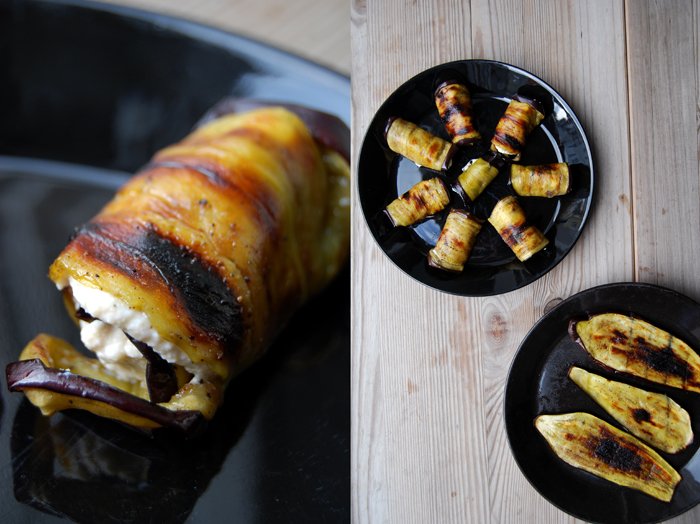
Imagine creamy, milky ricotta enhanced with sweet and thick balsamic vinegar, some fresh basil leaves stirred in and all this spread on grilled slices of aubergine, and you'll have a combination so smooth and velvety that it melts in your mouth! This to me is an absolute perfect match, maybe my favourite way to enjoy aubergine.
I like to make this as a starter for a dinner party, it's easy to prepare and my guests always love it, or as a luscious in between nibble. What's even better is to roll them for a relaxed dinner on a warm evening, with windows wide open, some ciabatta bread on the table and wine, cheese, thin slices of prosciutto or Mortadella di Bologna. I love it, it feels like a little holiday, for only a few hours but with the same effect as being in a restaurant in Italy. That's what I love about food, it's like music, it can put you in a different time, place and mood and it's all in your hands!
Grilled Aubergine Rolls filled with Ricotta, Balsamico Vinegar and Basil
As a starter for 4 you need
large aubergines (eggplants), cut into 1/2cm / 1/4" slices, 2
olive oil to brush the slices of aubergine, around 75ml, depending on the size of the aubergines
fresh ricotta 140g / 5 ounces
heavy cream 2 tablespoons
balsamic vinegar 2 tablespoons or more to taste
fresh basil leaves, cut into strips, around 10 or more to taste
salt and black pepper
Set your oven to grill (broiler).
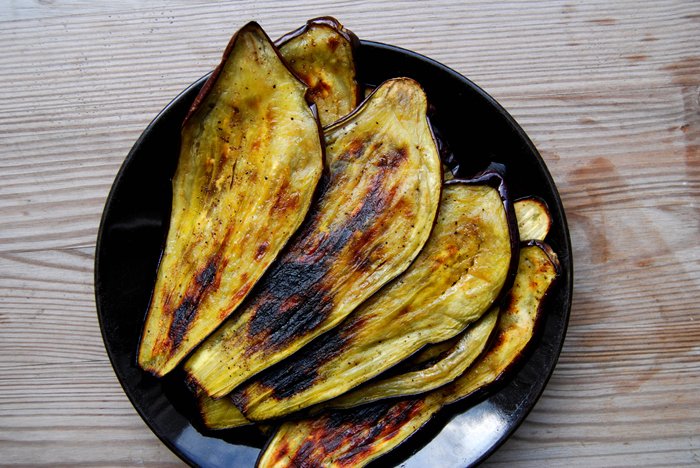
Brush the aubergines with olive oil on both sides and season with salt and pepper. Grill in the oven until golden brown and soft on both sides, they will darken partly but that's fine. Mine needed 7 minutes on one side and 5 minutes on the other but that depends on the oven. Set the aubergines aside and stack them, that will keep them moist and soft.
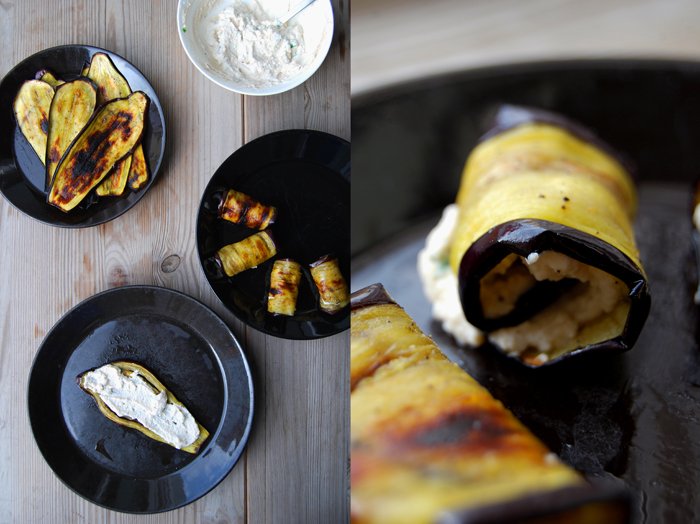
Whisk together the ricotta, cream and balsamic vinegar, season with salt and pepper to taste and stir in the basil. Spread a teaspoon of the ricotta cream on top of each slice of aubergine and roll lengthwise into a wrap.
Guacamole Bagel with spicy Chili Peppers
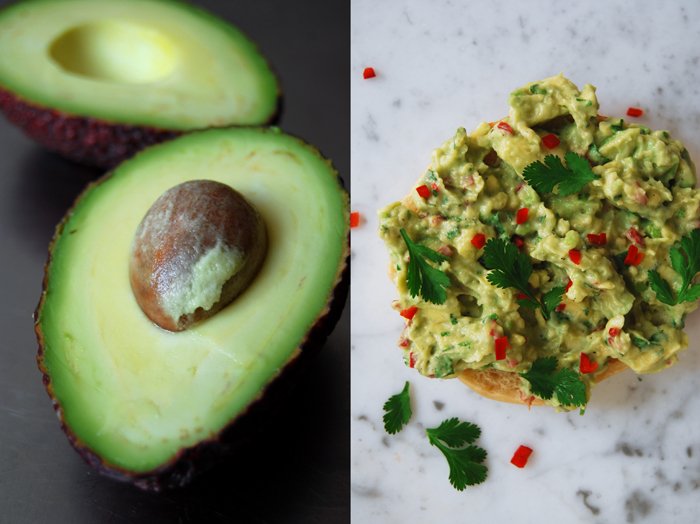
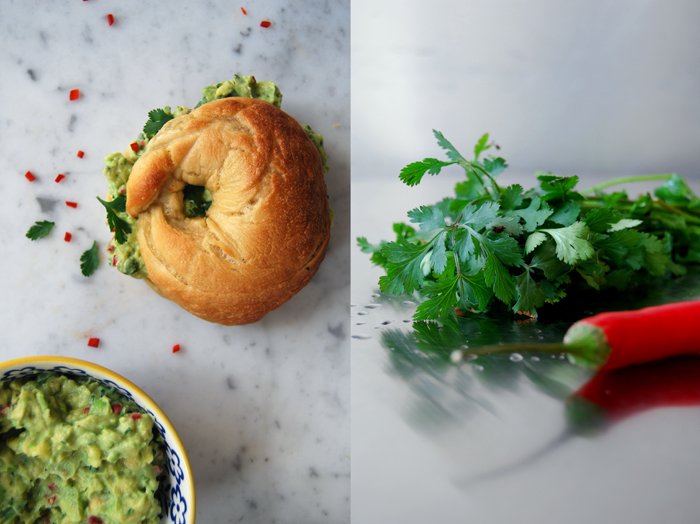
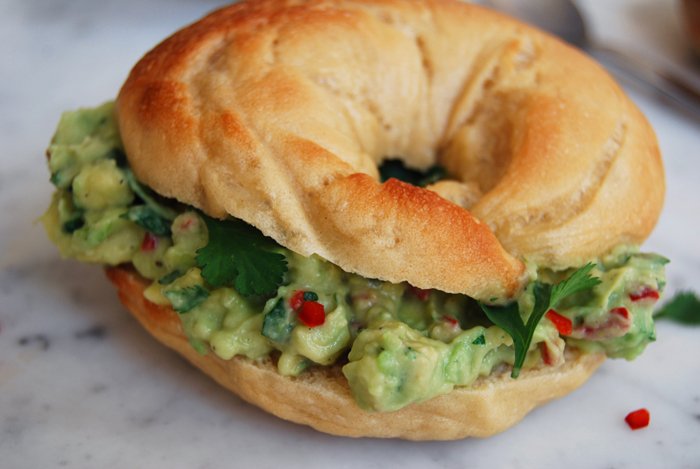
Whenever I make guacamole I have to make lots of it, I can eat it with a spoon! When an avocado is so smooth, ripe and buttery that you can scoop it out like an ice cream, it doesn't really need anything more. If only there wasn't this addictive Mexican dip which combines the fruit's oily richness with lemon juice, coriander, salt and pepper. There are endless variations on it, I always try out new versions, this time I added some sour cream and freshly chopped red chili pepper.
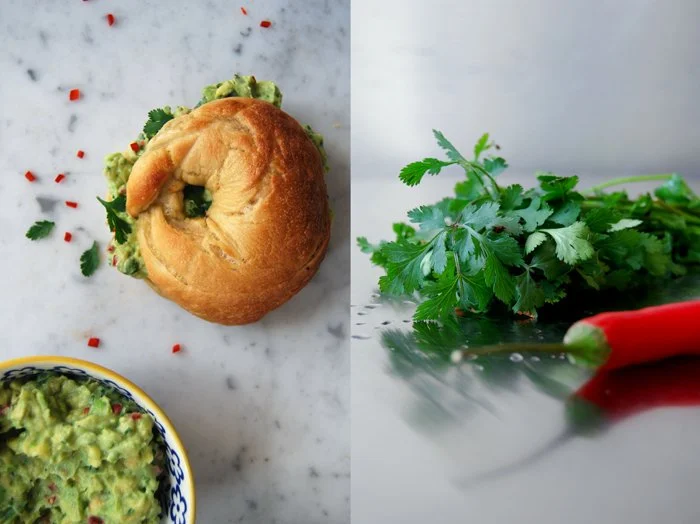
For this week's Sandwich Wednesday I had a bagel in mind. I had a couple of them in my freezer from the last batch I baked (I haven't forgotten that I still have to share the recipe, it will come soon!). For the guacamole, I chopped 2 ripe avocados roughly and mashed them with a fork, just a little as I wanted a lumpy texture. I mixed them with 2 tablespoons of sour cream, 1 tablespoon of lemon juice, salt and pepper and added 1 red chili pepper (without seeds) cut into tiny cubes and 2 tablespoons of roughly chopped coriander leaves. Spread on a juicy bagel or any other nice bun, it's divine!

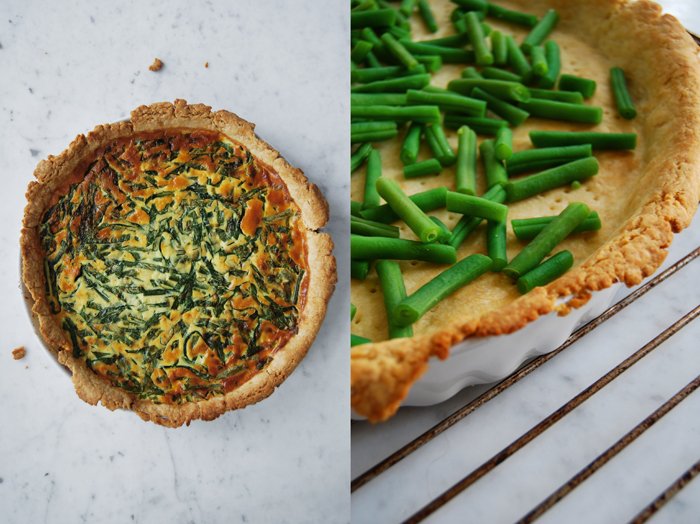
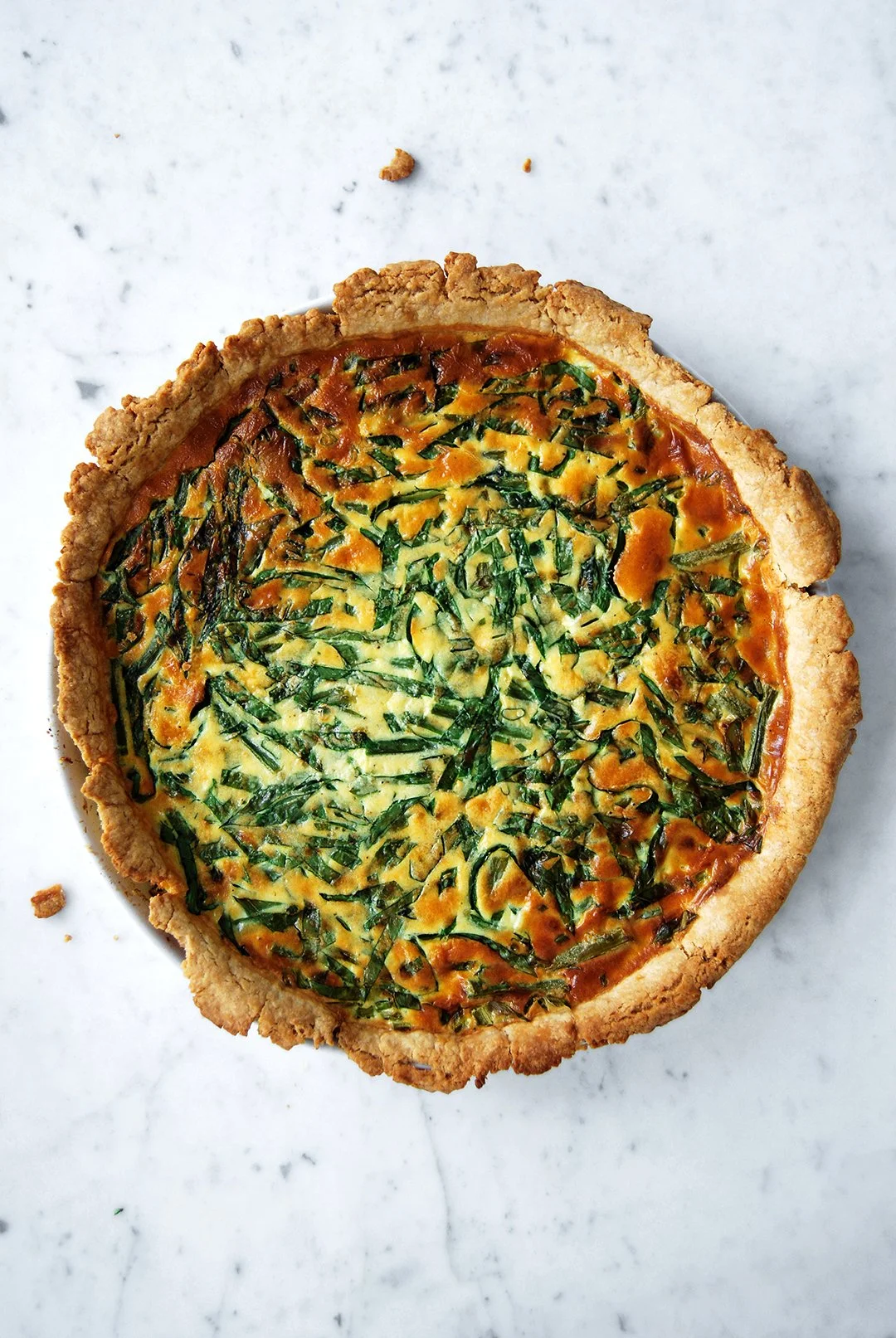
Bean and Ramp Quiche

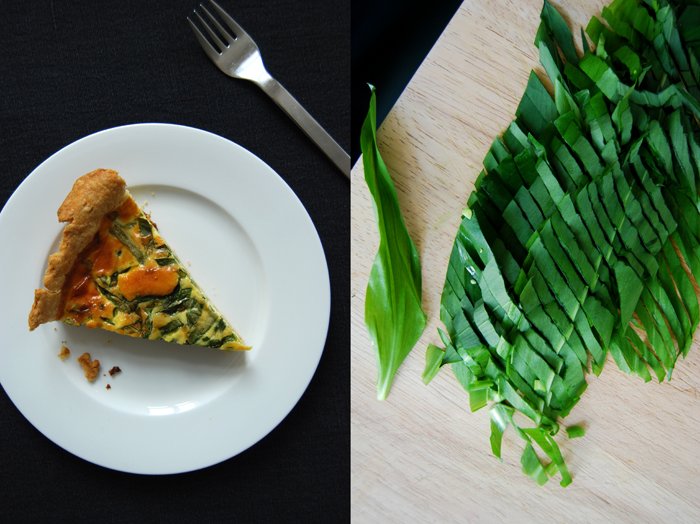
Quiche is one of those dishes which makes me feel good, always, no matter what my day has been like. As soon as I see a quiche in my oven and smell its buttery aroma spread through the kitchen I have to smile. Maybe it's the butter, or the eggs or the fact that I can look forward to another tart on my plate! That's why I've already written about a couple of my quiche recipes, my classic quiche with leek, tomatoes and thyme, an Italian-style tart with fennel and parmesan and here is another one, packed with greens. I fill this savory tart with beans, ramp (wild garlic) and spring onions and it has a deliciously light spring feeling!
I've praised its short crust at length which is so crisp and buttery, to me it's just perfect. My quiches always have a thin layer of an eggy and creamy mixture to keep it light and to leave space for the vegetable filling. Some recipes focus on the creamy filling which can make a quiche too rich and heavy, at least for my taste. I want to be able to eat a piece of quiche with my fingers, a tart for a picnic!

Bean and Ramp Quiche
For one quiche you need a round (27cm / 10.5″) or oval baking dish or tart pan.
For the short crust base
flour 250g / 8.5 ounces (I use spelt flour type 630 but you can use any other plain flour)
butter, cold 125g / 4.5 ounces
organic egg 1
salt 1 teaspoon
Combine the flour with the salt. Cut the butter with a knife into the flour until there are just little pieces of butter left. Continue with your fingers and work the butter into the flour until combined (there shouldn’t be any lumps of butter left). Add the egg and continue mixing with the hooks of your mixer until you have a crumbly mixture. Form a disc, wrap in cling film and put in the freezer for 10 minutes.
For the filling
green beans 200g / 7 ounces
ramp (wild garlic), just the leaves, cut into slices, 30g / 1 ounce
spring onion, cut into slices, 1/2
organic eggs 3
heavy cream 125 ml
crème fraiche or sour cream 125ml
salt 1 teaspoon
ground black pepper
nutmeg, freshly grated, a generous amount
The quiche
Set the oven to 210°C / 410°F top/ bottom heat.
Blanche the beans in plenty of salted water for a couple minutes until al dente.
Mix the eggs with the heavy cream, crème fraiche, salt, pepper and nutmeg.
Roll out the dough between cling film and line your baking dish with the flat pastry. Prick it with a fork and blind-bake in the hot oven for 10 minutes. Take your baking dish out of the oven and set the temperature down to 180°C / 355°F.
Spread the beans, ramp and spring onions on top of the pre-baked pastry base and pour the liquid mixture over it. Put the quiche on a baking sheet in the oven and bake for about 45 minutes or until golden, the top should be firm. Let it cool for 10 minutes.

My Grandmother's Kartoffelpuffer
My grandmother's kitchen had a wooden bench on one side, with a table and three chairs in front of a window from which I could see her peaceful garden. I used to sit there while she cooked for me, busy with her pots and pans preparing my favourite dishes. She grew beautiful roses next to a meadow which was covered in daisies blooming under the branches of her big cherry tree. It was the most perfect cherry tree, with a swing that made me feel like I could touch the sky! I could sit and swing for hours, daydreaming or waiting for my granny's lunch. Whenever I visited her for a couple days she asked me for a list of things I would like to eat. I used to give her a long list, always too long to be able to eat all of my favourites but I loved this ritual!
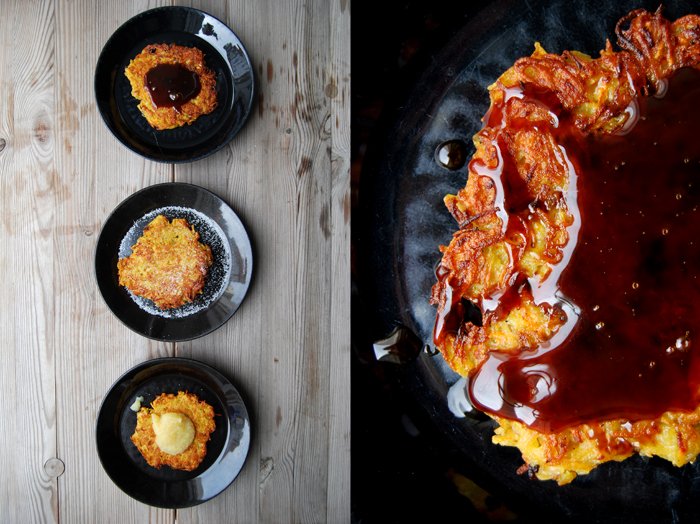
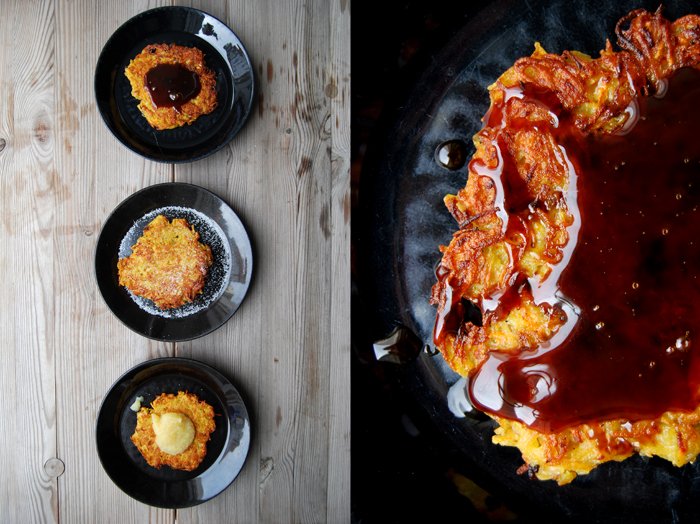
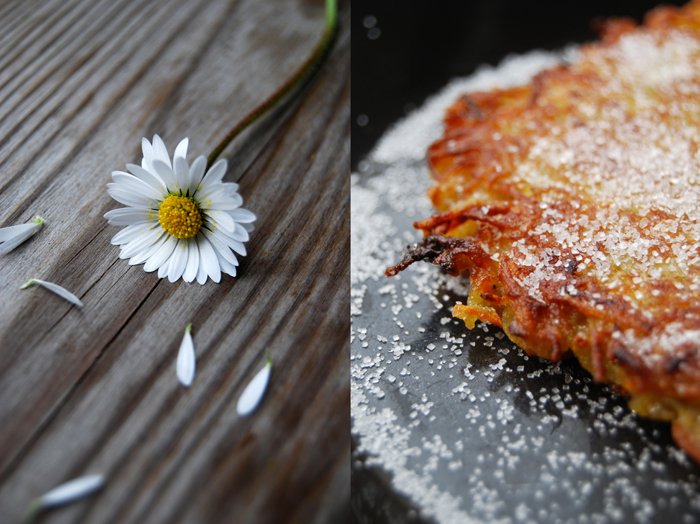
One of these lunches, my personal highlight that I always had to have at least once, was a fried cake made of grated potatoes, carrots, celery, onions, flour and eggs. It was crisp on the outside and juicy inside, similar to latke. Where I come from they are called Reibekuchen or Kartoffelpuffer meaning grated cake or potato cushions. We eat them with apple compote, sugar beet syrup or sugar which was my childhood favourite!

Kartoffelpuffer
For 3-4 people you need
potatoes, peeled and grated, 700g / 25 ounces
celeriac (celery root), peeled and grated, 150g / 5.5 ounces
carrots, peeled and grated, 200g / 7 ounces
large onions, peeled and grated, 2
plain flour 130g / 4.5 ounces
salt 2 heaping teaspoons
ground black pepper
vegetable oil for frying
granulated sugar for sprinkling
apple compote to serve
sugar beet syrup to serve
Squeeze the liquid out of the grated vegetables, dry them between kitchen role and mix with the other ingredients to a dough.
In a large heavy pan heat up the oil on highest temperature, the oil should cover the bottom about 1/2 cm / 1/4". When it's hot scoop about 3 tablespoons of the dough into the pan for each cake and even it out. I fry 3 cakes at a time. When they are golden brown, turn them around. They need around 2-3 minutes on each side, you might have to turn the temperature down a little. Take them out of the pan and put between kitchen role to soak the oil. Serve with sugar, apple compote or sugar beet syrup. If you prefer a savory version you can serve them with smoked salmon or my gravad lax.


Raw Asparagus Salad with Cherry Tomatoes and Parmesan
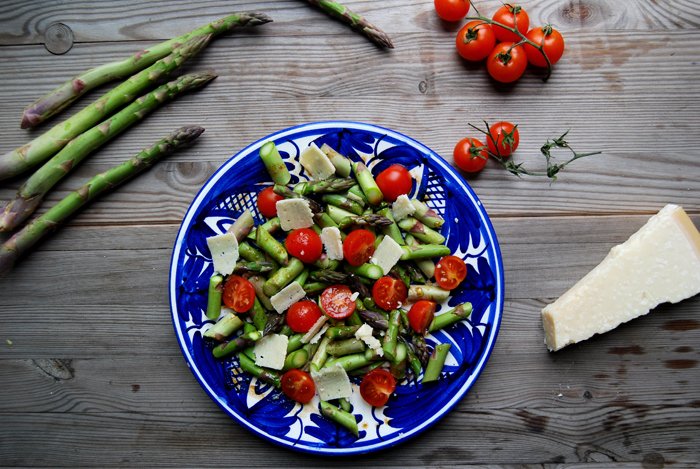
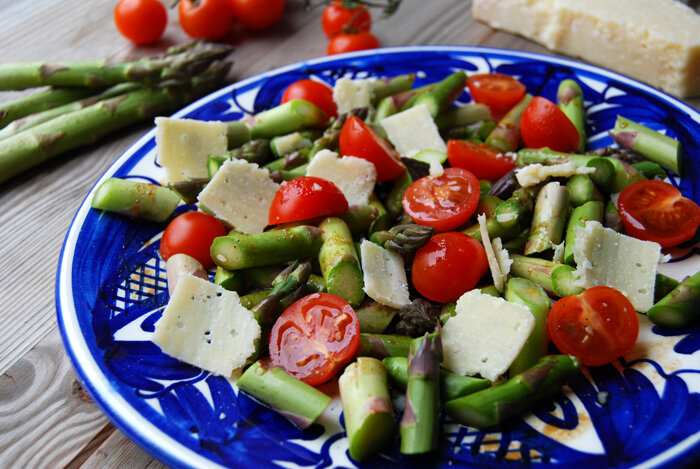
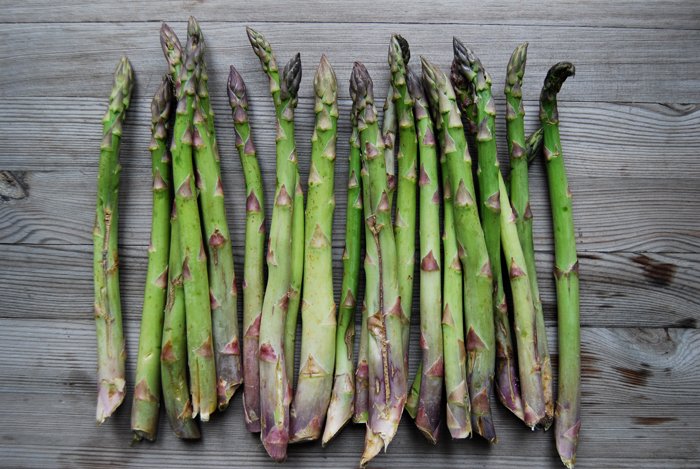
This is the best (and quickest) spring salad I've had so far this year, raw green asparagus with cherry tomatoes, thin slices of young parmesan and a light olive oil and Balsamico vinegar dressing. It combines the best of the season, crunchy, fresh and milky! It was the first time that I ever tried raw asparagus in my kitchen and I was impressed by how good it tastes. I didn't peel the stems, I just cut the bottoms off and before I started preparing the salad I cut a small piece of asparagus to find out how its texture would feel and taste in my mouth. I expected it to be a bit hard and woody but experienced quite the contrary. The outside felt a bit crunchy but the inside was almost tender. After it passed the test I could continue with the preparations for my first raw asparagus salad!
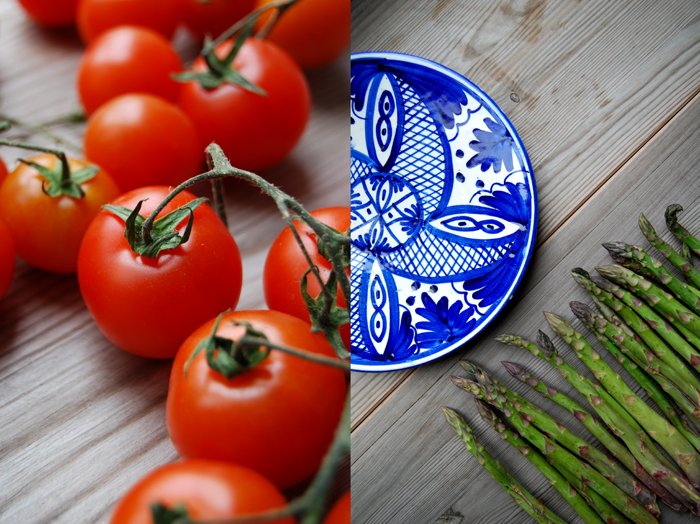
As a side dish or starter for 4, cut the woody bottom part (around 2 cm / 1") off of 500g / 1 pound of medium sized green asparagus and rinse the stems. Cut 16 cherry tomatoes in half and mix with the asparagus. For the dressing, whisk 3 tablespoons of olive oil with 1 tablespoon of dark Balsamico and 1 tablespoon of white Balsamico vinegar. Season with salt and pepper to taste and sprinkle over the salad. Slice 70g / 2.5 ounces of young Parmesan thinly and arrange on top of the salad.



Roast Garlic and Gruyère Sandwich

Garlic roasted in its skin is one of these things I can never have (or make) enough of. No matter how many of these little cloves I throw into the hot oven, I always feel like I could have made more. They cook in their delicate peel like in a little parchment pouch, steaming, softening and unfolding all of their wonderful flavours. It tastes less spicy than raw garlic but yet so aromatic, almost sweet and the texture is smooth, a bit oily. It's a great spread on bread!
Garlic is considered a natural antibiotic which has lots of positive effects on the body. It strengthens the immune system, stops free radicals and slows down the aging process. A tiny bulb that does a lot of good for our body! I strongly believe in the healing and strengthening powers of natural and good quality food. This is one of the reasons why I buy organic food as much as possible. I want natural food which is kept natural, no GMOs, no pesticides. Food in harmony with nature and not fighting against nature. A few years ago I started to drink organic green tea with freshly squeezed lemon juice every morning, since then I haven't had a single cold. It’s my natural booster for my immune system.
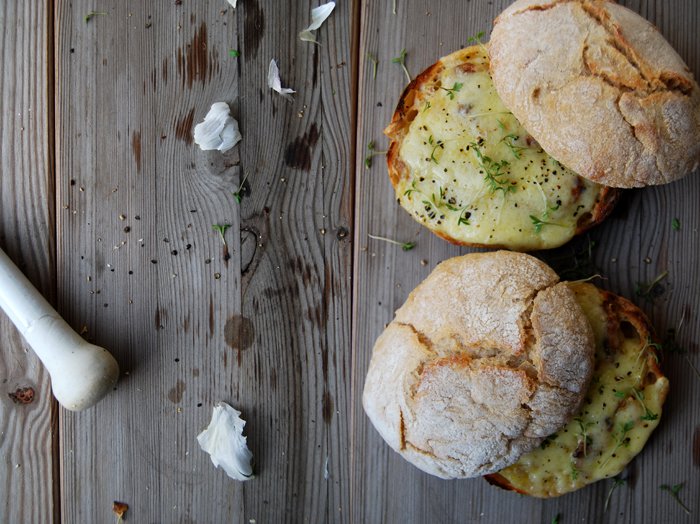
There must be something in garlic that my body loves and when it comes to roast garlic I feel like I could eat it with a spoon, in strong doses like in this sandwich made with 14 cloves of garlic for just 2 buns! I baked medium sized cloves of garlic in their skin in a 210°C / 410°F hot oven for about 12 minutes until golden and soft (you can cover them with aluminum foil if they start to get too dark). They were so soft that I could mash them with a fork, I just added some salt and spread the paste on the buns. I put a couple slices of Swiss Gruyère cheese on top (120g / 4.5 ounces for 4 halfs) and let them melt under the grill for 1-2 minutes until golden brown. I finished my sandwich off with crushed black pepper and some watercress sprinkled on top.
An oily and dense Ciabatta bread would have been good too but when I saw the Swiss Buns at the bakery which have a similar texture to the Italian bread I thought they would match the Gruyère cheese perfectly, it became a delicious and healthy Swiss sandwich!



Ricotta stuffed Zucchini in White Wine Sauce
When we have friends over for dinner, my mood always decides what treats I bring to the table. There are two options, I either feel like a sumptuous meal with several courses which might mean cooking for one or two days and which definitely requires good organisation before and on the night and most importantly enough time to enjoy all the preparations. The other approach is to take it easy and choose recipes which don't need a rigid plan. I just fill the table with plates full of food before or as our friends arrive and we all enjoy the night together. Eating, talking and laughing, drinking some wine of course, savoring and emptying the plates for hours. This was my choice when I had a dinner for 10 ahead of me a few days ago!
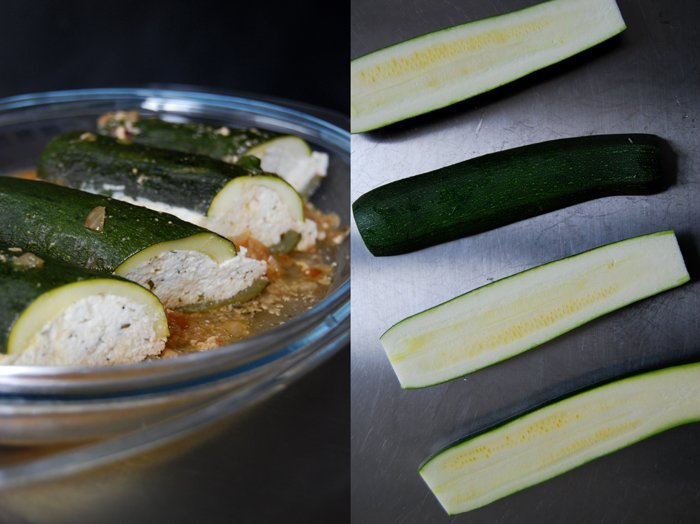
Some of our friends from Malta just moved to Berlin a few months ago. I know how much Maltese love and miss their home and food when they live abroad so I decided to make a traditional Maltese recipe, zucchini stuffed with lemon ricotta. I would have loved to get the small round courgette (Qarabaghliin Maltese) which would have been perfect for this recipe as you can close the stuffed fruit from the top. I worried that the ricotta would run down the sides of my long zucchini when I closed them but it worked fine. I cooked them for an hour in white wine together with the fried pulp of the fruits and some onions. Just a little of the creamy cheese went into the sauce and added some nice creaminess.
In the late afternoon, I cooked the zucchinis and left them al dente. I didn't want them to turn soggy as I had to warm them up again before our guests arrived. I filled my dining table with three different kinds of quiche which are very easy to prepare in advance and I can't really say if I prefer them warm or cold. Two loaves of homemade bread and a big batch of my raspberry chocolate brownies were on my list as well, both are great nibbles for a long night. When we all gathered around the table and I brought the dish with the steaming zucchini I didn't know that the night would go on for so long - our last guests left at 5 in the morning or so I was told, I fell asleep on the sofa at 4!
Zucchini stuffed with Lemon Basil Ricotta in White Wine Sauce
For 2 hungry people or for 4 when you have starters, you need
zucchini / courgette, cut in half (lengthwise) 2 (around 500g / 1 pound)
ricotta 200g / 7 ounces
Parmesan, grated, 20g / 1 ounce
organic eggs 2
basil, chopped roughly, 10 large leaves
lemon zest 1 teaspoon
salt 1/2 teaspoon
crushed black peppercorns
medium sized onion, chopped finely, 1
garlic, cut in half, 2 cloves
fresh parsley 3 sprigs
white wine 1 glass
tomato paste 1 tablespoon
olive oil for frying
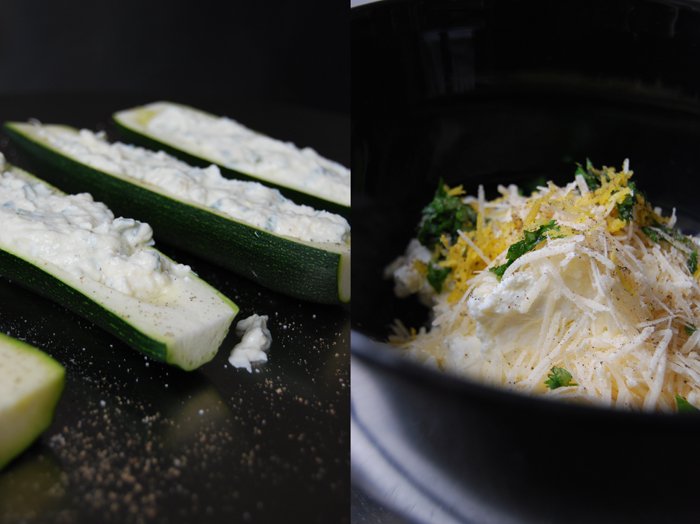
Whisk the ricotta together with the parmesan, eggs, basil, lemon zest, salt and pepper.
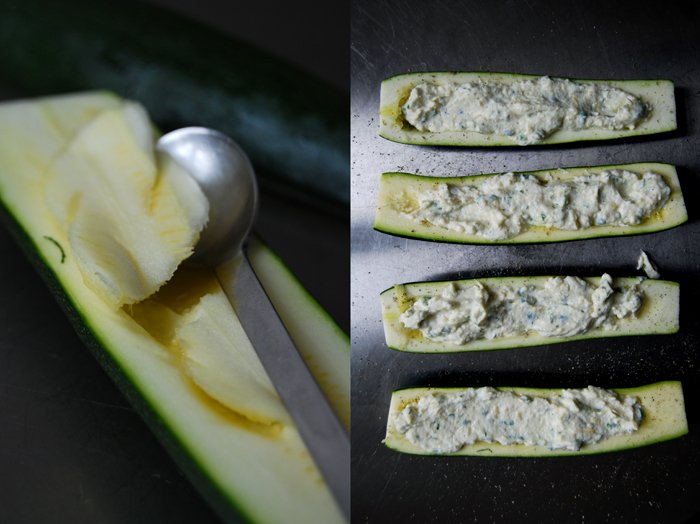
Scrape the pulp out of the zucchini with a small spoon and set aside. Season the inside of the zucchini with a little salt and pepper and fill both sides with the ricotta mixture. Close them just before you put them into the casserole.
In a large pot or casserole with a lid (big enough for the zucchinis), fry the onions in a little oil till golden and soft on medium heat. Add the garlic and the pulp and fry for 2-3 minutes, deglaze with some white wine and add the sprigs of parsley. Put the stuffed zucchini on top of the onions, add some more wine (1-2cm / 1/2-1" of the bottom should be covered), close with a lid and cook for 1 hour on low - medium heat. Check after 2o minutes, you may have to add some more wine, the bottom should remain covered.
When the zucchinis are soft at the bottom and al dente at the top, take them out with 2 spatulas, carefully, and set them aside. Take out the parsley, add the tomato paste to the sauce and season with salt and pepper to taste. Serve the zucchini together with the sauce.

The Family Waffles and Prokofiev's Peter and the Wolf
I used to have cosy tea time ceremonies with my mother and my sister on the weekends, just the three of us. We lit candles, got comfy in between piles of cushions and listened to music. I always wanted to play either Prokofiev's Peter and the Wolf or Ravel's Bolero, both dramatic and mesmerising. It fascinated me as a child, especially Prokofiev's musical fairy tale, just a narrator telling the exciting story and an orchestra interpreting the characters and scenes. It made me feel like I was right in the story, I could see Peter following the cat through the grass and then, the scene when the duck escapes through the garden gate which little Peter had left open! He shouldn't have because of the wolf (his grandfather had told him a million times) and as one can imagine, it doesn't look so good for the duck. I don't want to reveal the end of the story, I still love listening to it!
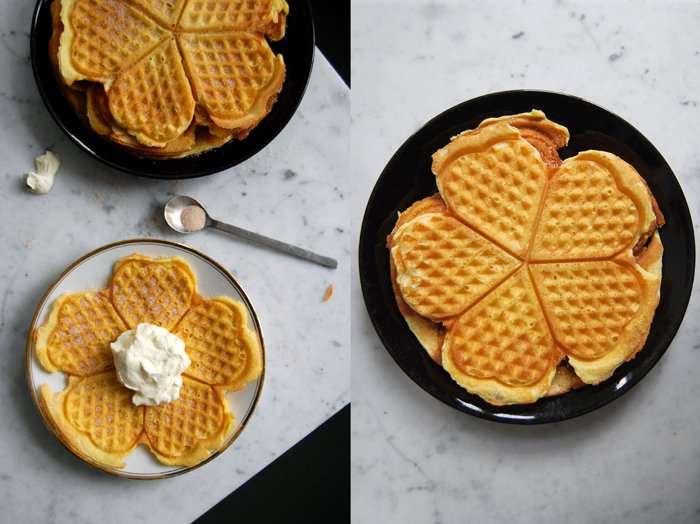
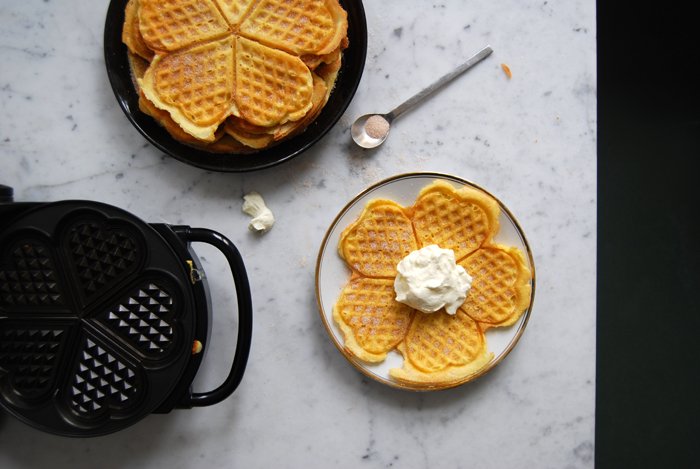
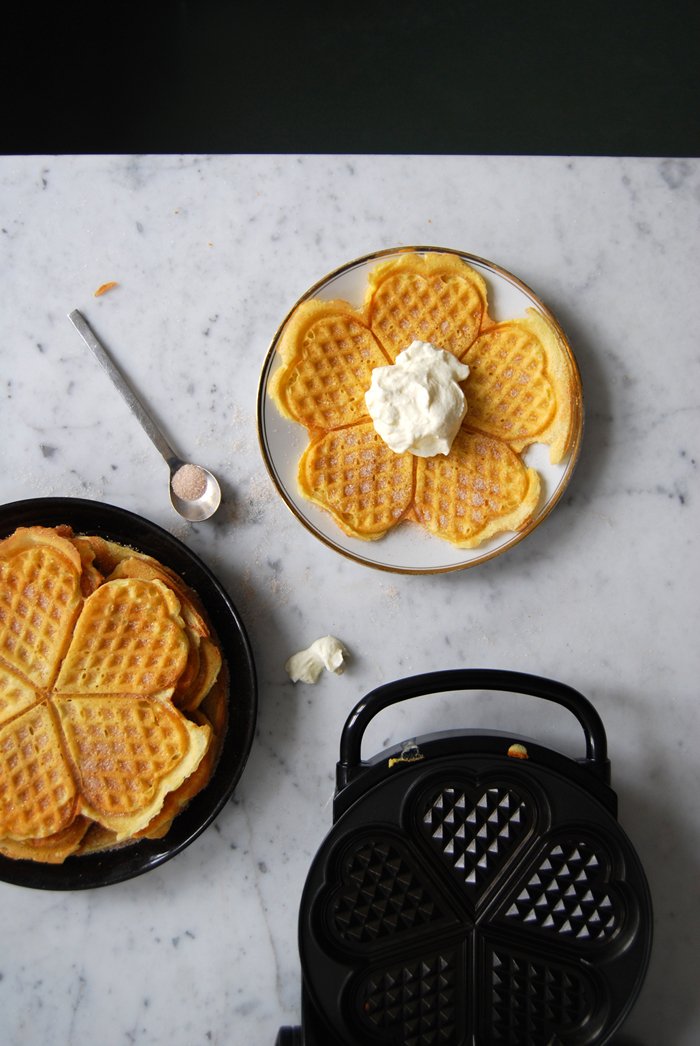
When we had our girly afternoons, we either baked a cake or made waffles, my grandmother's waffles who passed her much-loved recipe on to my mother and her siblings before the grandchildren started baking them as well. I'm one of them, still enjoying them as much as my family does. I never made any other waffle recipe myself but I've obviously had others. I'm biased, I know, never as good as my granny's! Hers are light and fluffy, not too sweet as the dough is made with only a pinch of sugar. She used to sprinkle the sugar on top of the waffles after they were baked, still warm out of the waffle maker, which is how I make them too, sometimes with some cinnamon mixed in.
When I thought of my grandmother, I remembered her gold rimmed plates which I don't use very often. I ate my waffles like I always do, sandwiched with whipped cream in between and I played Peter and the Wolf, all the sweet memories came back and with them a happy and thankful feeling!
This recipe has been featured by Food52!
Waffles with Cinnamon Sugar and Whipped Cream
For the 8 waffles you need
butter 50g / 2 ounces
milk 175ml (if you use a Belgium style waffle maker you need only 150ml of milk)
organic eggs 3
a pinch of salt
granulated sugar 1 teaspoon
plain flour 100g / 3.5 ounces
baking powder 1/2 teaspoon
a pinch of fresh vanilla
For the topping
granulated sugar 70g / 2.5 ounces plus 1 tablespoon for the whipped cream
ground cinnamon 1/2 teaspoon
whipping cream 200ml
Warm up your waffle maker.
Combine the sugar and cinnamon to sprinkle on the waffles and whip the cream together with a tablespoon of sugar.
Melt the butter and mix with the milk. Combine the flour and baking powder. Beat the egg whites with a pinch of salt till stiff. Mix the egg yolks with the sugar and vanilla till fluffy and add the milk and flour, mix well. With a spoon, fold the stiff egg whites gently into the dough until well combined.
Pour a ladle of the dough onto the waffle maker and bake until golden brown. Sprinkle with the cinnamon sugar while the waffles are still warm and served with whipped cream.



Savory Zucchini Bread
I've wanted to learn how to bake sourdough bread for years, the only problem is that I bake and love so many of my yeast bread recipes that, so far I've never approached this adventure. Dry or fresh yeast allows me to make a fresh and warm bread within a couple hours where as sourdough demands days of preparation. Most of the time, my baking isn't really planned far ahead, my mood decides what I will put in the oven. With the right ingredients a yeast bread is wonderfully juicy and spongy but I have to admit that it never creates a crust comparable to the more time-consuming alternative which also has the advantage that you can keep it for days. This is impossible with yeast bread, but to be honest that has never been an issue as all the fresh bread coming out of my kitchen doesn't survive for more than a day or two!
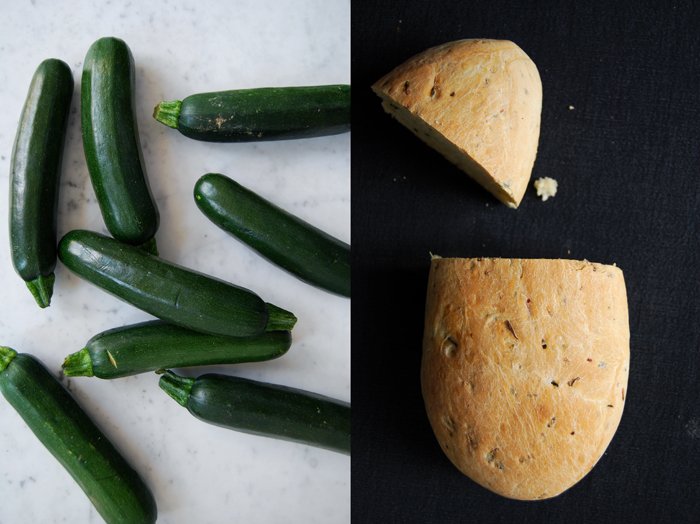
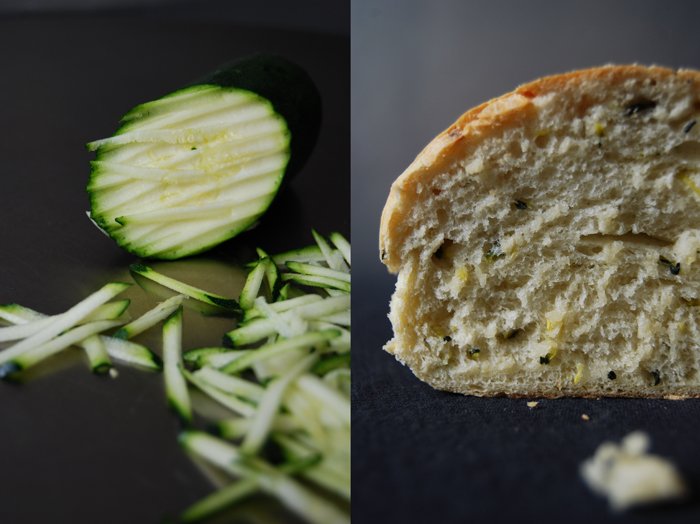
I know that one day sooner or later I will give the sourdough a try, but till then there is still a lot of bread to bake. One option, which is as juicy as my olive bread, is a loaf made with grated zucchini (courgette) which makes the texture so soft and spongy that it doesn't need more than some olive oil or butter spread on top. I served it with ramp (yes, again) butter when we had some friends over and I liked that a lot as well, it made it a bit garlicky.
It's really quick to bake, it only needs 20 minutes in the oven!
Savory Zuchini Bread
For 2 loaves of bread you need
plain flour 500g / 1 pound
dry yeast 1 package (for 500g / 1 pound of flour)
salt 1 heaping teaspoon plus 1/2 teaspoon for the zucchini
zucchini, grated 200g / 7 ounces
water, lukewarm, 225ml
olive oil for brushing
Put the grated zucchini in a sieve over a bowl, add 1/2 teaspoon of salt and mix with your fingers. Set aside for 15 minutes, rinse under cold water for a few seconds and squeeze the water out with your hands. Spread the zucchini on a tea towel and push another towel on top to dry. Scrape off the towel and set aside.
Combine the dry ingredients, add the zucchini and water and mix with your dough hooks for 5 minutes until well combined. Continue kneading with your hands for a few minutes until you have an elastic dough ball. Put the dough back into the bowl and cover with a tea towel. Let the dough rise in a 35°C / 95°F warm oven for 45 minutes. This works really well but make sure that your oven is set to top/ bottom heat and not to fan.
Take the dough out, punch it down and knead for 1 minute. Form 2 long loaves and put on a baking sheet lined with parchment paper. Cover with a tea towel and let them rise for 30 minutes in the warm oven.
Set your oven to 220°C / 430°F.
Brush the loaves with a thin layer of olive oil and bake for 18 minutes or until cooked through. If you’re not sure if it’s done turn the bread around and knock on its underside, it should sound hollow. Let it cool for a couple minutes before you enjoy the first slice of your freshly baked bread.