Bruschetta with Avocado, Tomato and Red Onions
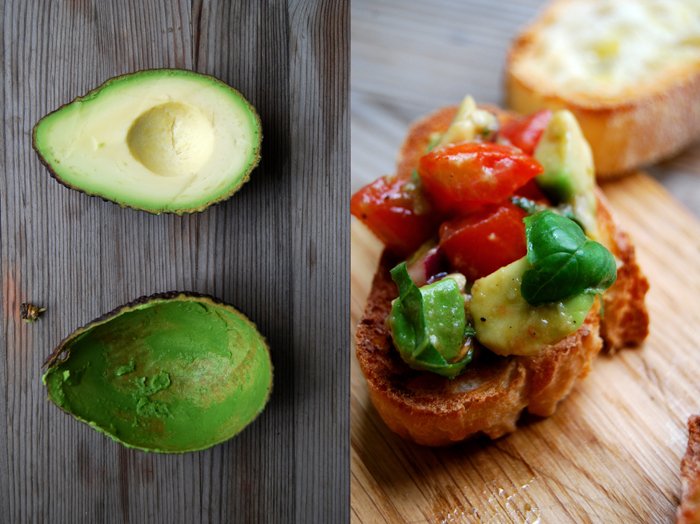
Whenever I have some bread leftovers, bruschetta is my solution! White bread doesn't stay fresh for so long, after 1-2 days it becomes a bit hard and dry but some olive oil drizzled on top and a few seconds under the grill will bring it back to life. A fruity dip, dripping and a little oily is the fine finish. I put the topping on just before we eat the bread so that it only soaks a little of the juices and the thin crust stays crisp.
Bruschetta can be the base for all kinds of dips, spreads and vegetables. In late summer I fancy one made with sautéed mushrooms, liver and thyme but luckily we aren't there yet. There's still lots of food in between now and then, lots of vegetables waiting to be chopped and mixed with some olive oil, garlic and herbs to end up on this crunchy bread. I'll start with a mix of velvety avocado, fresh tomatoes and a little spicy red onion.
For the 2 of us, I chopped up a ripe avocado with a fork, roughly, I didn't want to turn it into a mousse. I diced 2 medium sized tomatoes, sweet and ripe, chopped a clove of garlic finely and 1/4 red onion into small cubes. 8 fleshy basil leaves, 2 tablespoons of olive oil, 1 tablespoon of Balsamico vinegar, salt and pepper stirred in made this chunky spread complete. I used a 2 day old baguette for this recipe, sliced and drizzled with a little olive oil, roast under the grill for a minute until it turned golden brown.


Tomato Soup with Goat Cheese Nocken
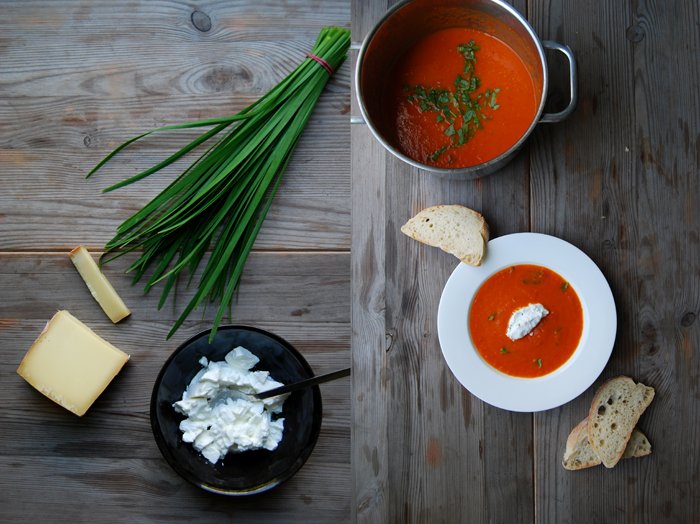
A few weeks ago I received one of my mother's recipe faxes again. The list of her culinary adventures and recommendations was long (as always) and included Tyrolean Nocken made of goat cream cheese mixed with finely chopped hard mountain cheese. Nocken are dumplings, they can be made of potatoes like Italian gnocchi, bread or flour but there is also an uncooked version in which case they are made of cream cheese or ricotta. I've made these a couple times but never mixed with hard cheese. This sounded interesting, especially because I've been wanting to make tomato soup for weeks which seemed like the perfect combination to me. The fruity soup, thick and sweet, refined with some strong goat milk and cheese flavours!
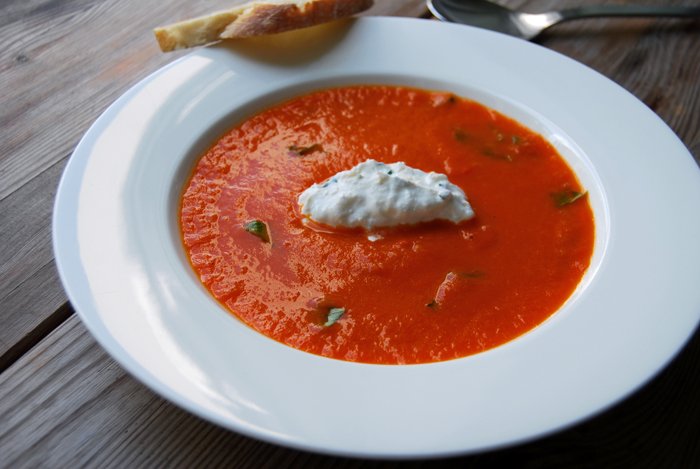
I slipped in some herbs as well, fresh basil for the tomatoes after the soup was done and chives for the Nocken. The soup is a strong concentrate of 2 pounds of tomatoes, chopped and cooked with skin and seeds for just 10 minutes. Some garlic rubbed with salt to a smooth paste, a tiny bit of broth, some vinegar and the basil, that's all it needed. Apart from the Nocken, which I scooped with a wet spoon, to place a white dot in the middle of a glowing red bowl!
I served the tomato soup warm, some prefer it cold but that's not really my thing.
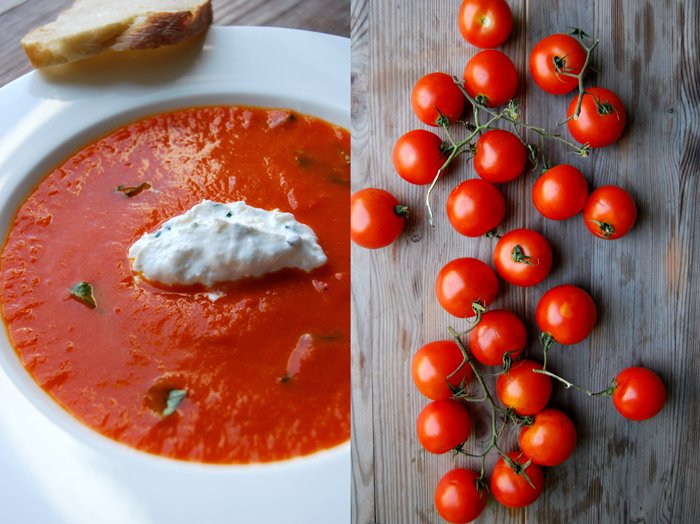
Tomato Soup with Basil and Goat Cheese Nocken
For 2 people as a main or 4 as a starter you need
ripe tomatoes, chopped, 1 kg / 2 pounds
broth 125ml / 5 ounces
garlic 2 big cloves
balsamic vinegar 1 tablespoon plus more to taste
a pinch of sugar
fresh basil leaves, roughly chopped, a small handful
salt and pepper
olive oil for frying
For the Nocken
fresh goat cream cheese 125g / 4.5 ounces
hard mountain cheese (like Appenzeller or Gruyère), finely chopped, 20g / 1 ounce
chives, snipped, 1-2 tablespoons
salt and pepper
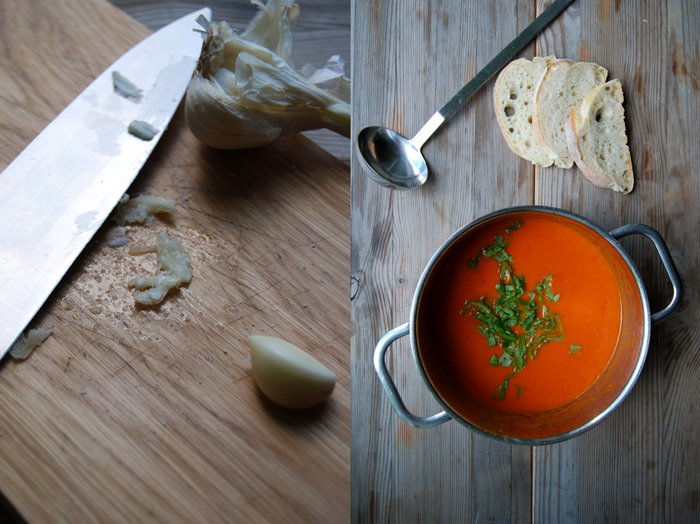
Rub the garlic with 1/4 teaspoon of salt under a big knife to a smooth paste.
In a big pot, heat a splash of olive oil, add the garlic paste and tomatoes and cook for 4 minutes on medium temperature (open). Add the broth, vinegar, sugar, salt and pepper and cook for 5 minutes (open). Take off the heat and purée with a stick mixer or in a blender. Season with salt, pepper and vinegar to taste and stir in the basil.
Mix the goat cream cheese, hard mountain cheese and chives, season with salt and pepper to taste. With a wet tablespoon form oval Nocken and place on top of the soup. Serve immediately.

Sicilian Sfincione with Tapenade
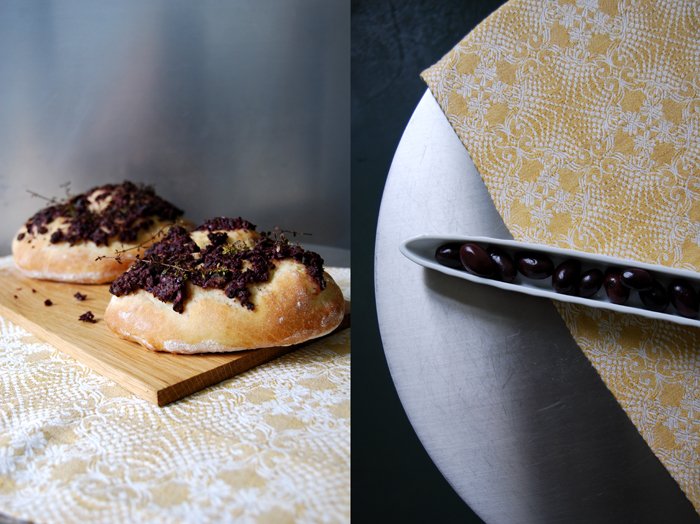
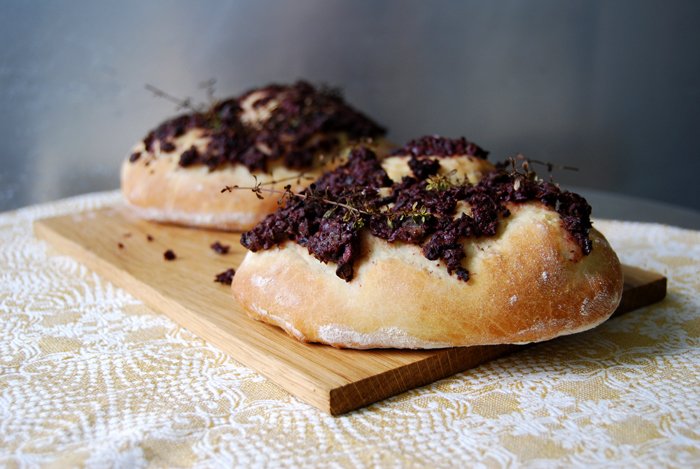
Forget thin and crisp, this pizza is thick and juicy! The Sicilian Sfincione is more like a focaccia, the dough is made with eggs and milk which gives it a bit of a sweet bread feeling. Its origin dates back to the late Baroque when the aristocratic Sicilian families liked to employ French chefs, the "Monzu" coming from the French Monsieur, some of them became famous Sicilian chefs. Here's the beauty of culinary exchange between two cultures, they influence each other, they don't confine each other but merge and evolve! If only cultural exchange was always so easy and well received!
In the beginning of the 18th century, these chefs started to influence Sicilian cuisine and left quite a few marks in the kitchen, also in the making of pizza. Eggs and milk, sometimes even butter, found their way into this famous dish and created completely different textures and tastes, like the popular Sfincione.
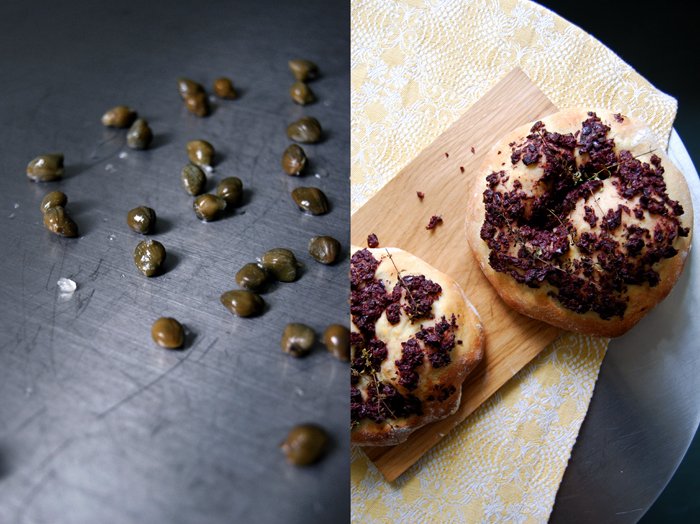
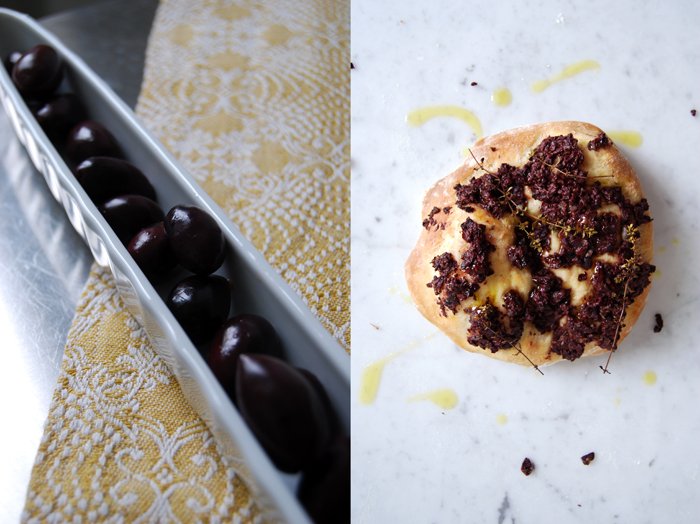
As there is already a French touch involved I thought I might as well continue working with it in the topping. I went for a rich Provençal tapenade made of lots of black olives, capers, anchovies, olive oil, brandy and lemon juice topped with thyme sprigs. It was great! This pizza is perfect for a picnic, as a starter or with a salad on the side. I love pizza, so much that I bake it every Sunday and this Sicilian variation is definitely a summer favourite!
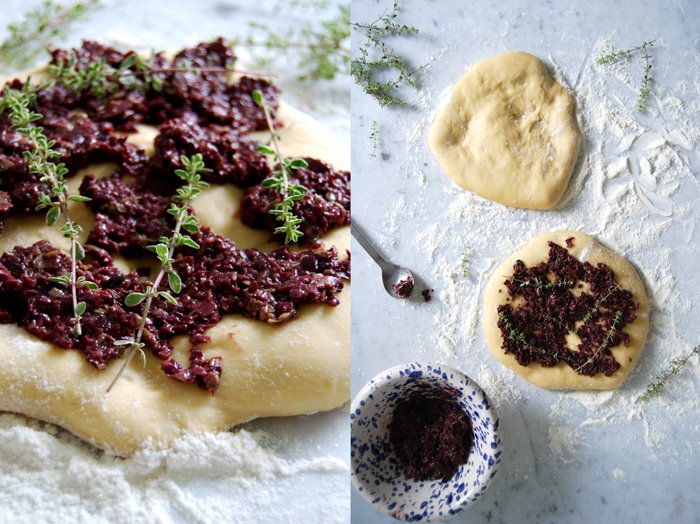
Sfincione with Tapenade
For 4 Sfincione (15cm / 6") you need
For the dough
plain flour 500g / 1 pound
dry yeast 1 package (for 500g / 1 pound of flour)
salt 1/2 teaspoon
organic egg 1milk, lukewarm, 250ml / 8.5 ounces
Combine the flour with the yeast and salt, add the lukewarm milk and egg and mix with your dough hooks for a few minutes. Continue kneading and punching with your hands until you have an elastic dough ball and put it back in the bowl. Cover with a tea towel and let it rise in a 35°C / 95°F warm ( top / bottom heat, no fan!) oven for 45 minutes.
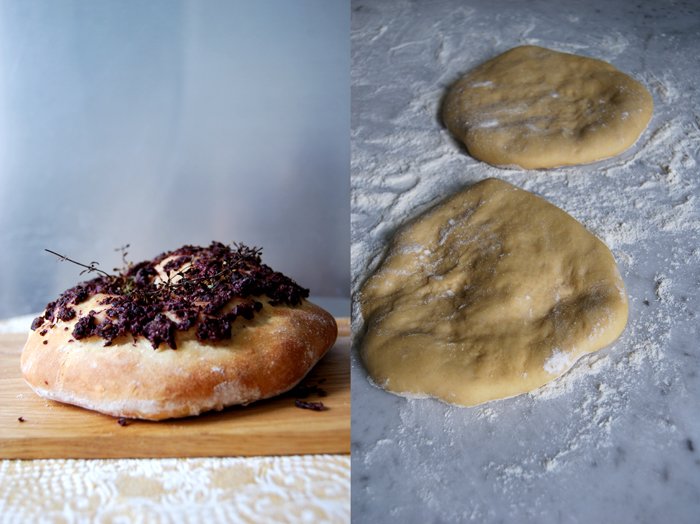
Divide the dough into 4, stretch into thick 15cm / 6" disks on a floured surface and cover with a kitchen towel. Let them rise while you continue the preparation for the tapenade.
For the tapenade
black olives 200g / 7 ounces
capers 40
anchovy, rinsed and dried, 2 fillets
olive oil 2 tablespoons plus more for sprinkling
brandy (or cognac) 2 tablespoons
freshly squeezed lemon juice 2 tablespoons
mustard 1 teaspoon
pepper
thyme 16 small sprigs for topping
Mix the ingredients for the tapenade in a blender and season with pepper to taste.
The Sfincione
Set the oven to 250°C / 480°F, my oven has a special pizza setting but you can use top / bottom heat as well. Line a baking sheet with parchment paper.
Spread a quarter of the tapenade on each pizza, put 4 thyme sprigs on top of each and bake for 6 minutes or until golden brown. Sprinkle with olive oil immediately and serve warm or cold.
Spinach and Melon Salad with Orange Mascarpone
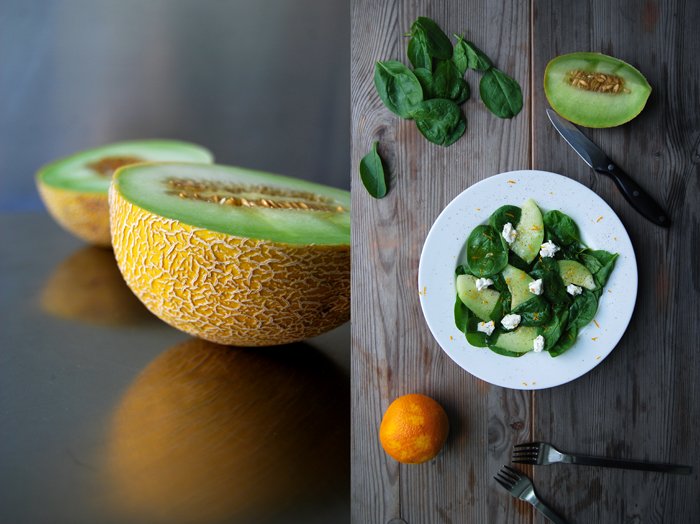
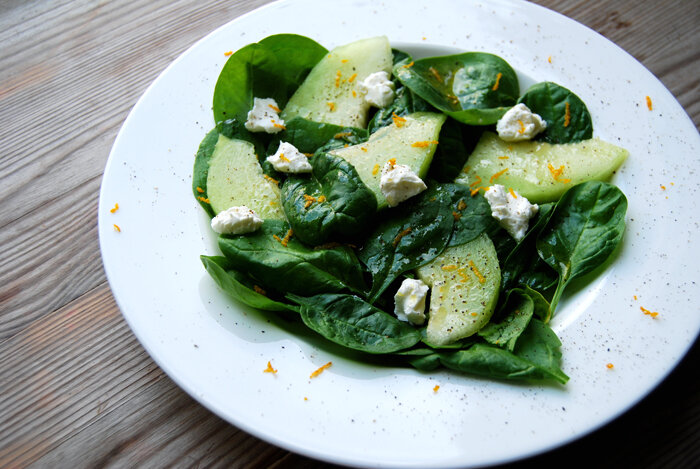
Crisp, young spinach leaves, sweet and ripe Galia melon, creamy mascarpone and a little orange zest becomes a delicious sweet and savory summer salad! It sounds a bit more exotic than it tastes, it's a very fresh and harmonious combination. The idea for it was born out of another recipe which didn't work out as I had expected. I felt like a salad made with melon and a milky flavour. At first, I mixed the melon with mozzarella di bufala but the result wasn't quite as pleasing as expected so I looked for another possible use for my juicy fruit. Spinach, mascarpone and orange, my second attempt was more successful and finally I was satisfied with my salad.
I just wanted a quick and light lunch so I spread a big handful of young spinach leaves on 2 plates together with a quarter Galia melon cut into wedges. I mixed 2 tablespoons of mascarpone with a little freshly squeezed orange juice and dolloped little pieces of it on top of the salad. For the dressing I whisked 5 teaspoons of olive oil with 3 teaspoons of orange juice, 2 teaspoons of balsamic vinegar and a little salt and pepper. I sprinkled the dressing on top of the leaves and fruit and finished it off with 1/2 a teaspoon of orange zest.
Sometimes you have to give your ideas a second try, change them a little but then you'll be rewarded. It definitely won't be the last time I make this salad!


Saffron Bread
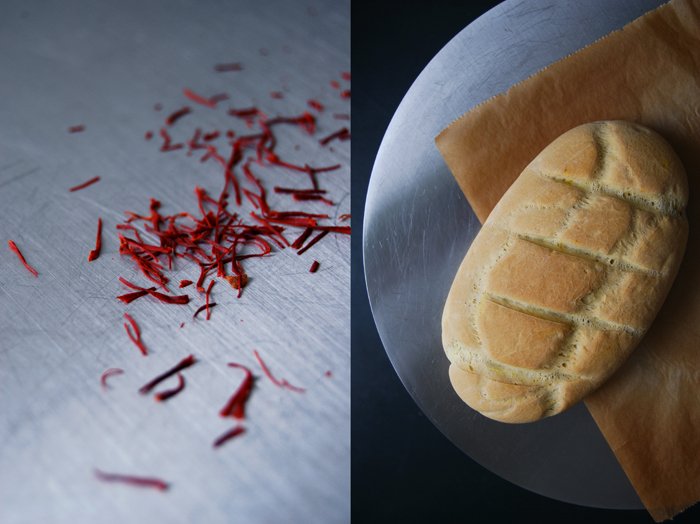
Here's the saffron bread I promised!
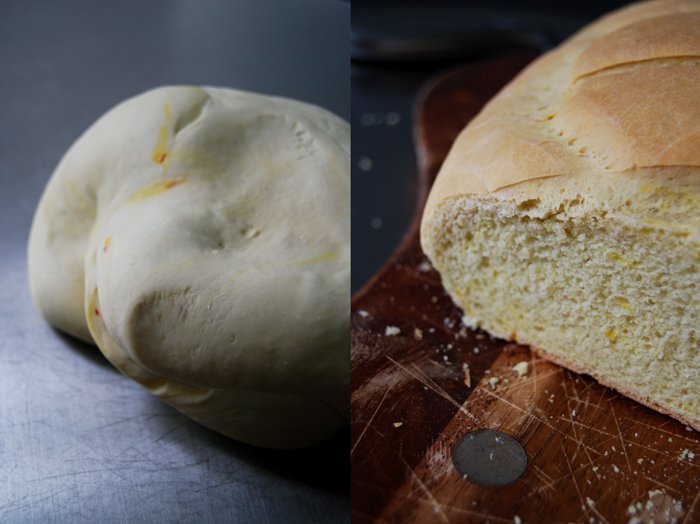
Let's start with the texture, it's juicy but light, a quality I love of all of my bread recipes, be it my Zucchini Bread, the Olive Loaf or my Potato Bread, but this one has a special aroma. It's made with one of the most precious and expensive spices, dried saffron threads. Only a very small part of the saffron crocus' flower is used for the production of this red spice, the three crimson stigmas growing at the end of the carpel. Lots of flowers, 150 - 200, are necessary to produce 1 gram of this treasure! Luckily, its aroma is so intense that a tiny amount is enough to refine other ingredients with its flavour.
For my bread made of a bit more than a pound of flour I used a pinch of saffron threads (around 1/5 teaspoon) to spread their unique taste. At first I was a bit worried that it wouldn't be strong enough for yesterday's sandwich, the Greek feta dip mixed with harissa and cayenne pepper had quite an impact of different flavours. To my surprise, the hot spiciness and the saffron complemented each other perfectly! It was a Greek reunion as antique mythology tells that the Greek God Zeus used to sleep on a bed covered in saffron.
Saffron Bread
For 1 big loaf of bread you need
plain flour 550g / 19 ounces
yeast 1 package (for 500g / 1 pound of flour)
salt 1 1/2 teaspoons
water, lukewarm, 230ml / 8 ounces
olive oil 4 tablespoons
a pinch of saffron threads (around 1/5 teaspoon)
Mix the saffron with 3 teaspoons of the water.
In a large bowl, combine the dry ingredients, add the olive oil, saffron liquid and the rest of the water and mix with your dough hooks for 5 minutes until well combined. Continue kneading with your hands for around 5 minutes until you have an elastic dough ball. Put the dough back into the bowl and cover with a tea towel. Let the dough rise in a 35°C / 95°F warm ( top / bottom heat, no fan!) oven for 60 minutes.
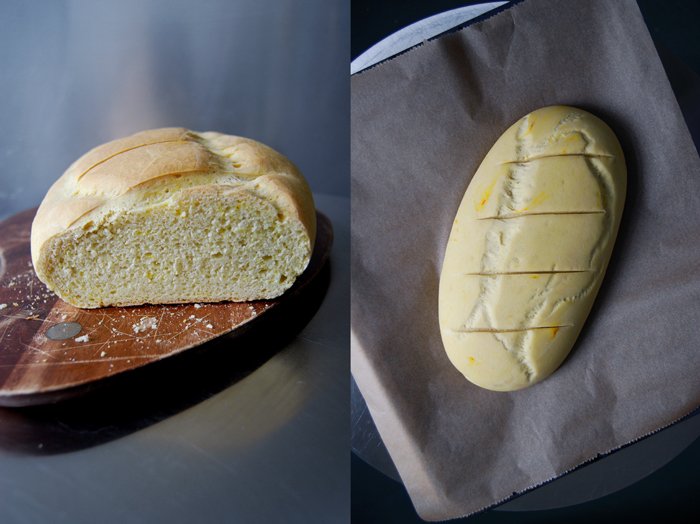
Take the dough out, punch it down and knead for 1 minute. Form 1 long loaf and put on a baking sheet lined with parchment paper. Cover with a tea towel and let it rise for 25 minutes in a warm place.
Set the oven to 225°C / 440°F.
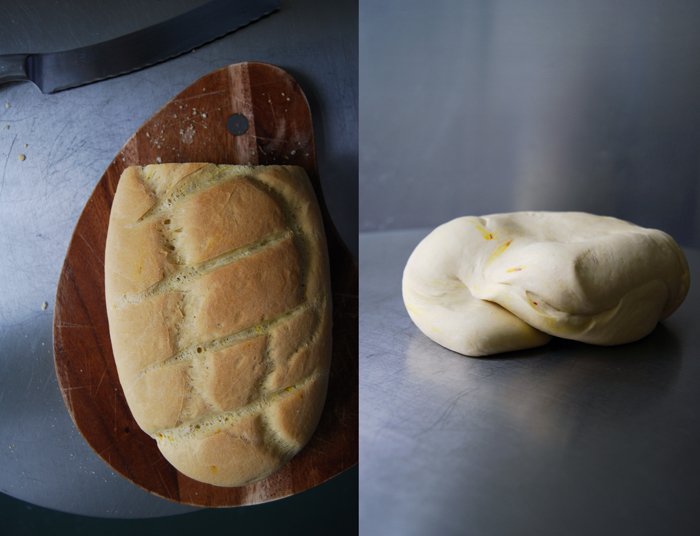
Cut 4 diagonal slashes into the bread and bake for 20 minutes or until cooked through. If you’re not sure if it’s done turn the bread around and knock on its underside, it should sound hollow. Let it cool for a couple minutes on a wire rack covered with a tea towel to soften the crust a bit.


A Greek Feta Dip with Harissa and Cayenne Pepper on Saffron Bread
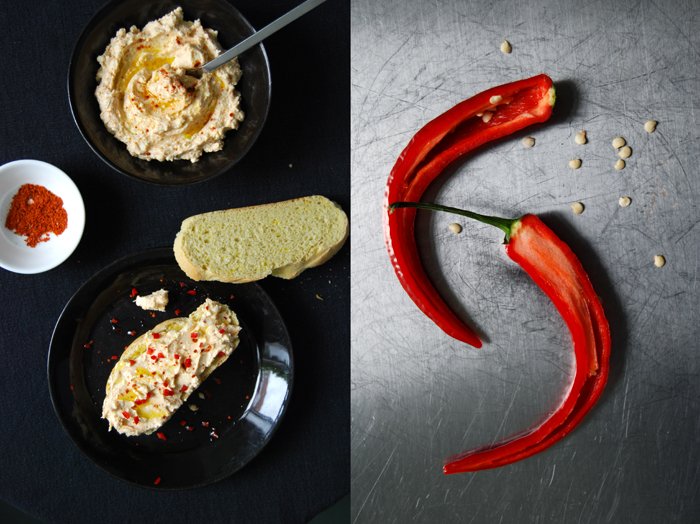
The Greek stand at the market pokes my weak spot for spreads and nibbles. Bowls full of stuffed vine leaves, bean salad, olives, dips and feta cheese in all kinds of variations, I could always buy a box of each of these delicacies and line them up on my long dining table. Together with some fluffy flatbread and a glass of red wine, this is as good as a holiday!
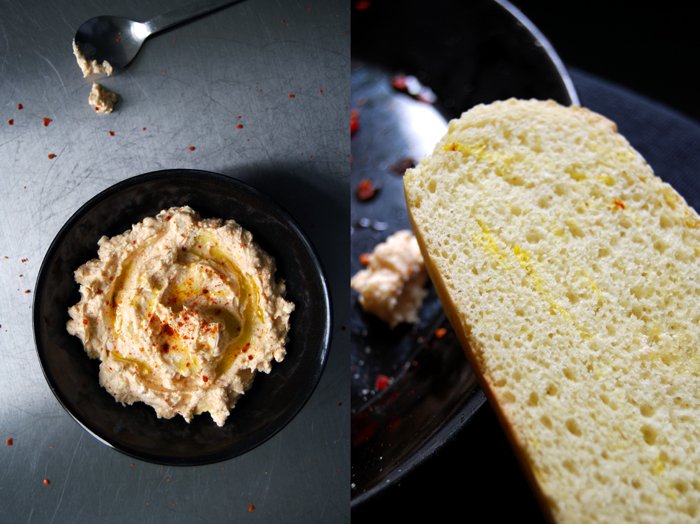
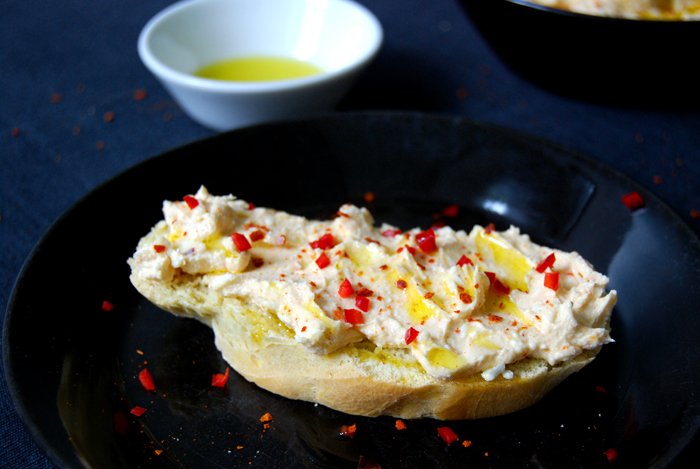
As much as I enjoy the convenience of just going there and choosing whatever my taste buds feel like, I also like to make my own feta dip with herbs, spices or olives. This time I go for a spicy spread with harissa, cayenne pepper and some fresh red chili peppers. It's accompanied by my wonderful loaf of saffron bread which I baked especially for this dip as I know and love its sandwich qualities. This yellow spice is strong but not overpowering and always manages to bring in its special flavour. The bread is very aromatic, spongy, juicy, it's so good that it doesn't really need a topping, some olive oil sprinkled on top is already heavenly. I could have left it at that but I like the combination of saffron and harissa, there wouldn't be a better bread for my dip, not even a greek flatbread from the market.
Tomorrow I will share the recipe for the saffron bread with you but here's my Greek feta dip with harissa and cayenne pepper (which tastes as good on any other tasty, fresh bread):
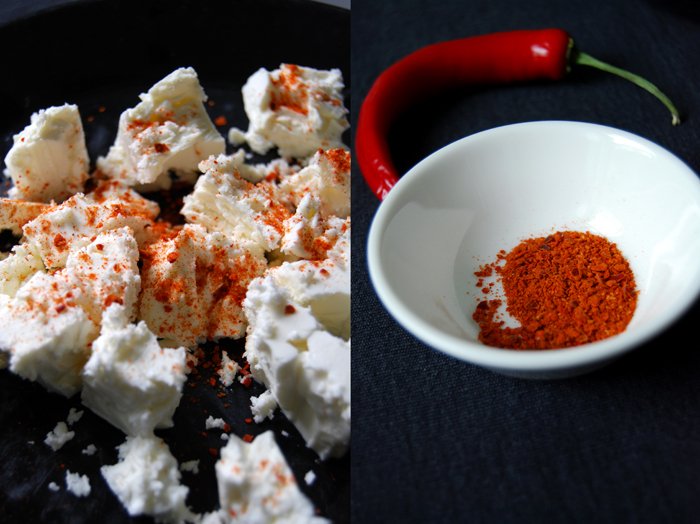
Mix 200g / 7 ounces of Greek feta cheese crumbled with a fork with 100g / 3.5 ounces of cream cheese, 4 tablespoons of olive oil and 1 tablespoon of heavy cream. Add 2 teaspoons of dry harissa spice mix and a pinch of cayenne pepper (or more if you like it hot and spicy) and whip with a fork. I didn't add any salt as the cheese makes it salty enough. Sprinkle with finely chopped fresh red chili pepper and some olive oil and spread voluptuously on a thick slice of bread. This dip is enough for 4 people as a starter, the 2 of us emptied the bowl in 2 days. It would be great for a picnic or barbecue as well!


Farfalle with Asparagus, Peas and Leek in Mustard Sauce
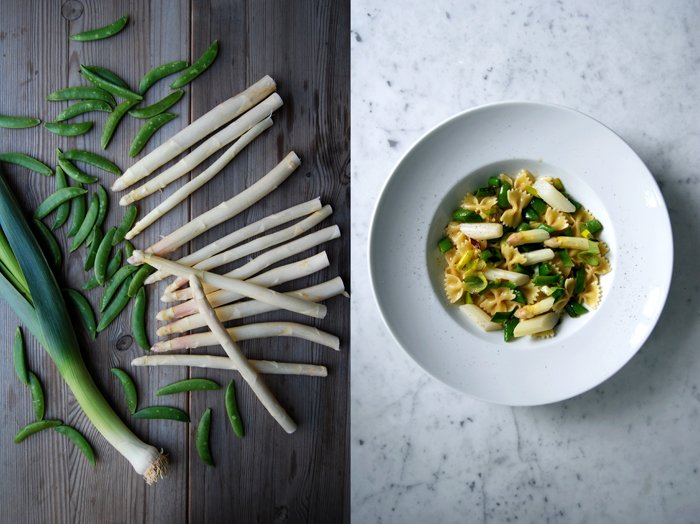
This is one of my oldest, most beloved and often cooked spring/ summer recipes. It's been with me for so many years and I still savour it as I did the first time I cooked it. It works both warm as a comfy pasta dinner with a glass of rosé wine, the windows wide open and the flowery smell of June in the air but also as a cold, summery picnic salad, enjoyed outside in the fields under the rustling leaves of a swaying tree.
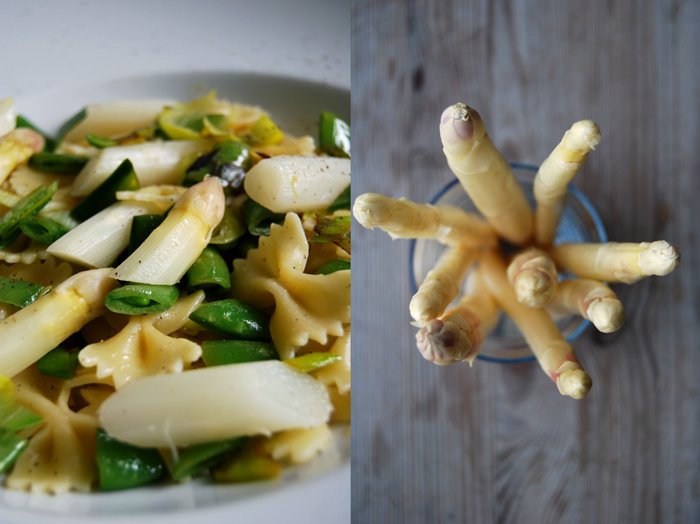
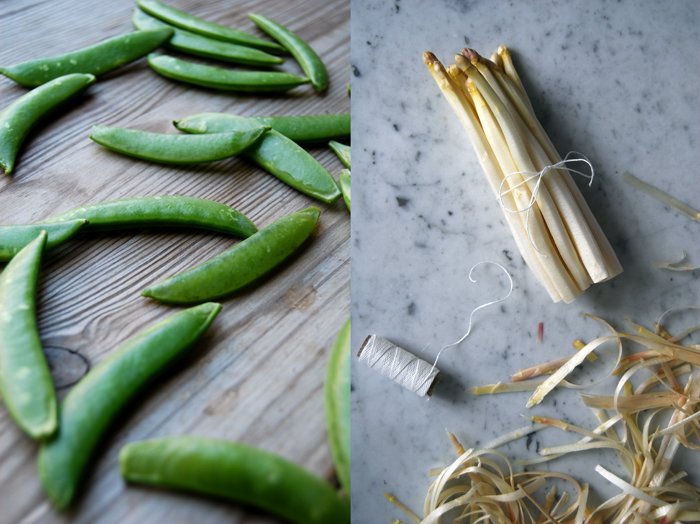
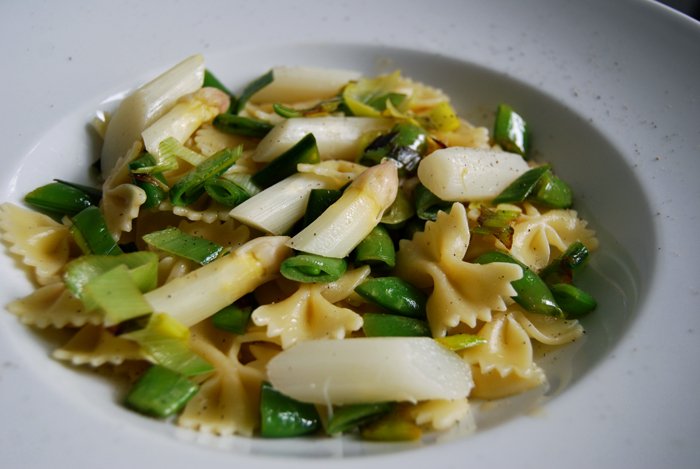
I'm talking about the wonderful combination of the fine flavours of white asparagus together with sweet peas in their crunchy pods, leek and a light sauce made with spicy Dijon mustard. All this on top of a big bowl of pretty Farfalle pasta, little bow-ties of perfect size and shape to catch all these nice vegetables like a shovel!
This meal tastes fresh and light and is absolutely easy to prepare. You just need to cook the asparagus (green or white), sautée the young pea pods and leek (you could also blanch some peas), deglaze them with white wine or vermouth and mix everything together with the cooked pasta, some mustard and cooking liquid, salt and pepper - that's it!
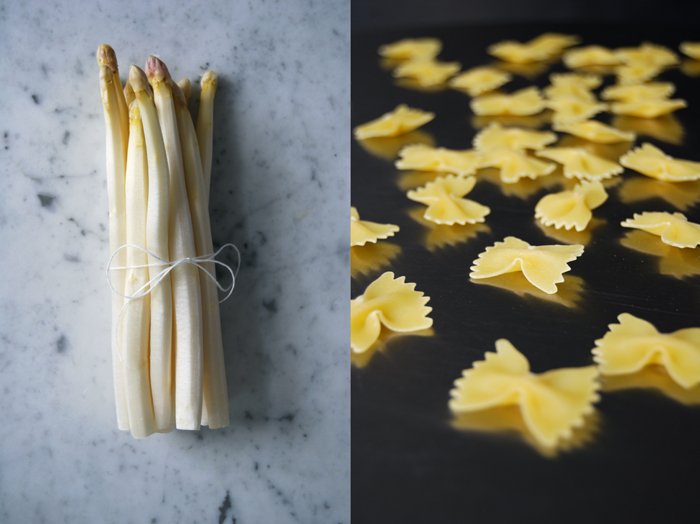
Farfalle with Asparagus, Peas and Leek in Mustard Sauce
For 2 people you need
Farfalle pasta, 200g / 7 ounces
asparagus (white or green), peeled (if necessary), bottoms cut off, 500g / 1 pound
young peas in their pods, cut into bite sized pieces, 150g / 5.5 ounces
leek, cut into slices, 1/2
water used to cook the asparagus 150ml / 5 ounces
Dijon mustard 2 teaspoons plus more to taste
white wine or vermouth for deglazing
salt and pepper
olive oil for frying
Cook the pasta al dente in lots of salted water.
Cook the asparagus al dente in lots of salted water with a pinch of sugar and cut into bite sized pieces.
In a large heavy pan, heat a splash of olive oil and fry the leek for a few minutes until soft and golden, add the pea pods and fry for another 1-2 minutes. Deglaze with a splash of wine, add the pasta, mustard and water used to cook the asparagus. Season with salt and pepper, add the cooked asparagus, mix and serve on big plates.
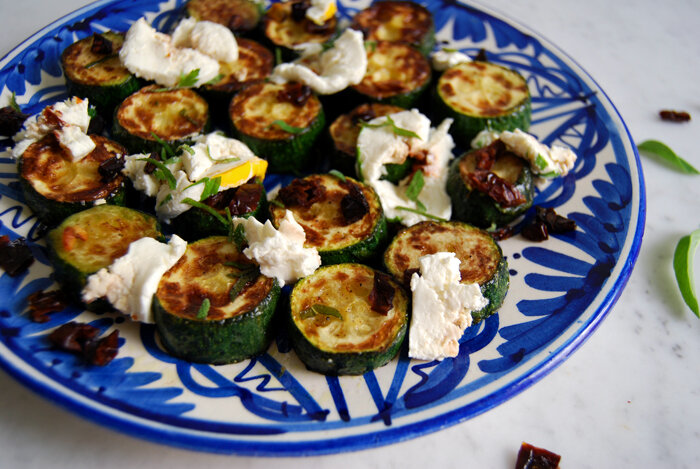
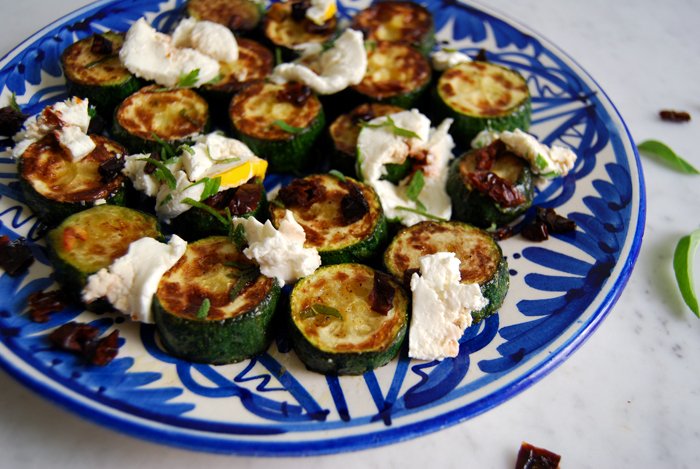
Juicy Zucchini Steaks with Dried Tomatoes, Sage and Chèvre

When I went to the market on Saturday I bought one of my favourite goat cheeses from a tiny stand run by a sweet lady who produces her own cheese. She just uses goat milk for her products and her display offers delicious soft chèvre rolls and creamy cheese balls coated in spices and herbs, with chili, herbes de provence, rosemary and basil. These soft cheeses are her absolute speciality, mild and milky with a soft hint of goat milk.
I planned to buy a plain cheese roll but a beautiful white chèvre covered in parsley leaves and pansy flowers caught my attention. The lady explained to me that it's filled with dried tomatoes, I was currious and forgot about my plain cheese immediately. I tried it, liked it and bought it! My plans for dinner involved golden sautéed zucchini cut into thick round steaks, juicy inside but far away from soft and soggy, topped with fresh goat cheese and sage. My find at the market inspired me to add some dried tomatoes, it was a good choice, the Mediterranean flavours were great together with the mild goat milk!
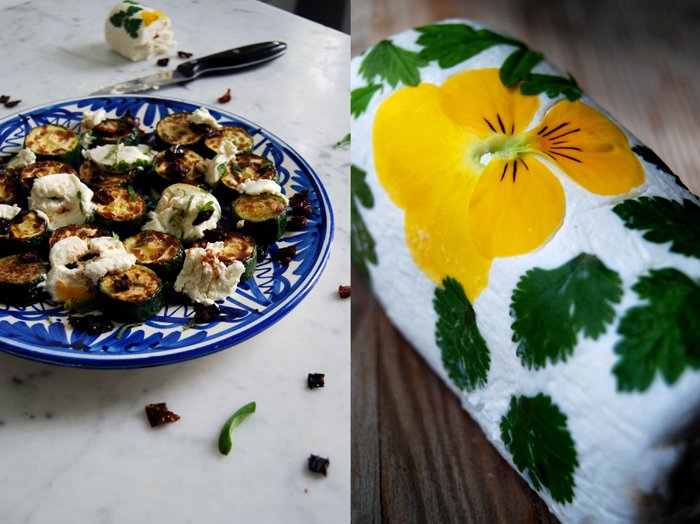
Zucchini Steaks with Dried Tomatoes, Sage and Chèvre
For 2 people you need
zucchini, cut into 1,5cm / 1/2" steaks, 300g / 10.5 ounces
garlic, thinly sliced, 1 clove
chèvre/ soft goat cheese, thickly sliced, 70g / 2.5 ounces
dried tomatoes, cooked in a little boiling water for 1 min, rinsed, dried and chopped, 1 1/2 -2
sage leaves, thinly sliced, 5
olive oil for frying
salt and pepper
In a large pan, heat a splash of olive oil together with the garlic and fry the zucchini on high-medium temperature for a few minutes until golden brown on each side. Add the cooked dried tomatoes and sage, season with salt and pepper and fry for 1 minute. On a plate, pile the zucchini steaks on top of each other and let them sit for 1 minute, that makes them a bit softer and juicy. Spread them on a big plate and place the chèvre on top of the warm zucchini and sprinkle with the dried tomatoes and sage from the pan.


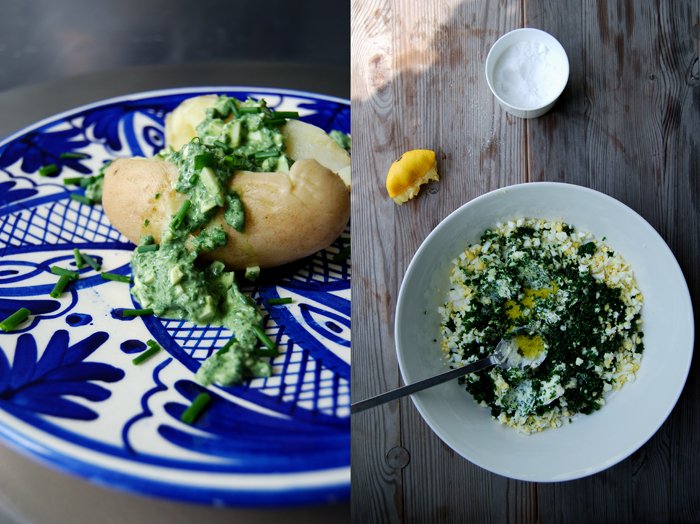
Frankfurt Green Sauce - 7 Herbs and Spring Potatoes
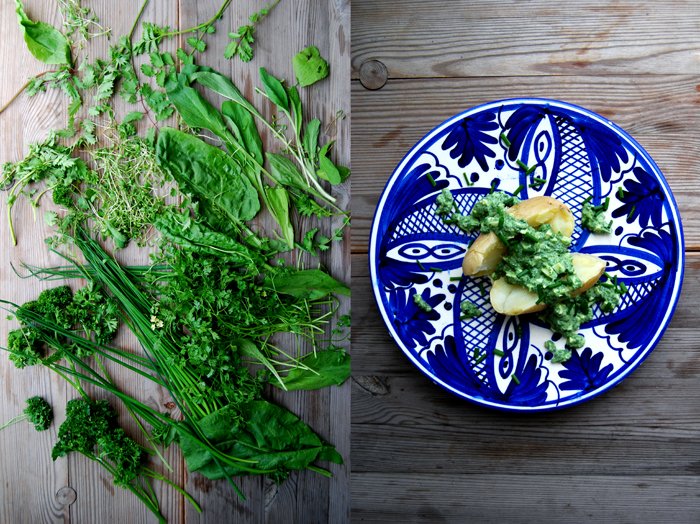
Sorrel, borage, chervil, burnet, parsley, chives and garden cress, these are the 7 herbs which make up the traditional Frankfurt Green Sauce. Similar to the Italian Salsa Verde or the French Sauce Verte, which are also mainly made of herbs, the famous German version is made of greens growing in the Frankfurt area. Legend has it that the origin of the green herbal sauce is in the Orient and it was brought to Europe by the Romans more than 2000 years ago, enough time for each region to create their own, unique recipes. Apart from the right selection of herbs, there isn't "one" recipe for this sauce from Frankfurt. They all vary, some add heavy cream, sour cream, yoghurt or mayonnaise, some are made with onions, garlic or mustard, but most involve a hard boiled egg.
I developed my own recipe a few years ago when I used to live close to the city of the sauce's origin. To me, the sauce needs 2 crumbled hard boiled eggs, sour cream, olive oil, lemon juice, a little heavy cream for some sweetness, white Balsamico vinegar and salt and pepper, but the focus is definitely on the herbs, you need a lot, 200g / 7 ounces in total!
Traditionally the cold sauce is eaten with boiled spring potatoes, some serve it with cold meat but I prefer to keep it simple and light, the sauce is so fragrant and aromatic that the mild potatoes fit just perfectly.

Frankfurt Green Sauce with Spring Potatoes
For 2-3 people you need
medium sized potatoes, boiled and peeled, 4-6
For the sauce
mixed herbs (sorrel, borage, chervil, burnet, parsley, chives and garden cress) 200g / 7 ounces
organic eggs, hardboiled, chopped finely, 2
sour cream 5 tablespoons
olive oil 2 tablespoons
freshly squeezed lemon juice 2 tablespoons
heavy cream 1 tablespoon
white balsamic vinegar 1 tablespoon
salt and pepper
Chop the herbs with a knife finely or mix in a blender. Put the herbs in a big bowl and add the eggs, sour cream, heavy cream, olive oil, lemon juice and vinegar and stir until combined. Season with salt and pepper to taste and serve on top of the potatoes.



Kalamata Olive and Cottage Cheese Sandwich
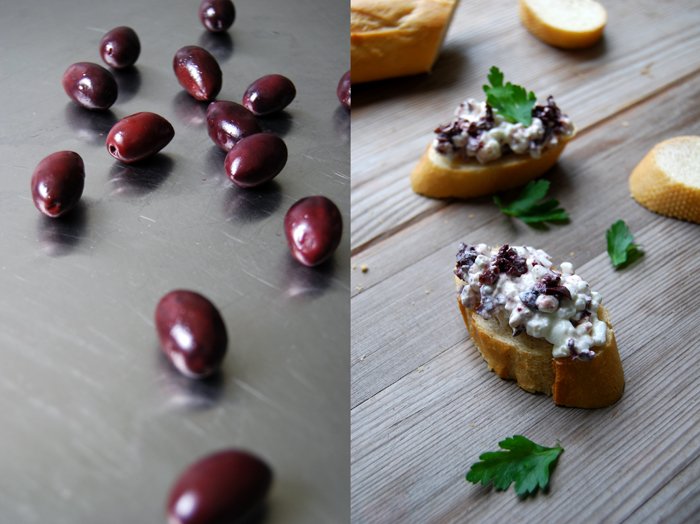
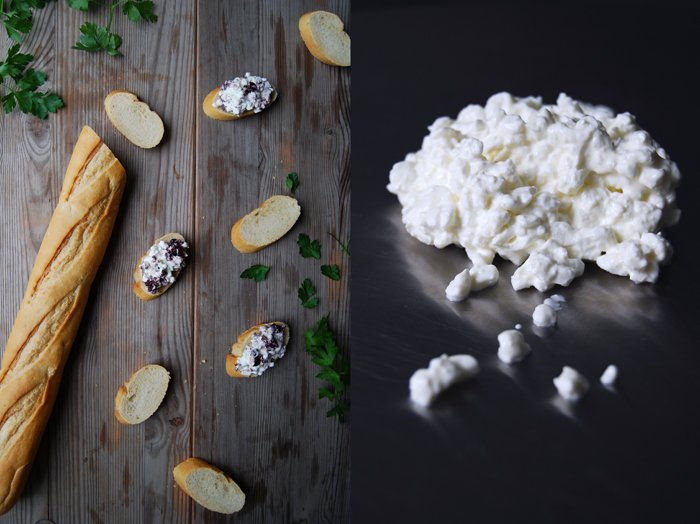
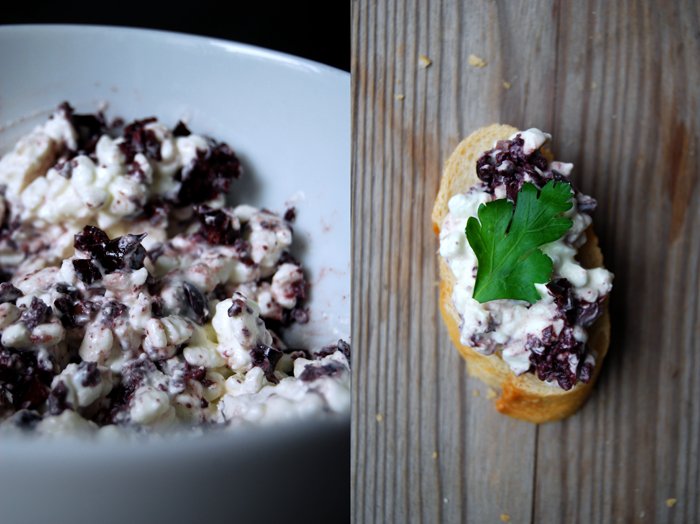
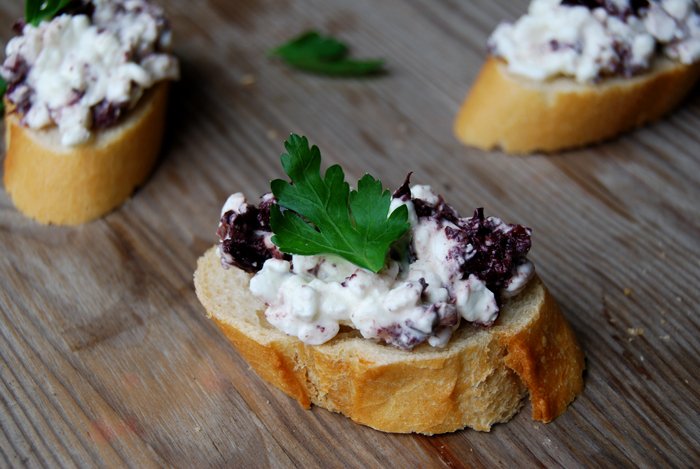
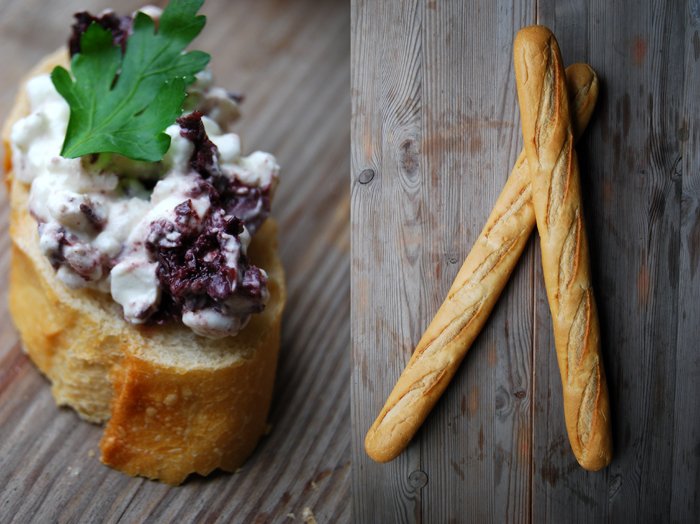
Creamy cottage cheese mixed with dark purple Kalamata olives, garlic, herbs, Balsamico vinegar, that's what I had in mind when I started my sandwich preparations. My plan changed abruptly as soon as I stirred the chopped olives into the crumbly cottage cheese, I stopped turning the spoon before the oily black mixture blended into the creamy white, the contrast looked so beautiful! I tried some of this puristic spread and I was so impressed by its intensity and simplicity that I dropped everything. This combination is too good, Kalamata olives (to me, they are the best black olives in the world!) plus cottage cheese, no distraction, no further addition, just a few slices of fresh baguette and one parsley leaf on top, that's all it needs! This is the quickest and most simple recipe I've made so far for my Sandwich Wednesday and it's already one of my favourite sandwiches!
If you're looking for a quick snack, a picnic treat, an easy dinner or just a nibble with some crackers, pull out some cottage cheese (200g / 7 ounces) and mix briefly with 50g / 2 ounces (or more) of chopped Kalamata olives. You could use other black olives as well but the large Greek fruits from the Peloponnese region have a wonderful aroma, exactly what you need if you mix only two ingredients. I didn't want to over mix it, I only stirred it twice before I spread the cheese on tiny slices of baguette. The green fleshy parsley leaves on top finished it off and added a fresh taste to this composition. I loved it so much that I ate one slice after the other, it was just enough for 2!

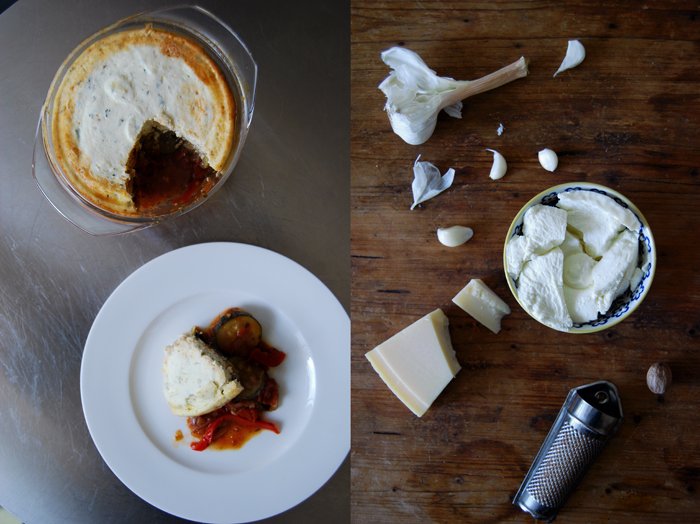
Zucchini, Bell Pepper and Aubergine Moussaka with Lemon Ricotta
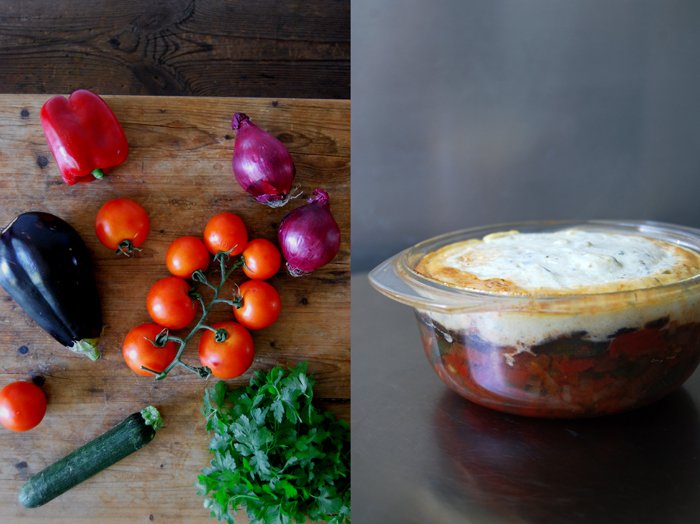
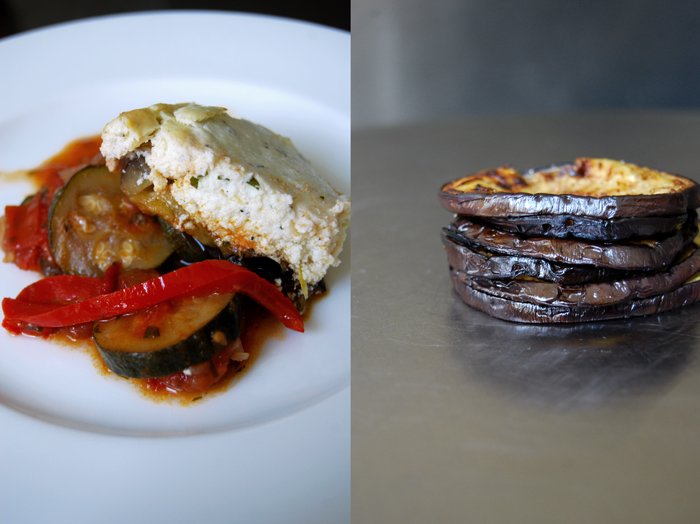
My Moussaka, truth be told, is a fruity ratatouille baked with a fluffy lemon ricotta soufflé on top. The traditional Greek Moussaka is made with a Béchamel sauce which I'm not too fond of. I like this creamy sauce in my lasagna or cannelloni but that's it. The ricotta tastes much lighter, enhanced with lemon zest, nutmeg, parmesan and fresh basil, it gives this dish more of a summer feeling. Contrary to the Greek version, I kept mine vegetarian, there's no minced meat involved, just zucchini, bell pepper, tomatoes, red onions, lots of parsley and a velvety layer of fried aubergine slices in between the vegetables and the cheese. It stops the ricotta from running into the juicy ratatouille.
When I cook a ratatouille I always make a big batch. This moussaka is perfect as a second day dish for ratatouille leftovers. Topped with the ricotta it just has to bake in the oven for half an hour, great if you have friend's over for dinner and not much time for preparations! I baked it in small casserole dishes closed with a lid so that each of us could have our own little pot.
Zucchini, Bell Pepper and Aubergine Moussaka with Lemon Ricotta
I bake the Moussaka in two 12,5cm / 5" casserole dishes with lids, you could use a big one instead but you may have to bake it a bit longer for the ricotta to set.
For 2-3 people you need
small aubergine, sliced into circles, 1
zucchini, sliced into circles, 1
red bell pepper, thinly sliced, 1
big red onion, quartered and thinly sliced, 1
big tomatoes, chopped, 4
garlic, thinly sliced, 3 cloves
parsley, chopped, 2 tablespoons
balsamic vinegar 2 tablespoons plus more to taste
olive oil for frying
salt and black pepper
For the topping
ricotta 260g / 9 ounces
organic eggs 2
Parmesan, grated, 30g / 1 ounce
small basil leaves, chopped, 30
lemon zest 1 teaspoon
lemon juice 1 teaspoon plus more to taste (I also added a little of the liquid of my Moroccan preserved lemons)
nutmeg, ground
salt and pepper
Spread the slices of aubergine on a baking dish and sprinkle with salt on both sides to pull some of its water out. Let it sit for around 15 minutes, rinse the slices and dry between kitchen roll paper. In a large heavy pan, heat a splash of olive oil and fry the aubergine for a few minutes on both sides on medium temperature until golden and soft, add a little more oil if necessary. Season with salt and pepper and set aside.
In a large pot, heat a splash of olive oil and fry the onion for a few minutes until golden and soft. Add the bell pepper and garlic and fry for 2 minutes before you add the zucchini. Fry the vegetables for 2-3 minutes and deglaze with 2 tablespoons of balsamic vinegar. Add the tomatoes, season with salt and pepper and cook for 10 minutes. Add the parsley and season with balsamic vinegar, salt and pepper to taste.For the topping, mix the ricotta, eggs, parmesan, basil, lemon zest and juice and season with nutmeg, salt and pepper to taste.
Set the oven to 200°C / 390°F top/ bottom heat.
Divide the vegetables between the 2 casserole dishes, cover with 3-4 slices of aubergine and spread the ricotta mixture gently on top. Cover with lids and bake for around 35 minutes until the ricotta mixture is set.

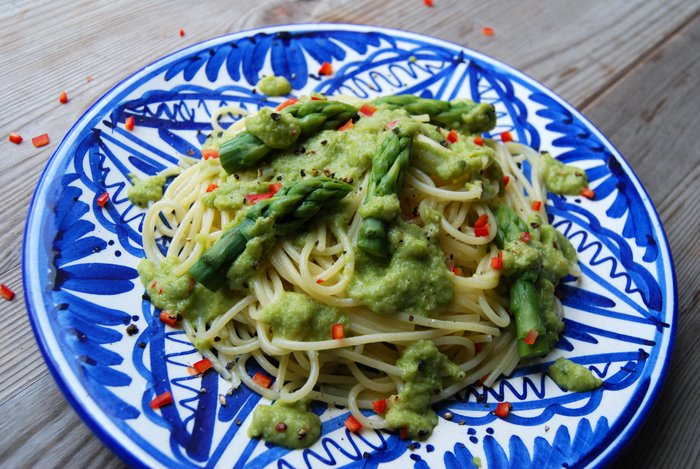
Spaghetti with Green Asparagus Anchovy Pesto
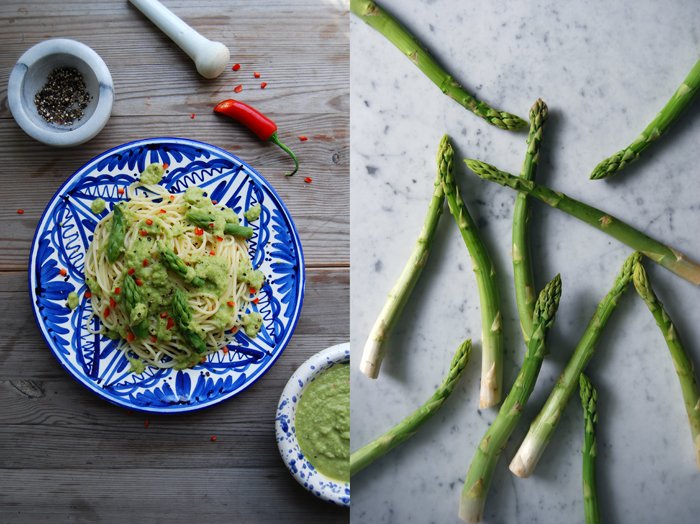
Asparagus season could be extended for months if it were up to me! So many recipes bring out different sides of this vegetable, be it green or white asparagus, it's so versatile thanks to its strong taste.
So here’s an asparagus pesto, light and fresh with a smooth texture, almost velvety. The preparation is the same as the broccoli pesto I made in March, the cooked vegetables are mixed with some of the water they are cooked in. I added garlic, fresh hot chili peppers, tarragon (my herb of the month) and anchovies. The fish adds subtle saltiness, which really makes this composition complete. I once made this pesto without the fish as I had run out and it really wasn't as good. I use 4 anchovies for 500g (1 pound) of asparagus, I originally started with just 2 when I made it the first time. I thought they would be too strong for the pesto but sometimes in cooking you shouldn't be shy, being bold and brave is the key to success!
For more asparagus recipes, click here!
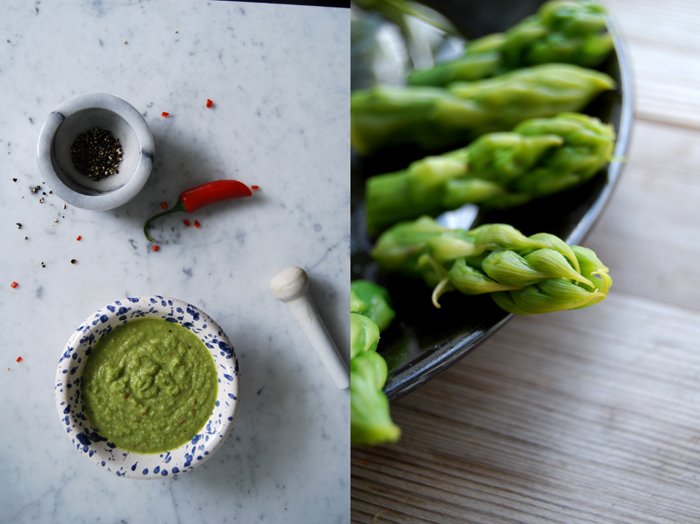
Spaghetti with Green Asparagus Pesto and Chili Peppers
For this meal it’s best to warm up the plates in the oven.
For 2 hungry people you need
spaghetti 200g / 7 ounces
green asparagus, the woody bottom part cut off, 500g / 1 pound
water used to cook the asparagus 30ml / 2 tablespoons
olive oil 60ml / 1/4 cup
freshly squeezed lemon juice 1 tablespoon
anchovy preserved in salt, rinsed and dried, 4 fillets
garlic, crushed, 3 cloves
tarragon 12 leaves
fresh red chili pepper, finely chopped, 1, half for the pesto the rest for topping
salt and pepper
Cook the spaghetti al dente.
In a large pot, cook the asparagus in lots of salted water for 7 minutes. Keep the water, take the asparagus out with a slotted ladle and cut into 3cm / 1″ pieces. Set the heads aside and leave for the topping.
Purée all the ingredients for the pesto in a blender (except the asparagus' heads and the chili peppers for the topping). Season with salt (carefully, I didn't need to add any because of the salty fish), pepper and lemon juice to taste.
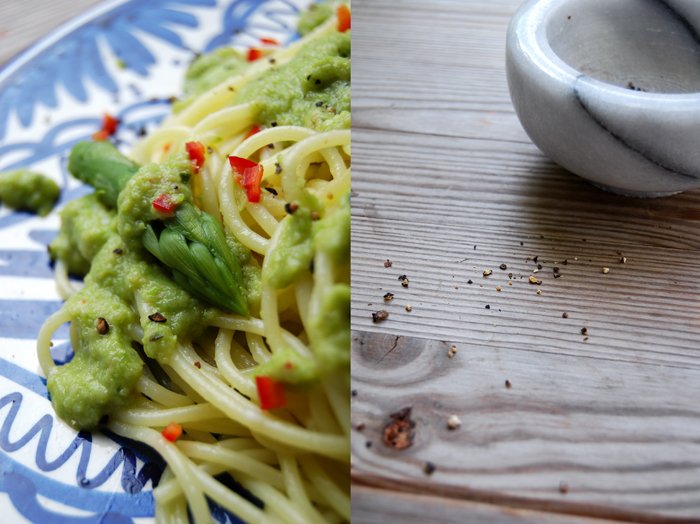
Arrange the spaghetti, pesto and asparagus' heads on the warm plates and sprinkle with chili and crushed black pepper.

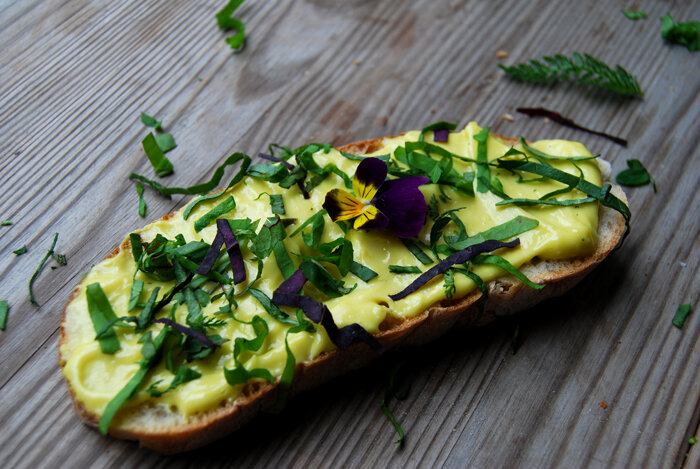
Aïoli and Wild Herbs Sandwich
When I went to Ibiza for the first time I got absolutely hooked on aïoli, I ate it every single day! It's more than twenty years ago and I had just turned thirteen. I was so happy to spend some time with my best friend at her parent's holiday home, it felt exciting to be on this island which is so famous for its parties (which I couldn't join as I was still too young)! I especially enjoyed the nights out at all the amazing restaurants we visited together, I have always loved Spanish food, tapas and barbecues, but in those days I was particularly fond of Ibiza's traditional appetizer, fresh bread and aïoli. In Spain, people usually go to restaurants quite late, at 9 or 10 in the evening, by that time I was already starving. As soon as we sat down and a basket full of warm bread and a bowl of creamy aïoli was brought to the table, nothing could stop me from emptying both!
It took me a while to make my own aïoli, a few years ago we had friends over from Barcelona and they introduced me to the traditional dip's secrets. It's surprisingly quick and easy to prepare:
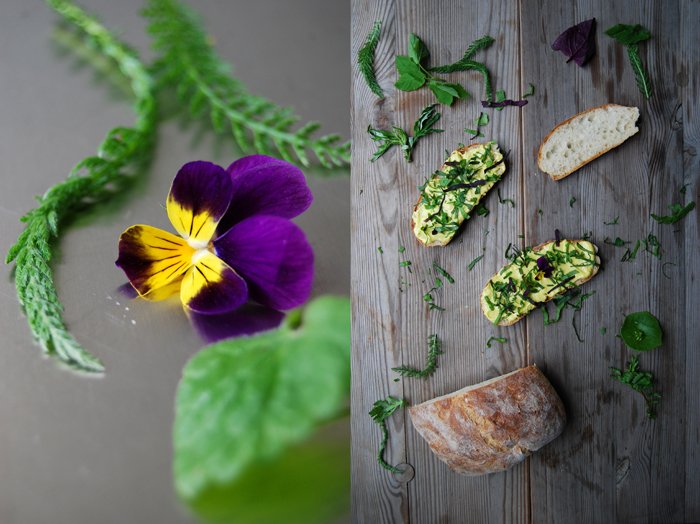
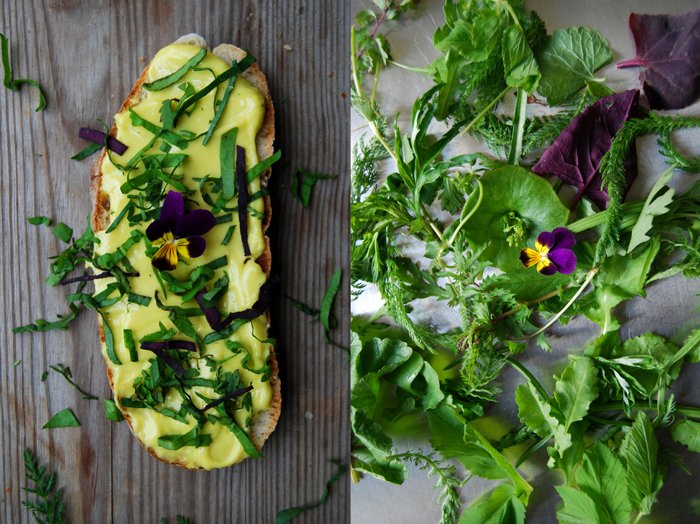
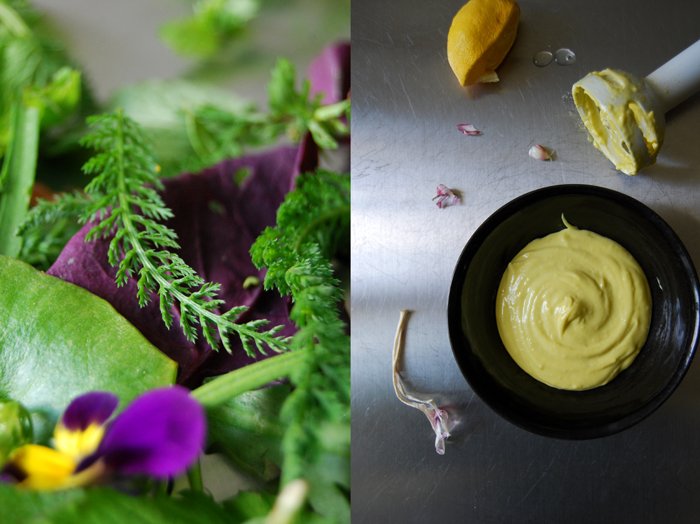
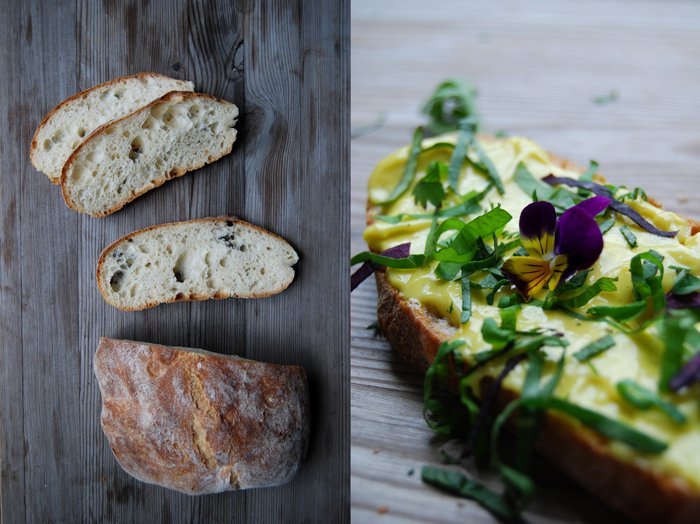
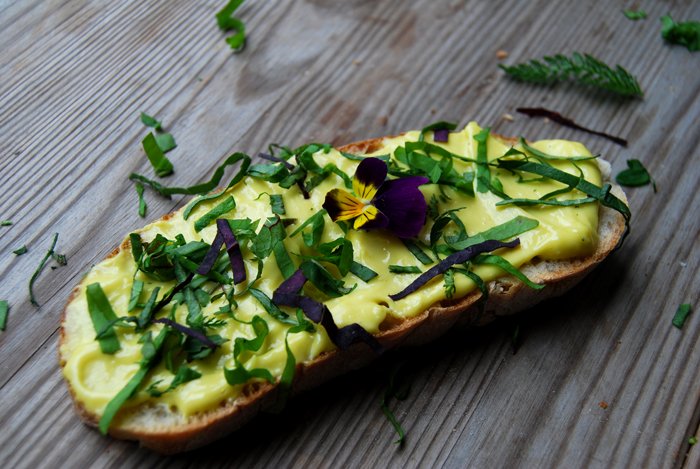
For 4 sandwiches you drop 2 egg yolks into a mug which should be just big enough for a stick mixer to fit in it. You mix 3 crushed cloves of garlic with 4 teaspoons of freshly squeezed lemon juice in one bowl, and measure 100ml / 3.5 ounces of good quality olive oil in another. Pour 1/4 of the oil onto the egg yolks and start mixing with the stick mixer, add more oil and the lemon garlic mixture, a little at a time, mixing constantly. When the dip is thick and creamy season with salt. Spread on 4 thick slices of white bread and sprinkle with mixed wild herbs. I found a fantastic mixture of wild herbs which I don't use often, saltbush (orache), burnet, rucola, pigweed, edible chrysanthemum, yarrow, cheeseweed and chickweed. Every bite brought in new flavours, all strong and delicious together with the aïoli!

A warm Salad with Artichokes in Vermouth
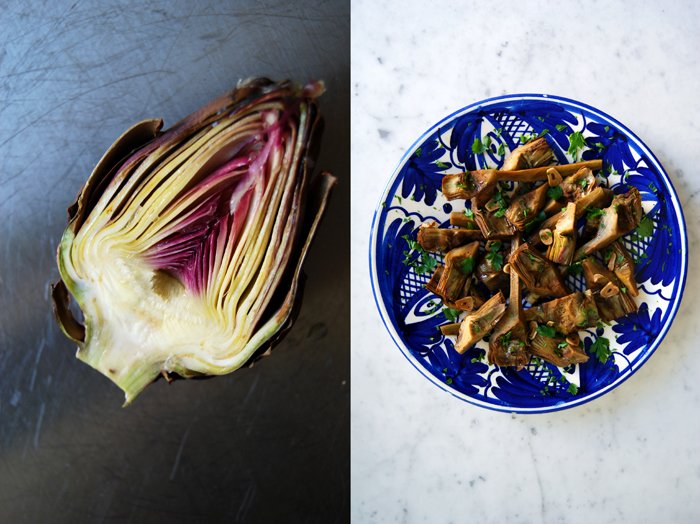
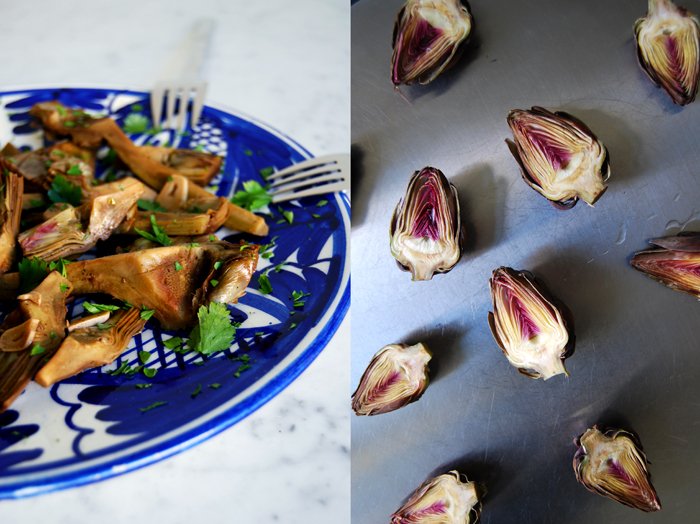
Artichokes seem to follow me in the past few weeks, even when I don't buy them they end up in my kitchen. I got a bag full of beautiful purple baby artichokes as a gift, the tiniest I've ever seen. A friend of mine had bought too many and knowing that I use everything that finds its way into my space she was happy to pass them over to me. I had already made plans for dinner but the vegetables couldn't wait a day longer. When I looked at them, a warm salad came to my mind, a little snack in between. I imagined them sautéed and deglazed with vermouth and some parsley on top, so I brought out my pan and started the cooker.
As a starter for 4 you need 6 small baby artichokes. Cut off the artichoke stem if it’s too woody and pluck the hard outer leaves. Cut the artichoke’s tip off (1/3 – 1/2 of the artichoke), quarter them and scoop out the hairy choke. Keep the prepared artichokes in a bowl of cold water and the juice of half a lemon while you’re finishing the rest.
Sautée the prepared artichokes in a large heavy pan in a dash of olive oil and 2 tablespoons of butter for about 5 minutes together with 1 thinly sliced clove of garlic. Deglaze with 75ml / 2.5 ounces of vermouth and season with salt and pepper. Add 75ml / 2.5 ounces of water and 1 tablespoon of freshly squeezed lemon juice and let them simmer on a medium heat for about 10 minutes until al dente. Sprinkle with roughly chopped parsley and season with salt and pepper to taste.



Gratin with Cauliflower and Garlic Mashed Potatoes
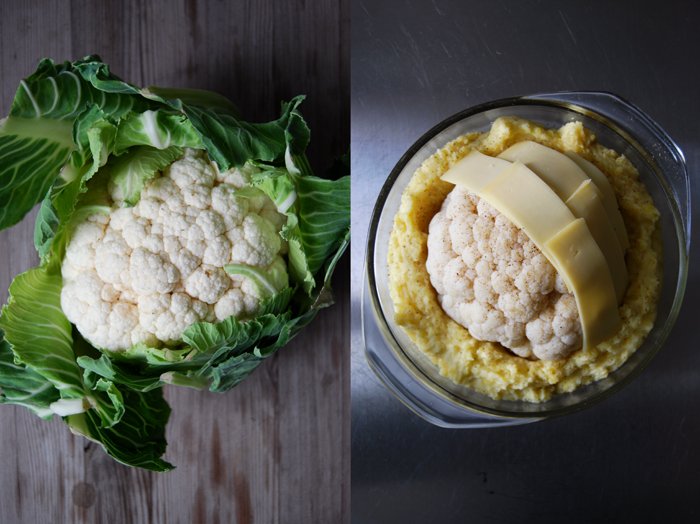
This is a recipe my father used to make for us when we were children. We all loved it because of the cheese and mashed potatoes! I still do as it's one of the few dishes made with cauliflower that I really like.
When I wrote about my ginger, lemon and cauliflower soup I mentioned that I don't use this pretty white cabbage so often in my kitchen, I only like it in a few combinations. I don't have anything against its unique taste, it just needs the right treatment to bring out its sweet side. The mashed potatoes are a good choice, seasoned with nutmeg which I also use for the cauliflower to refine its taste, they are a good match. I didn't want to disturb the mild flavours in the gratin so I picked a soft cheese for the crunchy crust, not too ripe and overpowering. I used a hard Gouda, this Dutch cheese melts well and develops a nice crust under the grill, it's also the cheese my father used for this meal.
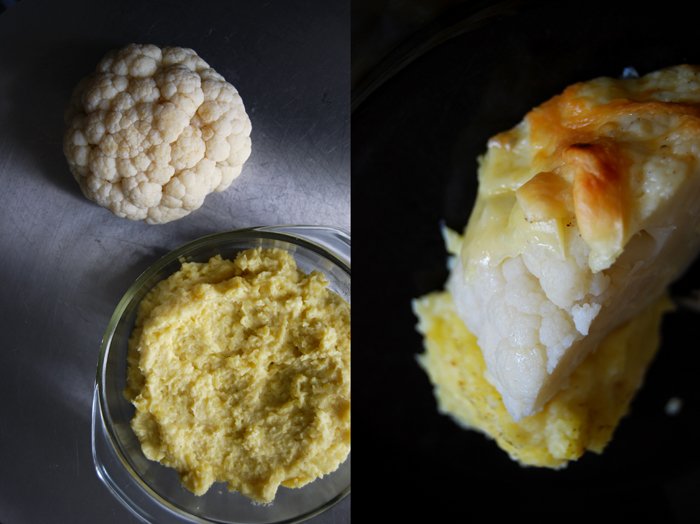
This recipe is very simple to prepare, a whole cauliflower cooked in one piece, pushed into creamy mashed potatoes and baked with cheese to a golden gratin. If you need a quick dinner for a handful of people, this is the perfect choice!
Gratin with Cauliflower and Garlic Mashed Potatoes
For 4 people you need
a whole cauliflower, around 700g / 25 ounces
potatoes, peeled, 650g / 23 ounces
garlic, in its skin, 3 big cloves
milk 200ml / 7 ounces
butter 50g / 2 ounces
nutmeg, freshly ground
salt and black pepper
hard cheese (Gouda, Emmentaler or cheddar), thinly sliced, 100g / 3.5 ounces
Cook the potatoes together with the garlic in salted water for 20 minutes. Rinse the potatoes under cold water for a few seconds and peel the garlic. Mash the potatoes together with the garlic, milk and butter, whisk and season with salt, pepper and nutmeg to taste.
Cook the cauliflower in lots of salted water al dente (around 10 minutes), it should be soft with bite without falling apart.
Scrape the mashed potatoes into a baking dish, put the cauliflower on top and push it down. Season the cabbage with salt, pepper and nutmeg and cover it with the cheese. Bake under the grill for a few minutes until golden brown, bubbly and crisp, slice like a cake and serve immediately.


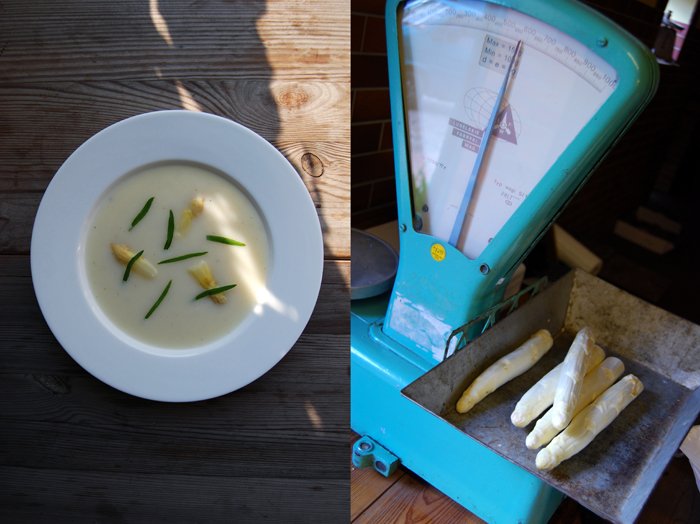
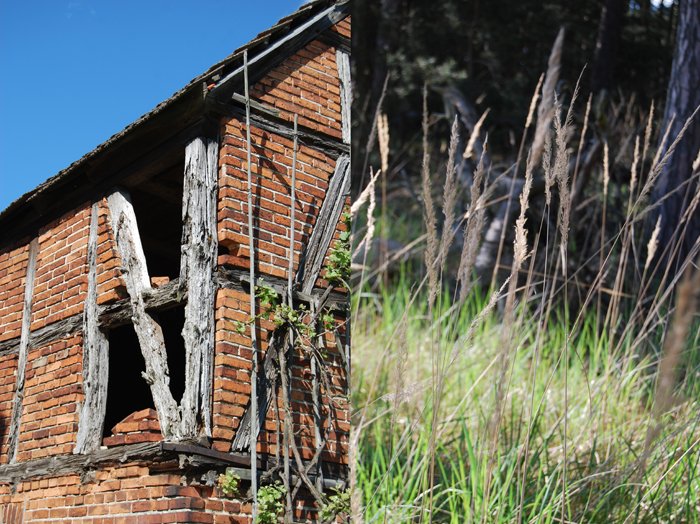
A Field in the Forest, Beelitz and Asparagus Soup

A couple weeks ago I had a conversation about asparagus with my aunt and uncle, we talked about the various tastes depending on the vegetable's origin. The soil, the climate and weather have such a big influence on these delicate stems. I've enjoyed great asparagus in my life, green and white, but we agreed that the best is from Beelitz, an area 50 km (30 miles) outside Berlin. I always wanted to visit to see the large fields covered in foil keeping them dark, to watch the harvest and buy my asparagus directly from one of the farmers.
It's May, the seasonal peak for asparagus and there's no time to wait any longer! A few days ago we got on a train heading South-West to search for the famous Beelitz asparagus fields. We took our bikes with us to explore some of the quiet and hidden corners of the countryside, the forest and the fields and I can say that we found what we were looking for, asparagus heaven!


We got off the train at a tiny station, an old timber framed house which seemed abandoned for years. We noticed that we were the only travelers on the platform, we were happy about that and enjoyed the silence. When you live in the city the absence of noise is one of the biggest luxuries! The early afternoon sun felt just right, soft and warm, we jumped on our bikes, excited to start our trip.
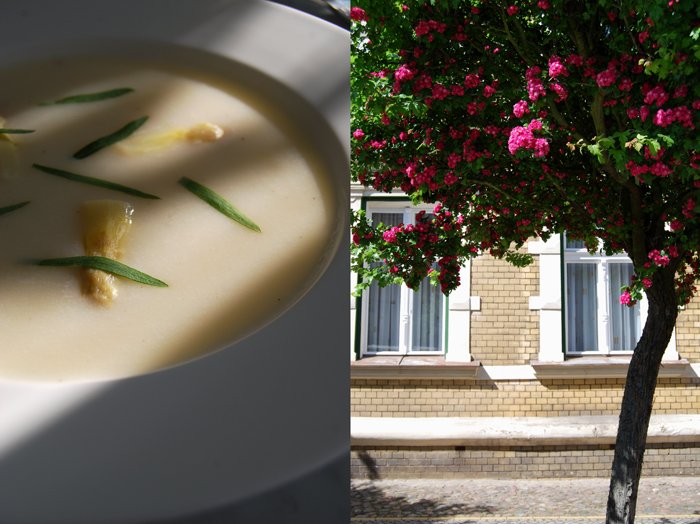
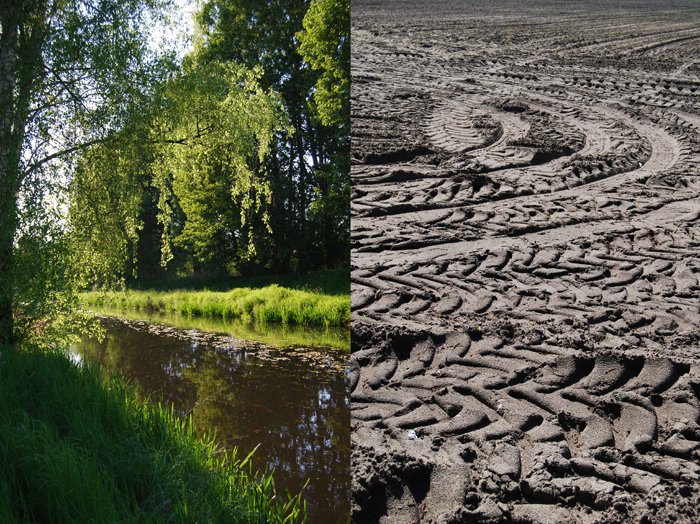
Beelitz is a small town, it's peaceful and pretty. Old brick houses line the narrow cobblestone streets, little trees along the pavements blossoming in bright pink, a perfect picture book scene. It didn't take us long to leave the town behind us. The world in front of us turned into a glowing green, majestic trees with fleshy leaves, lilacs blooming at every corner spreading their sweet scent. The grass on the wide meadows looked fresh and juicy. We crossed a river and filled our lungs with the cleanest air we smelled in months! We turned into a tiny path and met an old man gathering grass for his rabbits. We chatted for a little while before we continued our drive along endless fields, on hidden alleys and through lonesome forest.
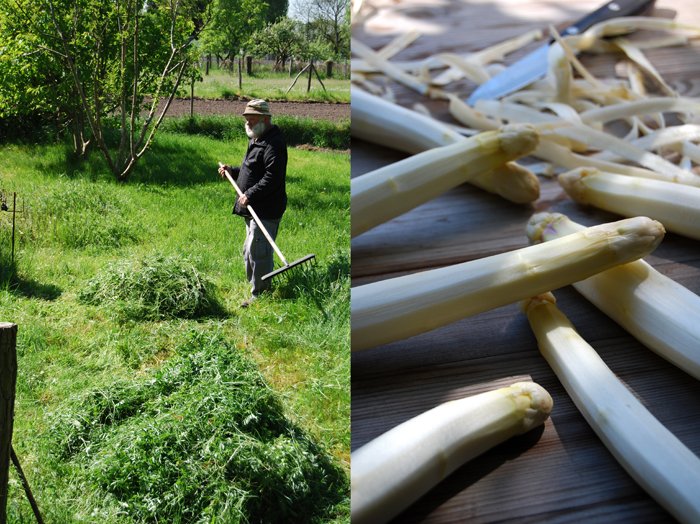


After driving through a dark forest of pine and fir trees for about half an hour we noticed a sparkle in the distance. At that point we weren't even thinking about asparagus anymore, we just enjoyed the peace and quiet, but there it was, right in front of us in the middle of hundreds of trees, an endless field of asparagus!
To keep the vegetables in the dark, they are covered with white foil which reflects the sun and creates a surreal, glittering scene, it felt like being on the moon! In the evening, on our way back to the train station we saw the pickers coming to harvest, creating dark shadows in front of a blinding white in the spotlight of the sinking sun. It was beautiful!
Behind the fields we spotted a farmer who offered thick and juicy white asparagus, the freshest I've ever bought. I filled my basket with the clean white stems knowing that I would turn a few of them into a delicious asparagus soup!

Asparagus Soup
For 4 people you need
white asparagus, peeled, the bottoms cut off, 1kg / 2 pounds
a pinch of sugar
water used to cook the asparagus 900ml / 2 pints
heavy cream 100ml / 3.5 ounces
nutmeg, freshly ground
salt and black pepper
tarragon, around 30 leaves for the topping
In a large pot, bring lots of water to a boil, add a pinch of sugar and salt and cook the asparagus for 20 minutes. Keep the water, take the asparagus out with a slotted ladle and cut into 3cm / 1" pieces. Set the heads aside and leave for the topping.
Bring 900ml / 2 pints of the water used to cook the asparagus to a boil and cook together with the cream on a medium heat for 5 minutes. Add the asparagus and purée with a stick mixer or in a blender. Season with salt, pepper and nutmeg to taste and serve in deep bowls sprinkled with the asparagus' heads and tarragon leaves.


Parmesan Risotto with crisp Fava Beans
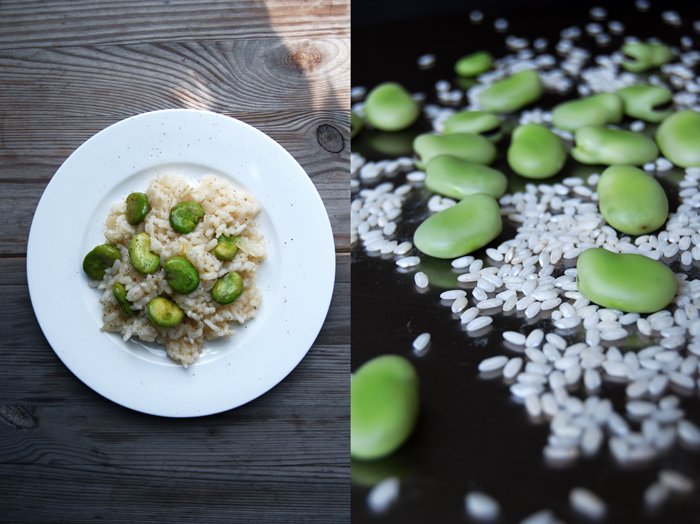
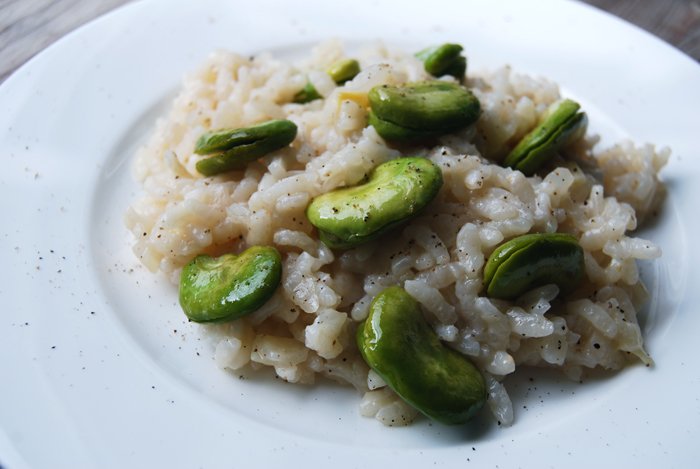
When my sister told me abut her latest risotto discovery from her trip to Italy, she sounded so thrilled that I couldn't wait to get the pot on the cooker. She was talking about a parmesan risotto which by itself isn't necessarily spectacular but this one is different. It's made with bigger pieces of cheese which are stirred into the creamy rice when the risotto is done. The parmesan melts, partly, but a few crumbs keep their crunchy center which makes it taste stronger, more concentrated. I was absolutely impressed, this method of preparation lifts parmesan risotto onto another level!
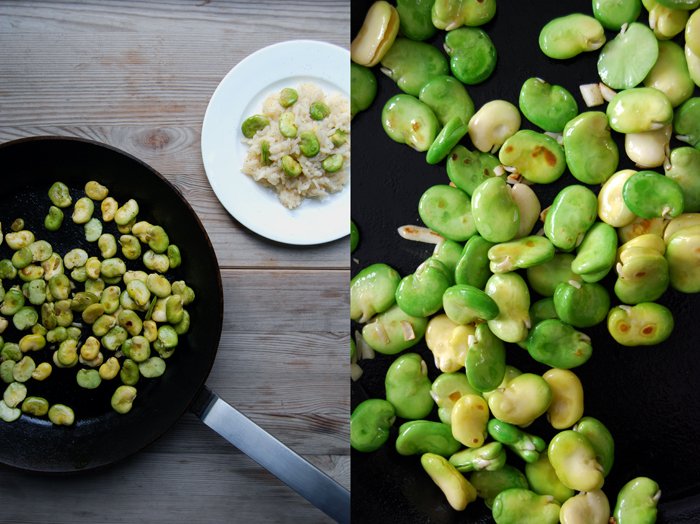
I had some fava beans left on my window sill which I added to the rice, I prefer to have some vegetables with my risotto. Be it a simple salad or some sautéed greens on the side, I need my vitamins as much as my carbohydrates! I fried the beans with some garlic, deglazed them with white wine and let them simmer for a few minutes. I wanted them al dente, a crisp topping for my smooth risotto!
I cooked the risotto with the water I had used to cook asparagus in a few days ago. It's a light broth which I always keep and freeze, great for recipes which need a soft vegetable aroma.

Parmesan Risotto with Fava Beans
For 4-5 people you need
Arborio rice 400g / 15 ounces
medium size onion, chopped finely, 2
broth around 2200ml / 4.5 pints
Parmesan, cut into 1cm / 1/2" cubes, 80g / 3 ounces
fava beans, peeled out of their pods and shells, 800g / 28 ounces (around 300g / 10.5 ounces peeled beans)
garlic, roughly chopped, 1 clove
white wine 120ml / 4 ounces
salt and black pepper
olive oil for frying
butter 2 tablespoons
In a large pan, heat a little olive oil and 1 tablespoon of butter, add the garlic and beans and fry on a medium heat for a few minutes until golden. Deglaze with half of the wine and let it cook for a minute. Season with salt and pepper and add the rest of the wine, close with a large lid and let it simmer for 5 minutes or until al dente. Season with salt and pepper to taste.
In a large pot, fry the onions in a little olive oil and 1 tablespoon of butter until golden and soft, stir in the rice and fry on a medium heat for a minute. Add some of the broth, the rice should be covered, stir and turn the heat down to medium-low. When the liquid has been absorbed add more broth, a little at a time stirring in between. Depending on the rice, it needs more or less liquid. When the rice is al dente and the broth is more or less absorbed take it off the heat, season with salt and pepper to taste and stir in the Parmesan, close with a lid and let it sit for a minute. Arrange on plates together with the fava beans.

Gorgonzola, Strawberry and Pink Peppercorn Sandwich
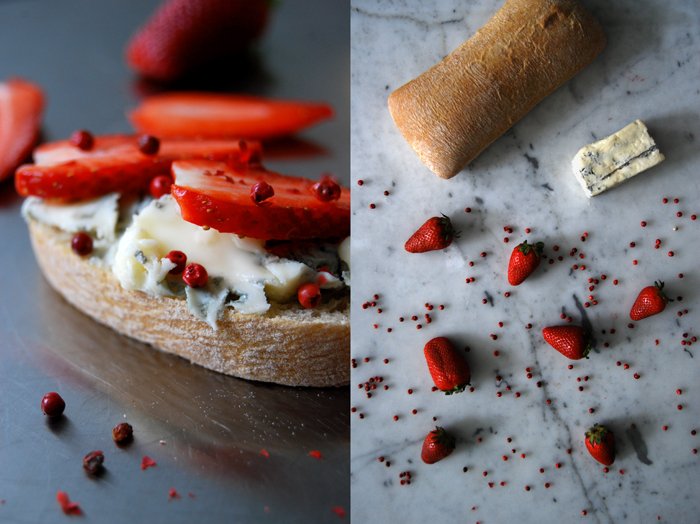
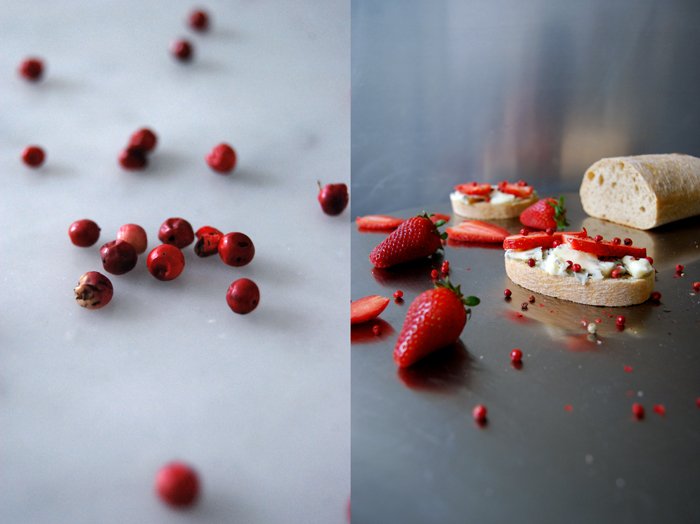
My first strawberries this year find their place on a sandwich together with the creamiest blue cheese of all, Gorgonzola! This cheese gets its name from its place of origin, the commune of Gorgonzola in the province of Milan. It's not as sharp and spicy as Roquefort or Stilton, it's more on the mild side, perfect for when I feel like a soft cheese aroma. That's what my strawberries needed, especially because their season has just begun here and they haven't reached their full spectrum of flavours yet. To bring some spice into this combination I added a few pink peppercorns, also gentle enough for the red fruits.
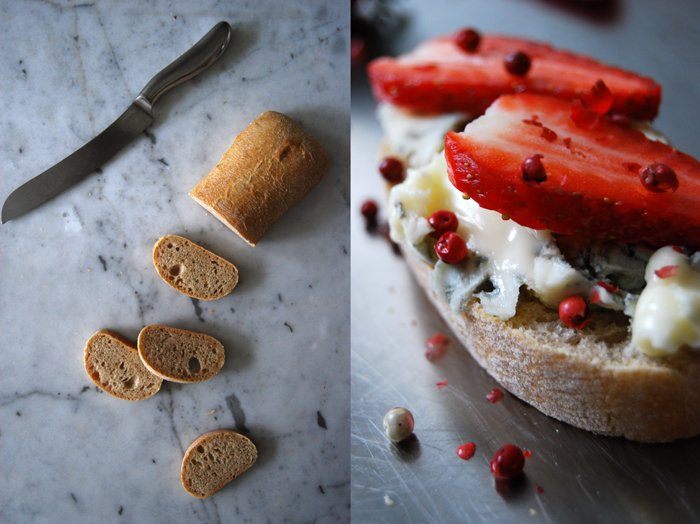
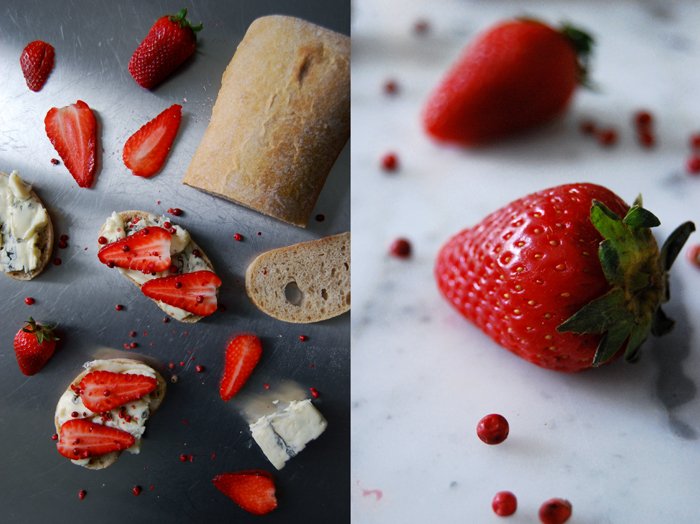
This sandwich is so sweet and creamy that a fluffy ciabatta bread felt like the right choice. I spread Gorgonzola (about 100g / 3.5 ounces for 2 people) in thick lumps on a few slices of the fresh loaf, I didn't want to spare on the milky creaminess before I covered the sandwiches with a couple slices of strawberries. Sprinkled with the pink peppercorns which are best when softly pressed before they join the red fruits, I felt a bit hesitant to take the first bite, this week's sandwich really is beautiful!

Buffalo Mozzarella, Cuore Di Bue Tomato and Mint Salad
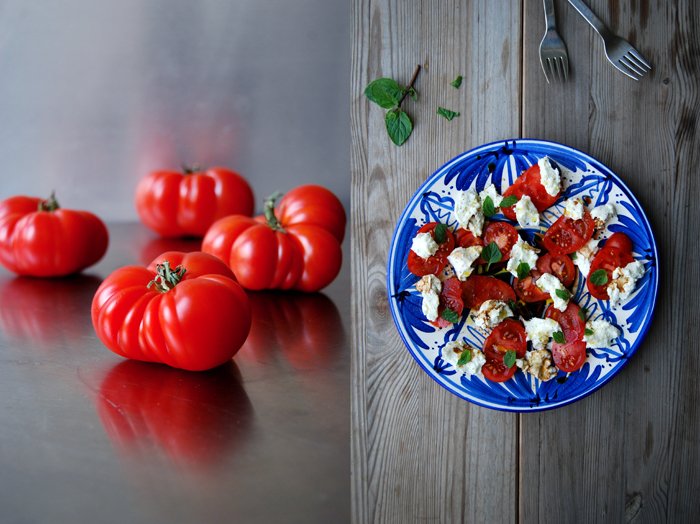
When I saw these beautiful Cuore Di Bue Tomatoes in the vegetable department of my local organic shop I had to buy them. I know these tomatoes from Malta where farmers sell them from their vegetable trucks at every street corner in the towns. These mobile shops are piled high with ripe, colourful fruits and vegetables from the island, surrounded by women chatting and exchanging the latest gossip while waiting to have their vegetables weighed. Many of them have been going to the same farmer for years and I gladly follow this tradition. Whenever I'm there I buy my groceries from my vegetable man, Leli, twice a week he parks his truck under pink oleander trees in the middle of Msida. He is one of the most friendly, calm and humble people I know, he doesn't talk much but he always has a little smile on his face. Before we leave the island at the end of our holidays, we visit him one last time to say good-bye, I never know who is more sad, him or us!
Back to the Cuore Di Bue Tomatoes, I buy and eat them in bulk when I'm Malta. Their taste is far away from most of the tomatoes you can buy in the cities, they are strong and sweet, very intense, they taste like real tomatoes! Their name comes from their shape and size which is similar to an ox heart but I thought that the Italian name, Cuore Di Bue sounds a bit nicer than Oxheart Tomatoes!
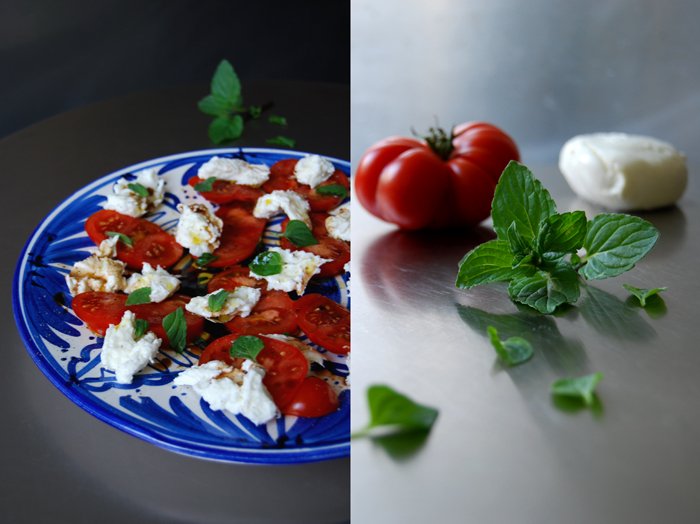
I had a buffalo mozzarella in my fridge which had to be used soon, a quick salad mixed with my beautiful tomatoes was the first idea that came into my mind. I still love this Italian classic which can be a delicious starter or snack when it's made with good quality ingredients. Unfortunately, lots of restaurants offer it made with tasteless tomatoes and mozzarella, which has damaged its image a little over the years. Buffalo milk however creates a very strong mozzarella which is great for this salad, to add a green taste as strong as this cheese, I replaced the traditionally used basil with mint. Our salad for 2 was ready within seconds, 125g / 4.5 ounces of buffalo mozzarella roughly torn into bite sized pieces mixed with 2 ripe Cuore Di Bue tomatoes sliced thinly and a few leaves from my mint plant. The dressing was as easy, 3 tablespoons of olive oil whisked with 2 tablespoons of Balsamico vinegar, salt and pepper.


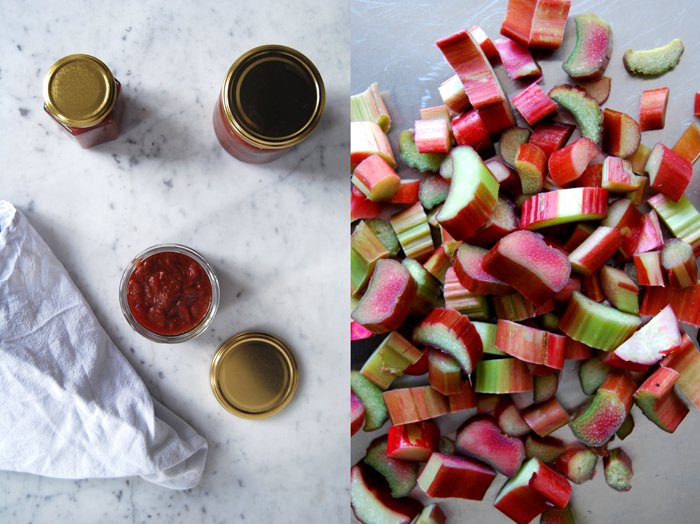
Sweet and spicy Rhubarb Chutney
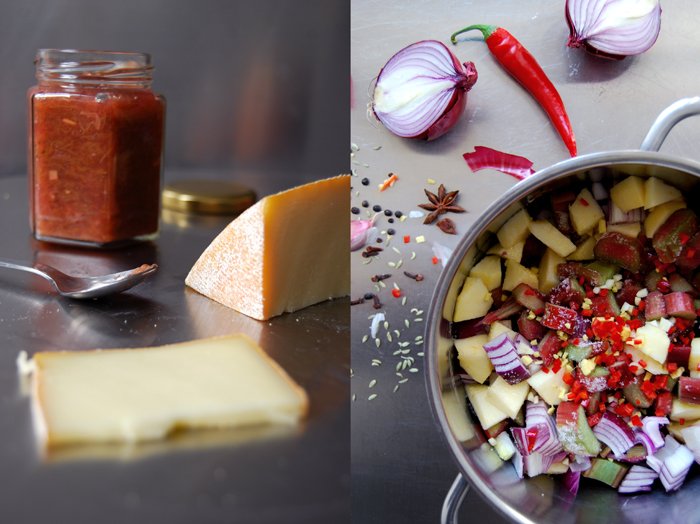
My love for chutney developed quite late, almost nine years ago while I lived in England for a couple months. One night I found out about the glorious combination of Yorkshire Wensleydale cheese and chutney. I knew about a similar duo, ripe cheese and fig mustard, a great alternative to a sweet dessert, heavenly when the cheese's milkiness unites with the spicy and fruity flavours in your mouth! When my dear friend Audrey, a lady who likes good cheese as much as I do, offered me this North Yorkshire delicacy I was taken after the first bite. My favourite was a young cheese, mildly flavoured with cranberries, a bit crumbly and just perfect together with sweet onion chutney. Sometimes, after we had been out, we used to chat in Audrey's kitchen, get out some jars of pickles, chutneys and a truckle of Wensleydale and we quite often ate more than just a midnight snack!
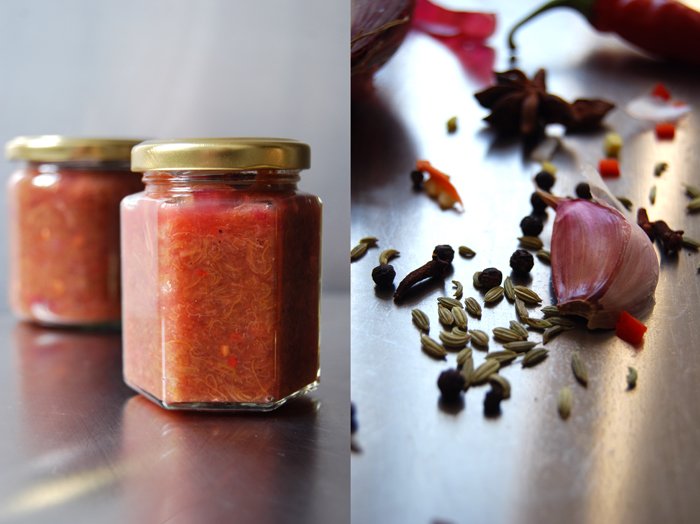
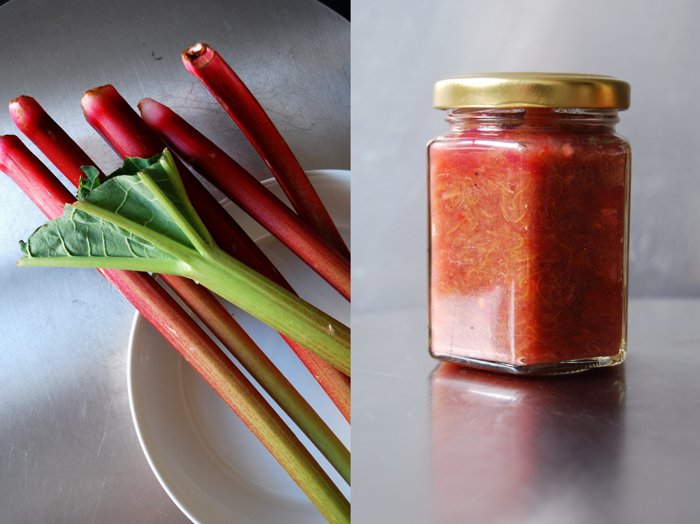
Not too long after this culinary discovery I started to make my own chutneys. I experimented for a while and came up with a recipe which I now use for all kinds of chutneys, plums, apples, onions or rhubarb. Depending on the fruit's taste I adjust the spices a little bit but the basic recipe remains untouched. Most of the time I mix in red onions and red hot chili peppers for the spiciness, a couple apples to thicken the texture and lots of spices, turmeric, cloves, star anise, fennel seeds, black pepper, garlic and ginger. Rhubarb is at its seasonal peak at the moment, the best time to turn it into a sweet and spicy chutney!
Cheese and chutney isn't the only way to enjoy chutney, you can also use it to flavour aromatic gravies, eat it with slices of warm or cold roast meat or spread it on sandwiches.
Rhubarb Chutney
For 3 medium sized jars you need
rhubarb, sliced 550g / 19 ounces
apple, peeled and roughly chopped, 125g / 4.5 ounces
red onion, medium sized, roughly chopped, 1
cider vinegar 220ml / 7.5 ounces
granulated sugar 150g /5.5 ounces
fresh hot chili pepper, without seeds, finely chopped, 1/2
garlic, chopped, 1 clove
fresh ginger, grated or chopped, 1 heaping teaspoon
For the spice mixture (makes 2 teaspoons, you might only need 1 1/2)
turmeric, ground, 1/8 teaspoon
cinnamon, ground, 1/2 teaspoon
cloves, ground in the mortar, 12
star anise, ground in a mortar, 2 single pieces
fennel seeds, ground in a mortar, 1/2 teaspoon
small dried chili, ground in a mortar, 2
spirit to sterilise the rims of the jars
Sterilise the jars in boiling water for 5 minutes.
In a large pot, bring all the ingredients together with 1 1/2 teaspoons of the spice mixture to the boil. Cook for about an hour on medium temperature until the chutney thickens. You can add more of the spice mixture if you like before you fill the chutney into the jars.
Dip the rim of your jars in spirit and wash out the lids with the alcohol as well. Fill your jars with the chutney and close well immediately.
You can eat the chutney right away but I prefer to let it sit for 3 weeks. You should keep an open jar in the fridge (mine stays fresh for months) and the closed jars in your pantry.